
Caravaggio’s Calling of St. Matthew
“As Jesus passed on from there, he saw a man named Matthew sitting at the customs post. He said to him, ‘Follow me.’ And he got up and followed him.” - Matthew 9:9 (NABRE)
Caravaggio created three paintings of St. Matthew for the Contarelli Chapel in San Luigi dei Francesi, a church in Rome. The most iconic of the trio is The Calling of St. Matthew, which was completed in 1599–1600. It hangs on the left side, and today visitors can insert a coin into a box to illuminate the painting. The Baroque master’s application of tenebrism, or sharp contrast between light and dark, creates a dramatic visual retelling of a famous Gospel story: Christ calling Matthew (also called Levi), a tax collector, to follow Him.
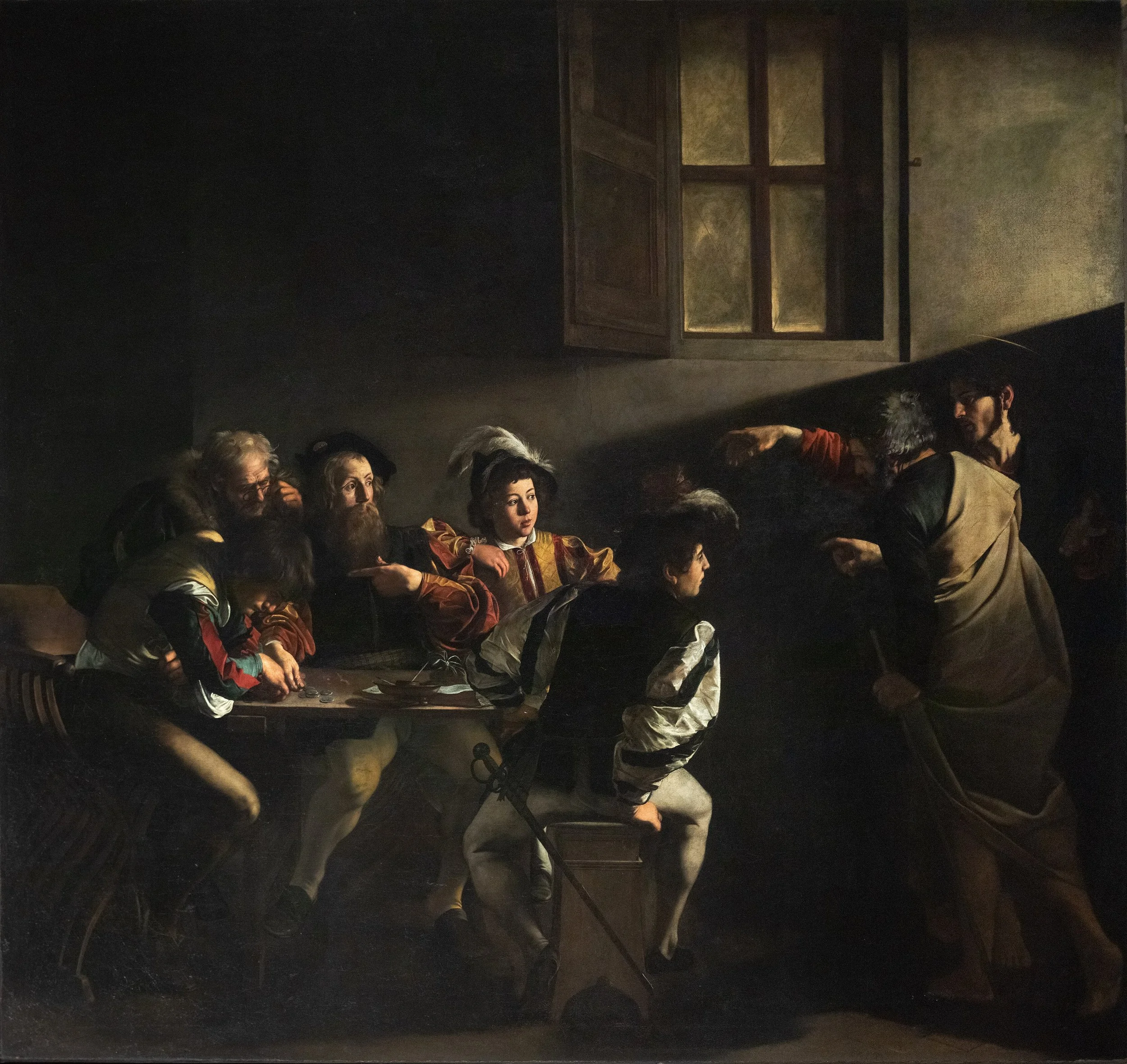
Caravaggio, The Calling of St. Matthew, 1599-1600, Wikimedia Commons, Public Domain
Caravaggio was known for using ordinary people and settings as models for his paintings. Some of his contemporaries and patrons disapproved of this approach, considering it too profane compared to the sacred subjects he was depicting. Regardless of its reception, Caravaggio’s technique lent his work a naturalism that speaks to the human experience. The faces and scenes bear a familiarity that reminds viewers that salvation history is also human history.
There is a certain rawness and genuineness to Caravaggio—he does not try to hide the true state of humanity. Instead, he highlights how Christ enters into the lives of ordinary people and transforms them through the gift of new life. This is exactly what is happening in the Calling of St. Matthew. Jesus has entered into a dim room accompanied by St. Peter. They stand on the right, and a beam of light crosses behind Christ’s head. He is the “light of the world” and has come to dispel the darkness in Matthew’s life.

The hand of Christ versus the hand of Adam, The Calling of St. Matthew and Creation of Adam
Christ lifts one hand and motions toward the table of men to the left. His gesture echoes one of the most famous frescoes on the Sistine Chapel ceiling, the Creation of Adam by Michelangelo. However, Caravaggio did not give Jesus the same hand as God the Father, as might be expected. Instead, Christ reaches out toward Matthew with the hand of Adam. In the Calling of St. Matthew, Christ is the Second Adam who is giving life rather than receiving it. As the Gospel of John states, “In him was life, and the life was the light of all people” (John 1:4).
Above Christ’s head is a single window with cross-shaped beams. These beams may symbolize His Passion and death, through which He would save mankind from its sins. Now, Christ is offering Matthew the fullness of life in view of what He would soon accomplish. Perhaps Caravaggio wished to emphasize Christ’s triumph over death on the Cross, a sacrifice that would bestow new life on the human race.
Matthew has been interrupted in the midst of counting money with his companions. Coins and a money bag lie on the wooden table before them. This table scene may have been inspired by Hans Holbein the Younger’s famous woodcut, The Gamesters. Like the figures in the woodcut, Caravaggio’s figures are split between oblivion and awareness. Light slants across the composition and reveals the reactions of the money counters. The old and young men on the far left continue intently with their task, while the other three men have ceased their activity to look at Christ.

The Calling of St. Matthew by Caravaggio (Detail)
Art historians generally identify the bearded man sitting in the middle as Matthew, although his identity has been debated. How does Caravaggio have him respond to Christ’s simple, two-word invitation to follow Him? Matthew points incredulously at himself, as if saying “Who, me? You can’t possibly mean me!”
This marks a moment of spiritual enlightenment for Matthew—an opportunity for conversion. The light represents the entrance of the divine into the ordinary circumstances of earthly life. For Matthew, it is simply another day at work. But now a man has come and told him to follow Him. How will Matthew respond to the grace that is offered him?
In Caravaggio’s painting, Christ’s feet are already turned to leave. He is allowing Matthew to make a free choice, and He will not force Matthew to join Him. Thankfully, we know the conclusion of the story. Matthew recorded the outcome in his own Gospel, telling us that “he got up and followed him.”
Caravaggio’s Calling of St. Matthew remains prominent in Christian art history, attracting visitors from around the world every year. The painting prompts us to consider Christ’s personal invitation to each one of us. The dramatic depiction of Matthew’s calling reflects a much deeper reality. Christ desires us to follow Him so that He can give us life. He is the only light that can dispel the darkness in our lives.