
September Sacred Artwork of the Month: St. Michael Vanquishing Satan by Raphael
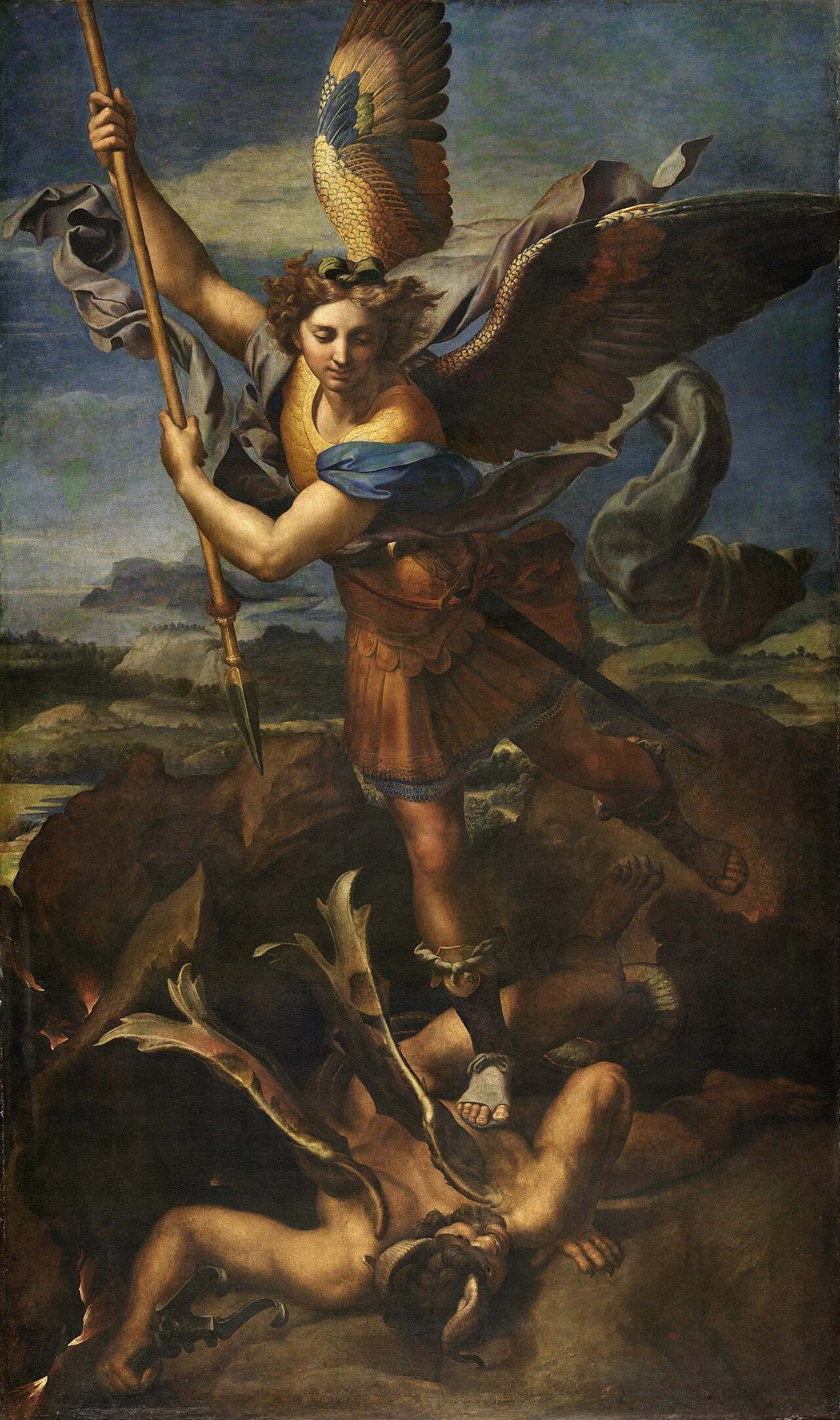
Raphael, St. Michael Vanquishing Satan, 1518, Louvre Museum, Wikimedia Commons, Public Domain
In 1518, Raphael and his workshop created two important paintings for Pope Leo X. The Holy Father commissioned them as gifts for Francis I, the king of France, and his wife, Claude. The paintings arrived in France later that year—a fitting time, considering the marriage of the Pope’s nephew, Lorenzo II de’ Medici, to the King’s cousin, Madeleine de la Tour d’Auvergne, in May 1518. The gift of the two sacred artworks was meant to strengthen the diplomatic ties between Pope Leo X and King Francis I.
The first painting, the Holy Family of Francis I, depicts the Holy Family with St. Elizabeth and the young St. John the Baptist. It was intended for Francis’ wife, while Francis received the second artwork: St. Michael Vanquishing Satan. While Raphael is credited with designing both compositions, he is believed to have had more of a direct hand in St. Michael. Pope Leo X may have chosen the subject of St. Michael because he believed it would hold deep meaning for Francis I, who was the head of the Order of St. Michael. King Louis XI founded this prestigious and selective French order of chivalry in 1469.
St. Michael Vanquishing Satan is a powerful High Renaissance painting of St. Michael the Archangel conquering the devil. The proportioned and athletic build of St. Michael, along with his twisting form, recalls the human bodies portrayed by Michelangelo. Raphael masterfully gives the impression of movement, as St. Michael swoops down upon Satan and plants his right foot upon him. A blue cloth swirls around the archangel, and his blond hair ripples from the breeze. St. Michael grips a spear that parallels the vertical position of his body, drawing the eye downward to the enemy beneath his foot.
This dramatic scene unfolds before a backdrop where heaven and earth meet. The upper half of the composition shows a blue sky with a golden aura, representing the heavenly realm. The color palette of blue and gold continues throughout the attire of St. Michael, whose gleaming breastplate and magnificent wings further communicate the majesty and splendor of the Kingdom of God. In contrast, the bottom half of the painting features muted and earthly tones, indicating the fallen state of the natural world. The devil lies facedown on a rock, turning his head to view his conqueror. The gloomy, barren atmosphere also suggests hell, the region to which the devil will ultimately be banished. Tongues of fire flicker on the left side, reinforcing this imagery.
Raphael’s St. Michael painting is a traditional image of the archangel defeating Satan as described in Revelation 12. This Scripture passage details the battle between the heavenly powers, led by St. Michael, and the fallen angels:
“Then war broke out in heaven; Michael and his angels battled against the dragon. The dragon and its angels fought back, but they did not prevail and there was no longer any place for them in heaven. The huge dragon, the ancient serpent, who is called the Devil and Satan, who deceived the whole world, was thrown down to earth, and its angels were thrown down with it.” (NABRE, Revelation 12:7–9)
In Raphael’s composition, the victory of St. Michael is conveyed through the open position of the archangel’s wings. On the ground, Satan’s wings appear closed and almost lifeless, like shriveled leaves. He is rendered powerless when faced by the mighty warrior of heaven.
This painting also reminds us that the spiritual battle is still raging here on earth. Revelation 12 goes on to say that the dragon went after “those who keep God’s commandments and bear witness to Jesus” (12:17). Christ has certainly won the final victory, and the devil will endure a final defeat at the end of time. However, the evil one will continue to roam the world until then, seeking to ensnare human souls in sin. St. Michael Vanquishing Satan points us toward a powerful intercessor in the midst of this ongoing conflict. St. Michael the Archangel wants to offer us his protection and fight for us—we simply need to call upon his name through prayer.