
Christian art of St. Michael the Archangel typically depicts the heavenly warrior as described in Revelation 12:7–9. The biblical account relates how St. Michael led the angels in battle against Satan and his followers, casting them from Heaven. Devotion to St. Michael dates back to the early Church and has inspired a rich tradition of sacred art. In Catholic art, two major motifs of St. Michael are depictions of him as a warrior slaying the devil or a weigher of souls. Here are ten paintings of St. Michael the Archangel, including works by Raphael, Pietro Perugino, Guido Reni, and other renowned religious artists.
1. St. Michael Triumphs over the Devil by Bartolomé Bermejo
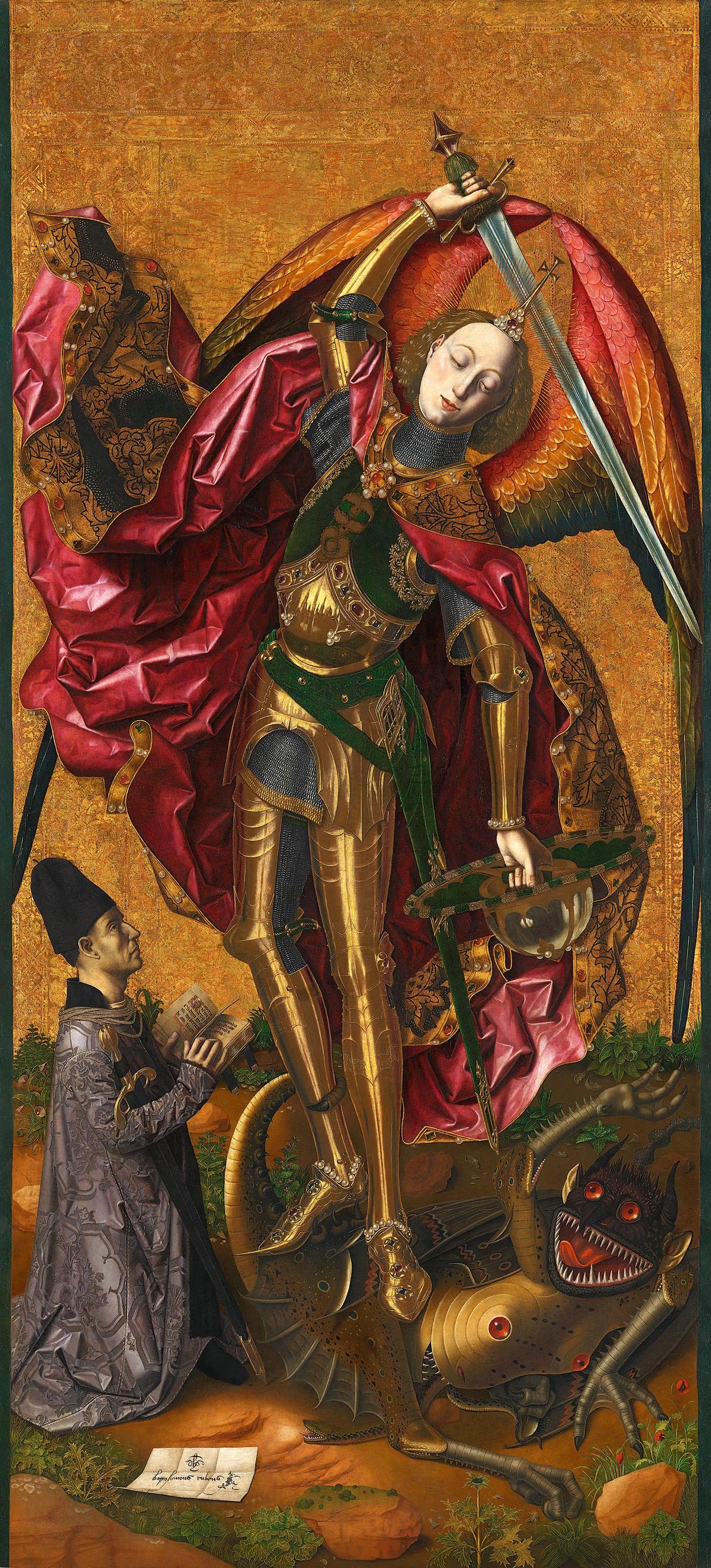
Bartolomé Bermejo, St. Michael Triumphs over the Devil, 1468, National Gallery, London, Wikimedia Commons, Public Domain
St. Michael Triumphs over the Devil by Bartolomé Bermejo is a painting that features the traditional imagery of St. Michael from Revelation 12. The National Gallery in London describes it as the most important fifteenth-century Spanish painting in England. The earliest documented work by Bermejo, it was likely made as part of a polyptych, or multi-paneled altarpiece, in the church of San Miguel in Tous, a town near Valencia. St. Michael's luxurious attire recalls his status as the “Prince of the Heavenly Host,” as he is clothed in medieval armor embellished with the finest materials. His breastplate bears an image of the Heavenly Jerusalem.
From gleaming pearls to the plush green velvet covering the upper breastplate, sword, and sheath, Bermejo reveals himself to be a master of texture, indicating that he may have been familiar with Netherlandish art. The grotesque creature beneath St. Michael is a composite demon, a common medieval representation of the devil as composed of parts from various animals. The small man praying on the left is the donor, and his presence completes a pyramidal structure with the other two figures that balances the composition.
2. St. Michael by Piero della Francesca
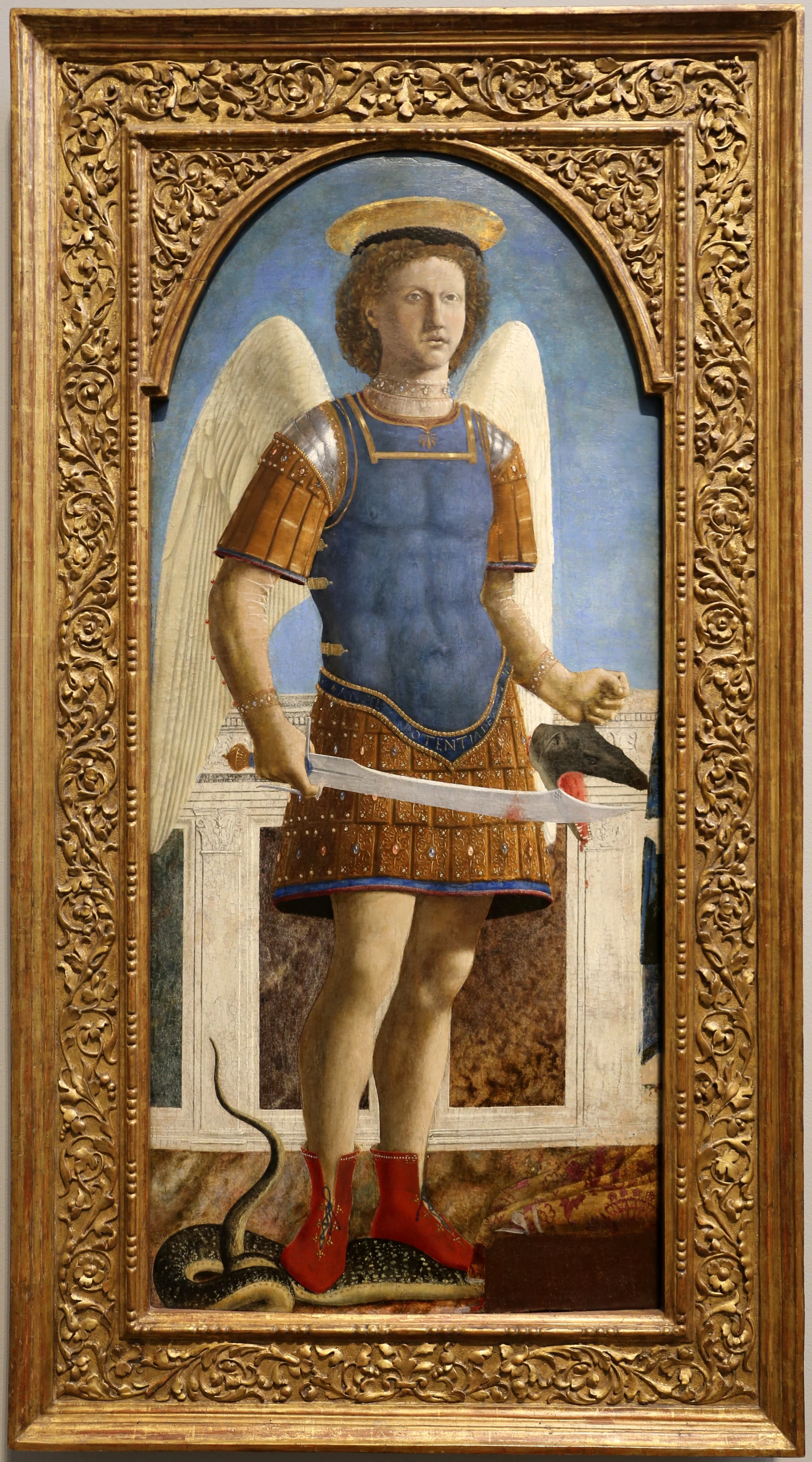
Piero della Francesca, St. Michael, c. 1469, National Gallery, London, Wikimedia Commons, Public Domain
The Italian painter Piero della Francesca created St. Michael as one of the side panels for an altarpiece commissioned for the church of Sant’Agostino in Borgo Sansepolcro, his hometown. In the painting, St. Michael appears as an athletic youth wearing Roman armor. His pale skin, contrapposto stance, and muscular build echo a Classical sculpture, which some Renaissance artists attempted to emulate in their work. The blue breastplate and encrusted gems contribute to his otherworldly appearance, identifying St. Michael as a warrior from the spiritual realm. With a sword in one hand, St. Michael grasps the head of a serpent in the other, its decapitated body lying at his feet.
3. St. Michael Archangel by Pedro García de Benabarre
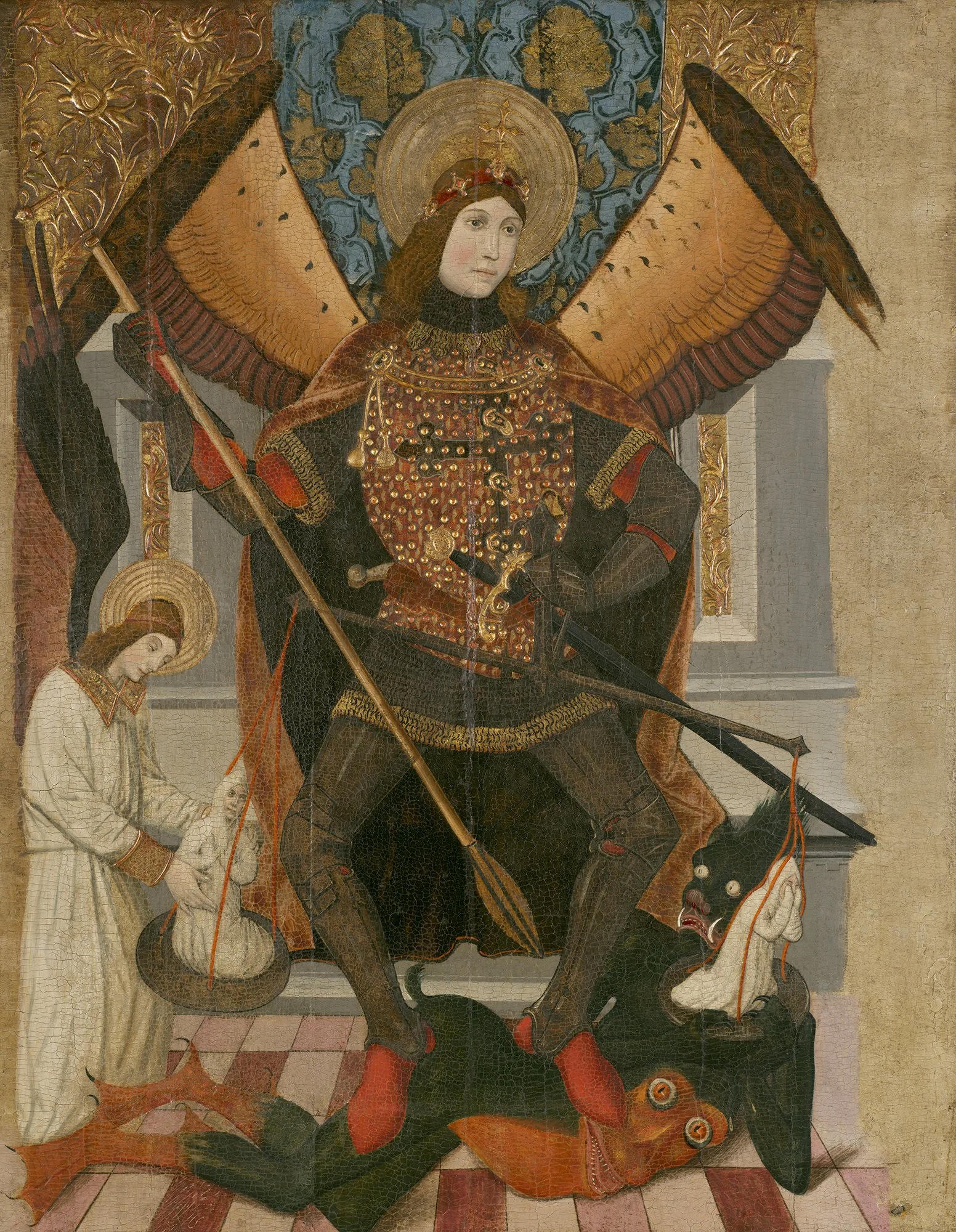
Pedro García de Benabarre, St. Michael the Archangel, c. 1470, Isabella Stewart Gardner Museum, Wikimedia Commons, Public Domain
St. Michael the Archangel by the Spanish painter Pedro García de Benabarre depicts St. Michael as both the weigher of souls and warrior slaying the devil. He created this panel as part of an altarpiece for a church in Catalonia. Seated on a throne, St. Michael holds a pair of scales containing two figures representing human souls. This depiction follows a Catholic tradition of St. Michael as protector of souls and an agent of divine justice. In García de Benabarre’s depiction, an angel embraces the soul on the left, while a two-headed demon attempts to grab the soul on the right. However, St. Michael defends the endangered soul by trampling on the devil and threatening him with a lance.
4. St. Michael by Carlo Crivelli
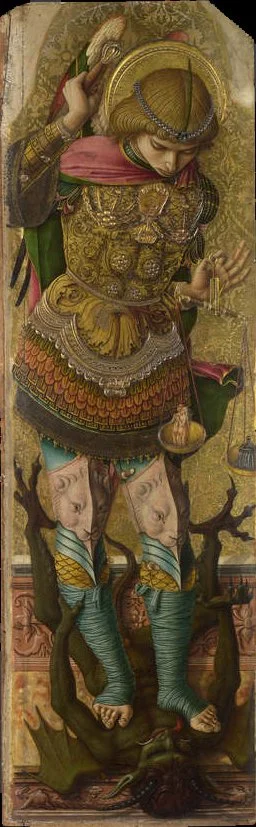
Carlo Crivelli, St. Michael, c. 1476, National Gallery, London, Wikimedia Commons, Public Domain
In Carlo Crivelli’s St. Michael, the archangel stands atop a demon. The appearance of the two contrasts sharply: a blond-haired, youthful warrior in colorful armor versus the dark, scaly creature with horns. Clusters of pearls on St. Michael’s breastplate symbolize his angelic purity, while the lion heads covering his knees may represent majesty and courage. With his sword raised in his right hand, St. Michael holds a pair of scales in his left, keeping them out of the devil’s reach. The demon has placed a heavy weight on one side to tip the scales in his favor. The tiny man and woman on the other scale are likely two souls who are facing the Last Judgment.
5. The Archangel Michael by Pietro Perugino
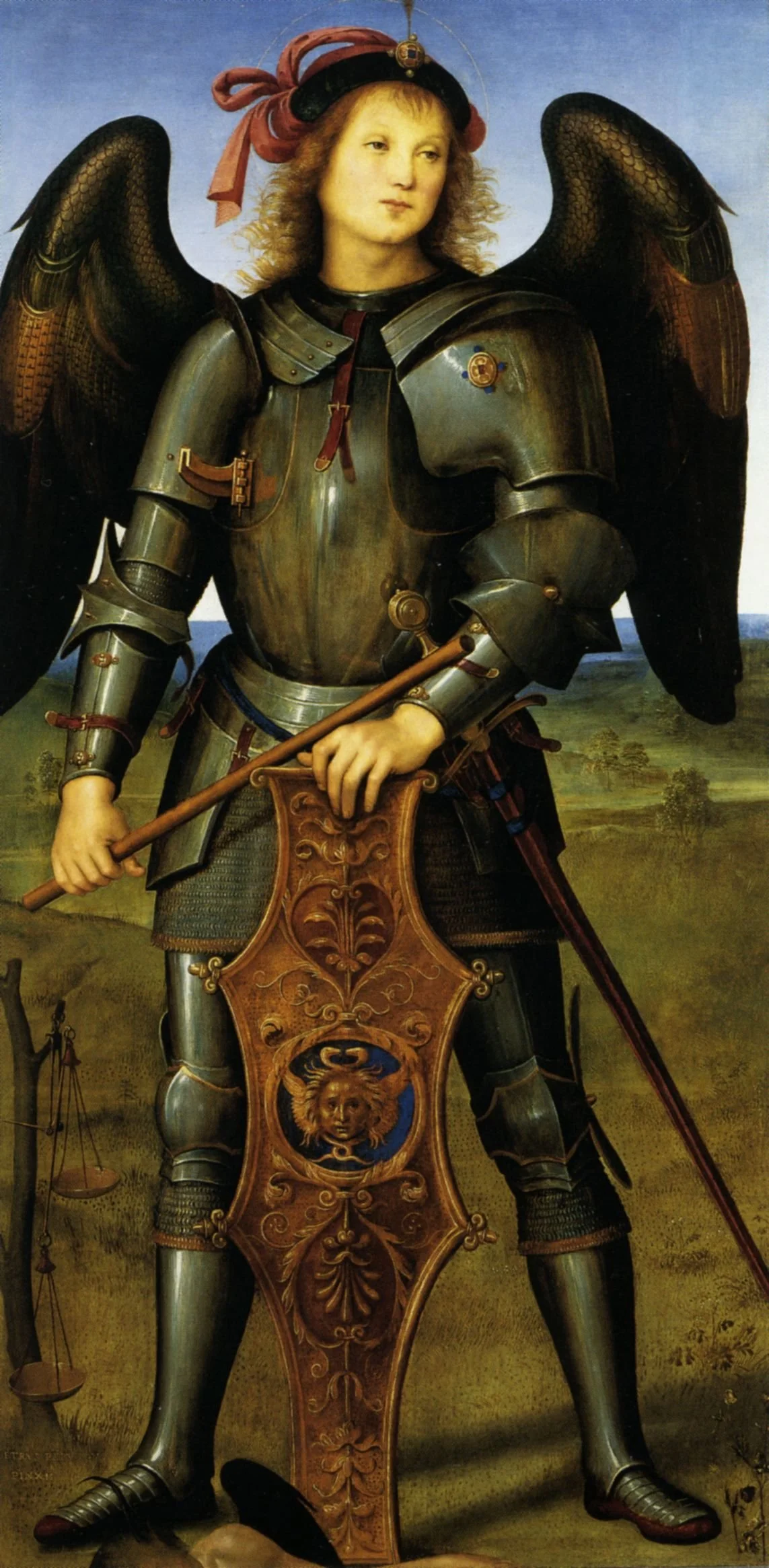
Pietro Perugino, The Archangel Michael, c. 1496–1500, National Gallery, London, Wikimedia Commons, Public Domain
Pietro Perugino painted The Archangel Michael as one of three lower panels for an altarpiece commissioned by the Duke of Milan for the Carthusian monastery in Pavia. St. Michael is wearing a full suit of armor, which Perugino skillfully portrayed by using white paint to capture the light reflecting on its metal surface. The devil at the bottom is barely visible, since part of the painting was cut off during its removal in the eighteenth century. A balance scale hangs on a tree stump to the left, indicating St. Michael’s traditional role as weigher of souls.
6. St. Michael and the Dragon by Raphael
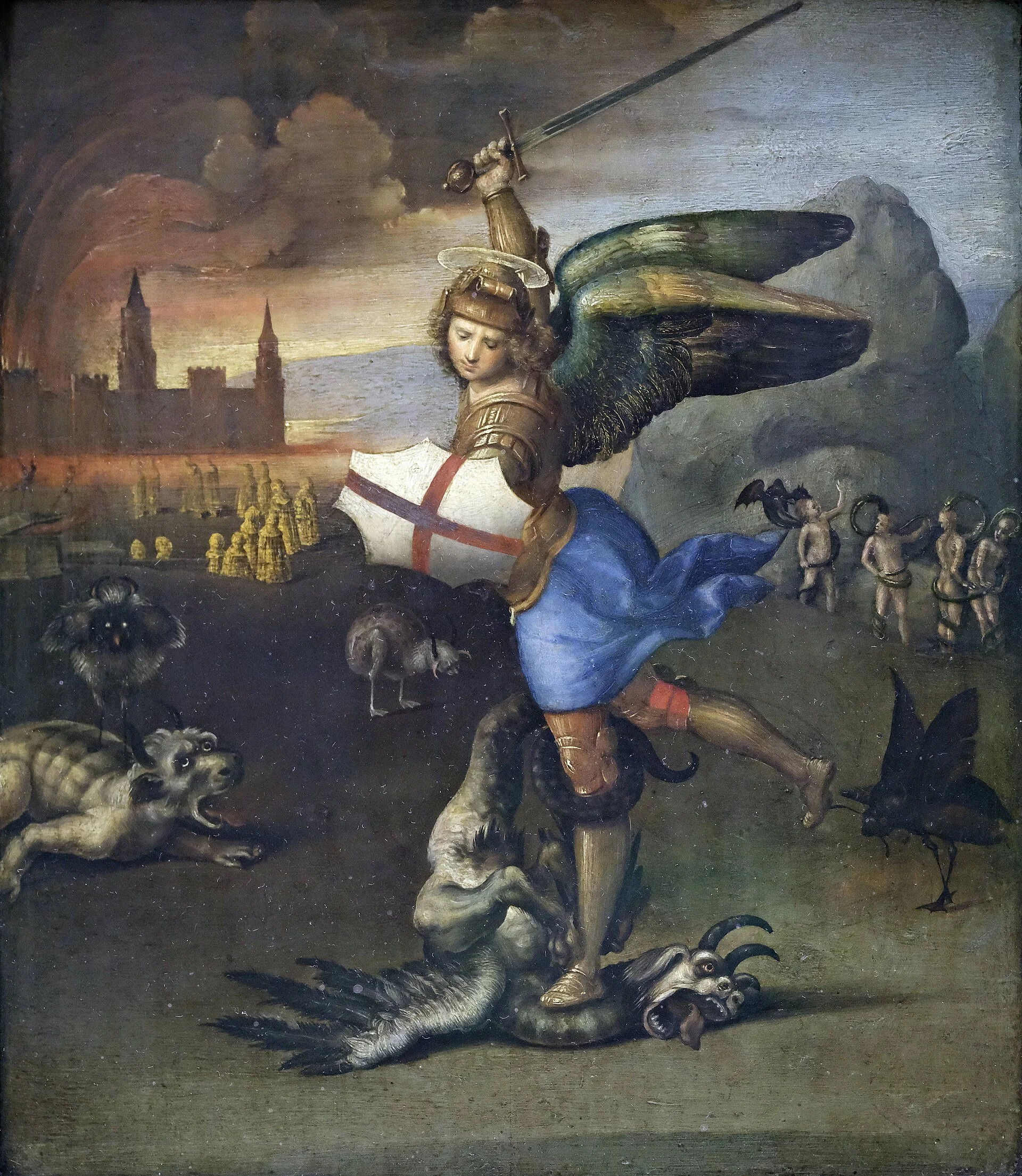
Raphael, St. Michael and the Dragon, c. 1504–1505, Louvre Museum, Wikimedia Commons, Public Domain
St. Michael and the Dragon is an early work by Raphael. To differentiate it from his later painting of St. Michael, this High Renaissance painting is also known as the Little St. Michael. The central focus of the composition is St. Michael and the devil in the foreground. The archangel lifts his sword high in the air, preparing to strike the grotesque demon choking beneath his foot. Several other demons lurk nearby. The background features scenes inspired by Dante’s Inferno, depicting the suffering of damned souls in Hell. On the left, hypocrites trudge along in leaden coats. The right side contains four naked thieves attacked by serpents. The figure of St. Michael provides a natural boundary between these two halves of the painting.
7. St. Michael Vanquishing Satan by Raphael
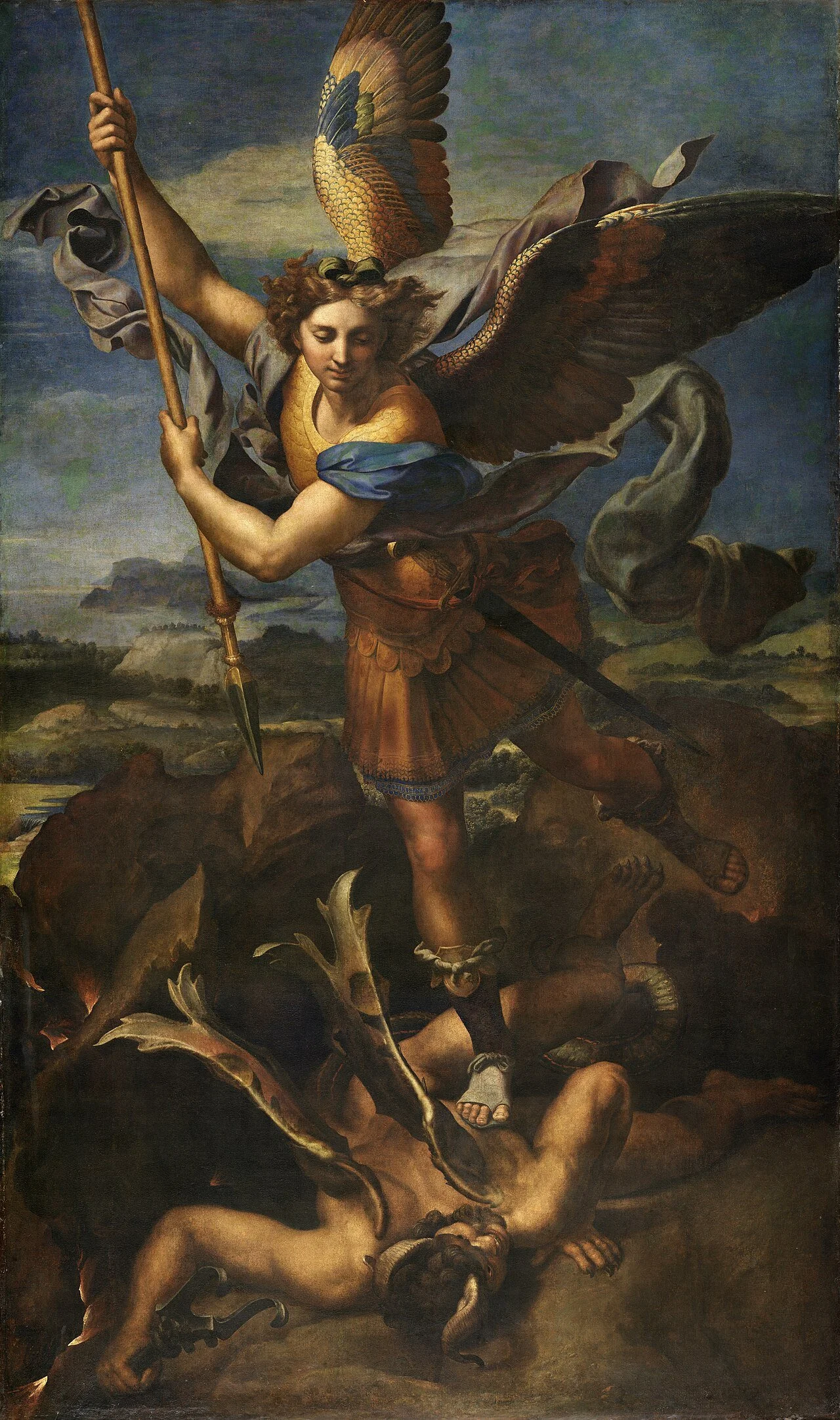
Raphael, St. Michael Vanquishing Satan, 1518, Louvre Museum, Wikimedia Commons, Public Domain
St. Michael Vanquishing Satan by Raphael was commissioned by Pope Leo X as a gift for King Francis I of France. Completed more than a decade after the Little St. Michael, this painting demonstrates the development of Raphael’s artistic abilities. The archangel’s gleaming wings and gold breastplate lend an aura of supernatural splendor to the upper half of the painting. The blue sky behind St. Michael and the drape fluttering in the breeze recall the heavenly realm. The devil lies facedown on the bare ground below, with the dark, earthen tones contrasting sharply with the upper half of the composition. Satan’s wings resemble shriveled leaves and appear lifeless compared to the majestic wings of St. Michael, which are spread open to indicate his victory.
8. The Archangel Michael Defeating Satan by Guido Reni
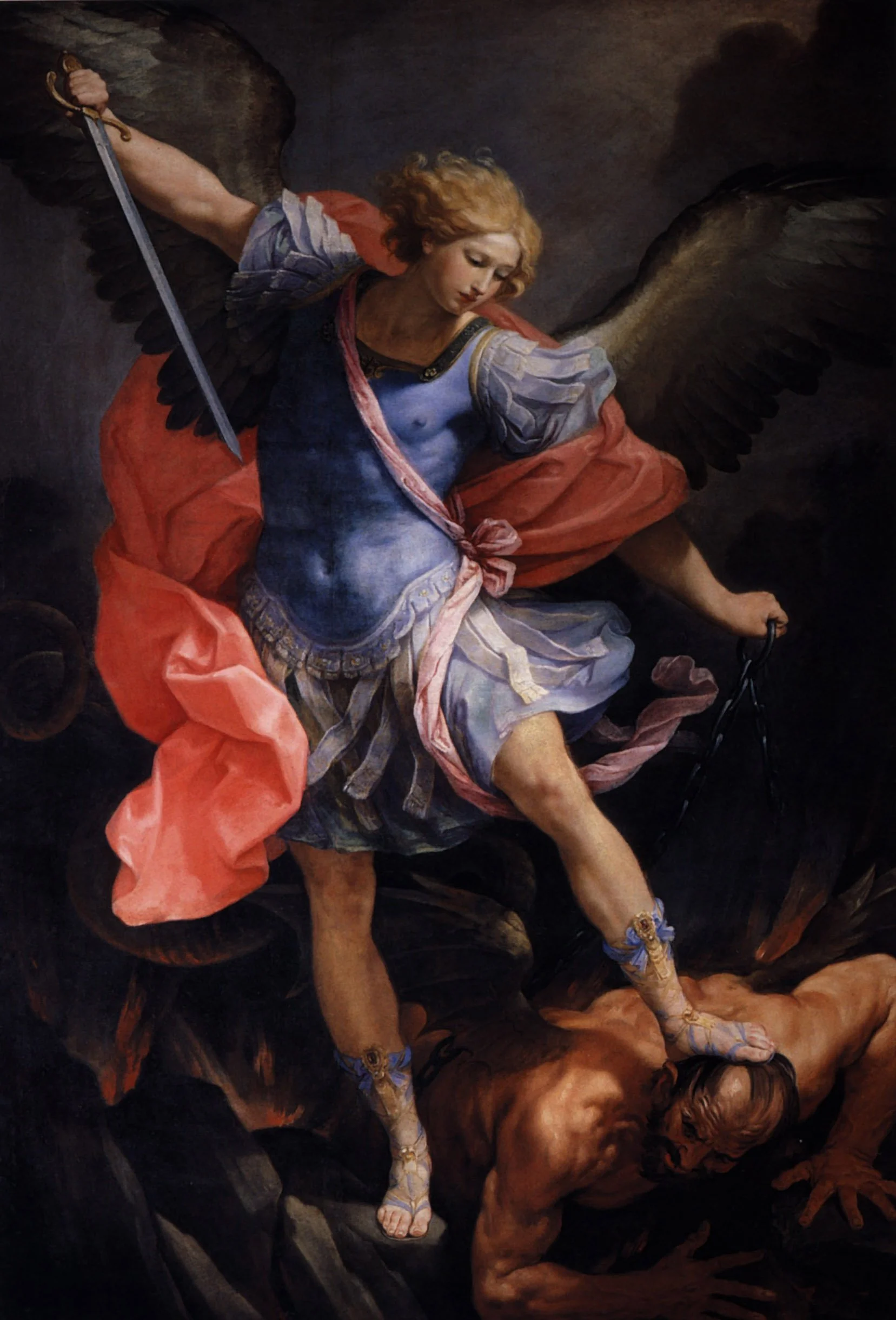
Guido Reni, The Archangel Michael Defeating Satan, 1635, Wikimedia Commons, Public Domain
Guido Reni’s The Archangel Michael Defeating Satan is an Italian Baroque masterpiece commissioned by Cardinal Antonio Barberini, the brother of Pope Urban VIII. It remains in its original location: a side chapel of Santa Maria della Concezione dei Cappuccini in Rome. Reni’s work has become one of the most recognizable depictions of St. Michael in Catholic devotion. The use of chiaroscuro, the contrast between light and dark, dramatizes the traditional depiction of St. Michael vanquishing the devil. Light illuminates part of his blue tunic, emphasizing his muscular physique. The saint holds a heavy chain in his left hand, which wraps around the devil pinned beneath his foot.
9. The Fall of the Rebel Angels by Luca Giordano
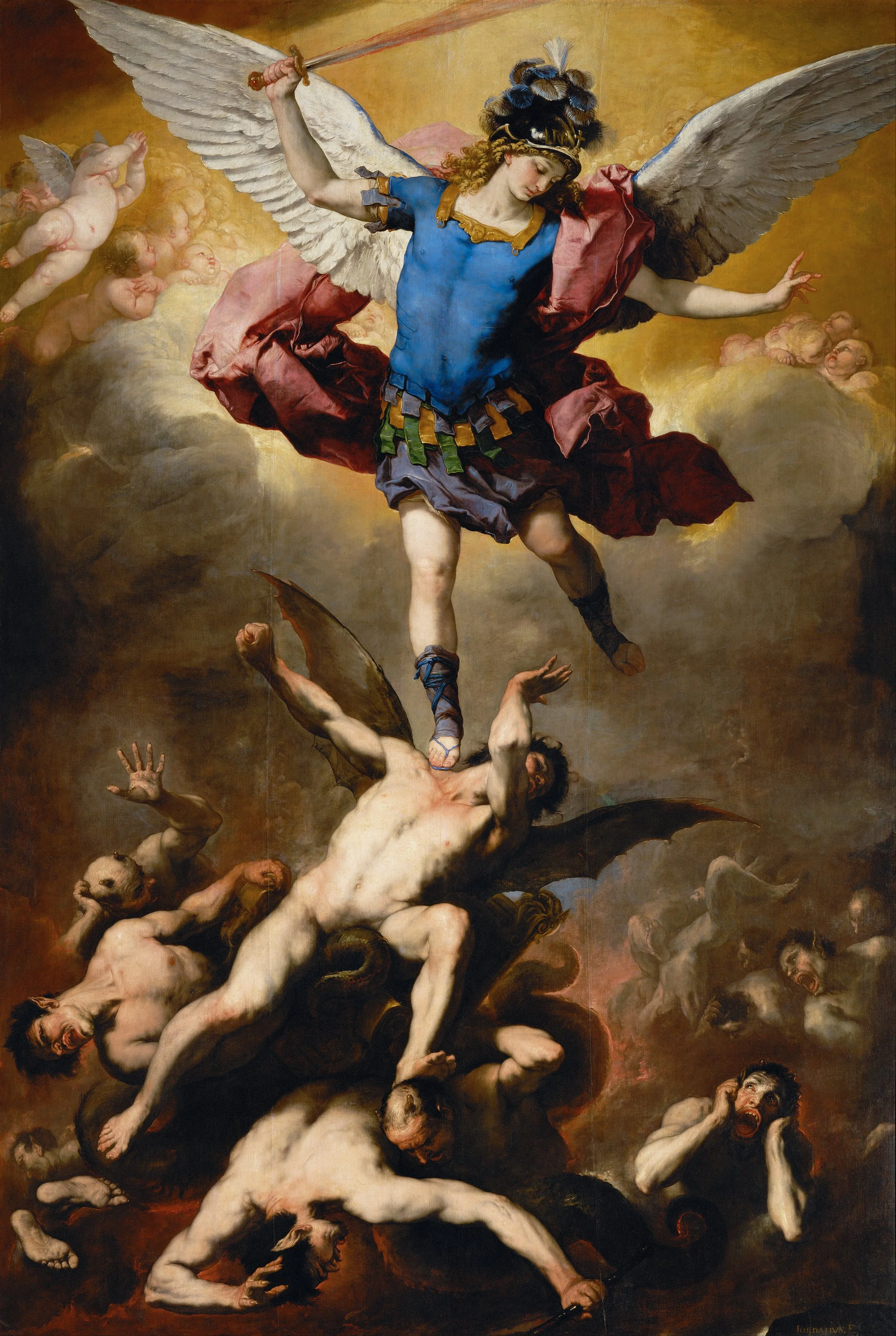
Luca Giordano, The Fall of the Rebel Angels, c. 1666, Kunsthistorisches Museum, Vienna, Wikimedia Commons, Public Domain
The Fall of the Rebel Angels is a large Italian Baroque altarpiece created by Luca Giordano. The upper half shows St. Michael with outstretched wings and arms, raising a sword with his right hand. The brilliant colors of his attire and gold background suggest the influence of the Venetian school. St. Michael is standing gracefully on Lucifer, who lies sprawled atop a heap of demons. Fires flicker among the writhing figures in the lower half, which is rendered in chiaroscuro reminiscent of Caravaggio and Jusepe de Ribera. The contrast between the two halves of the composition reflects the cosmic conflict between good and evil that is embodied in the battle between St. Michael and Satan.
10. The Archangel Michael Defeating Satan by Antonio Palomino
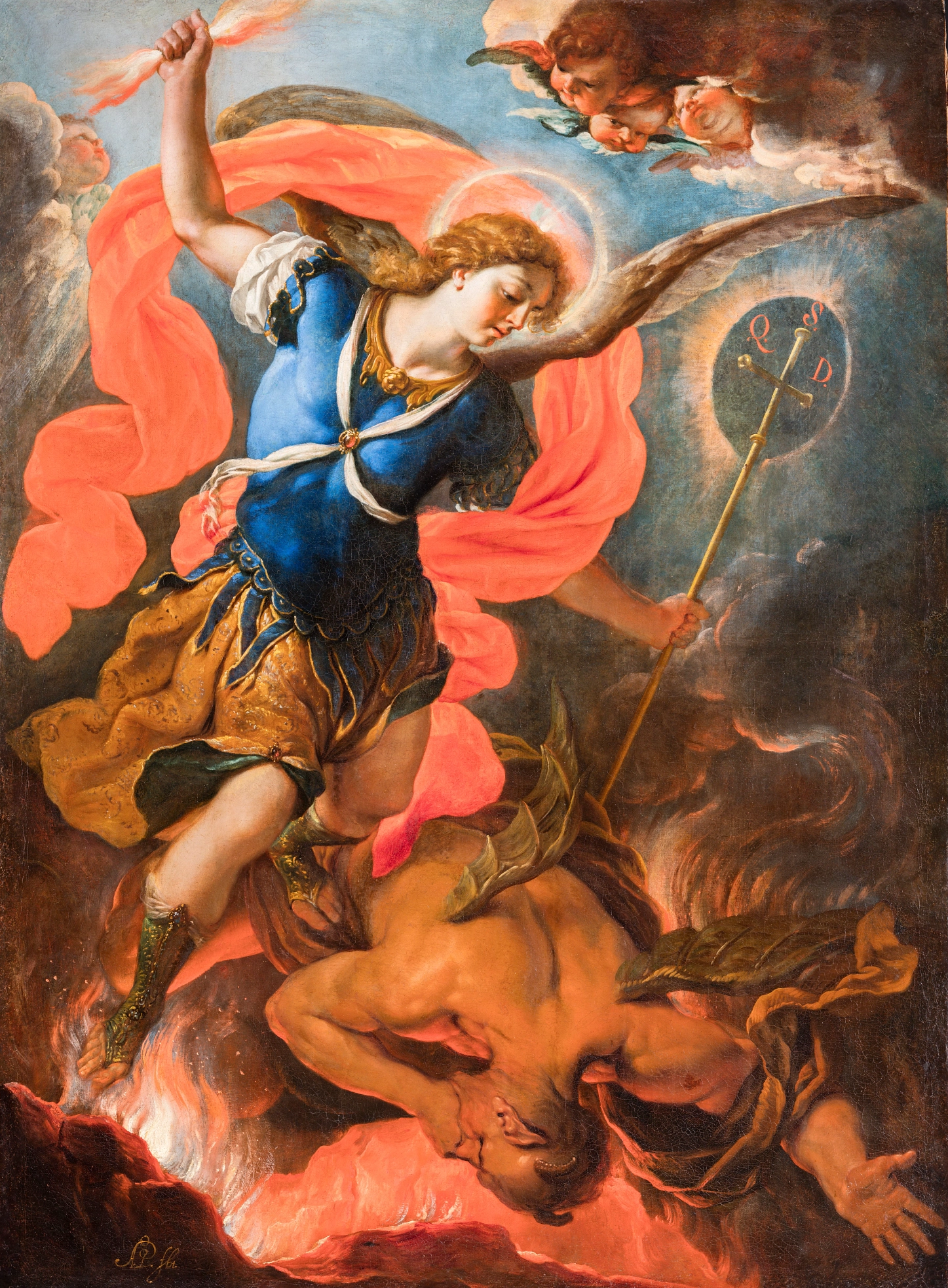
Acisclo Antonio Palomino de Castro y Velasco, The Archangel Michael Defeating Satan, c. 1692–1705, Detroit Institute of Arts
In The Archangel Michael Defeating Satan, the Spanish Baroque painter Antonio Palomino includes two distinctive attributes not featured in the previous paintings. Instead of a sword or lance, St. Michael grips a flaming bolt of lightning in his right hand, symbolizing God’s divine power and judgment. The second unique element is the staff in his left hand. The three arms of the cross are marked with the letters Q, S, and D. This is the abbreviation for the Latin phrase Quis sicut Deus? (“Who is like God?”), a translation of the Hebrew meaning of the name Michael.
With his composition, Palomino follows a popular artistic convention of depicting St. Michael in blue and gold, with a contrasting red drape, a color combination frequently seen in Renaissance and Baroque imagery. The archangel is shown casting Satan into the glowing fires of hell below.
Conclusion
In Christian sacred art, St. Michael the Archangel is typically depicted as a heavenly warrior defeating the devil or as a weigher of souls. The imagery of St. Michael defeating Satan reflects the biblical account of Revelation 12:7–9, while his role as weigher of souls derives from Catholic tradition. Paintings of St. Michael ultimately capture the power that he has in the spiritual battle between good and evil. As the Prince of the Heavenly Host, he offers his aid and protection to those who invoke his intercession. In Catholic devotion, artwork of St. Michael conquering the devil is often found on holy cards with the Prayer to St. Michael the Archangel.