
October Sacred Artwork of the Month: St. Francis in the Desert by Giovanni Bellini
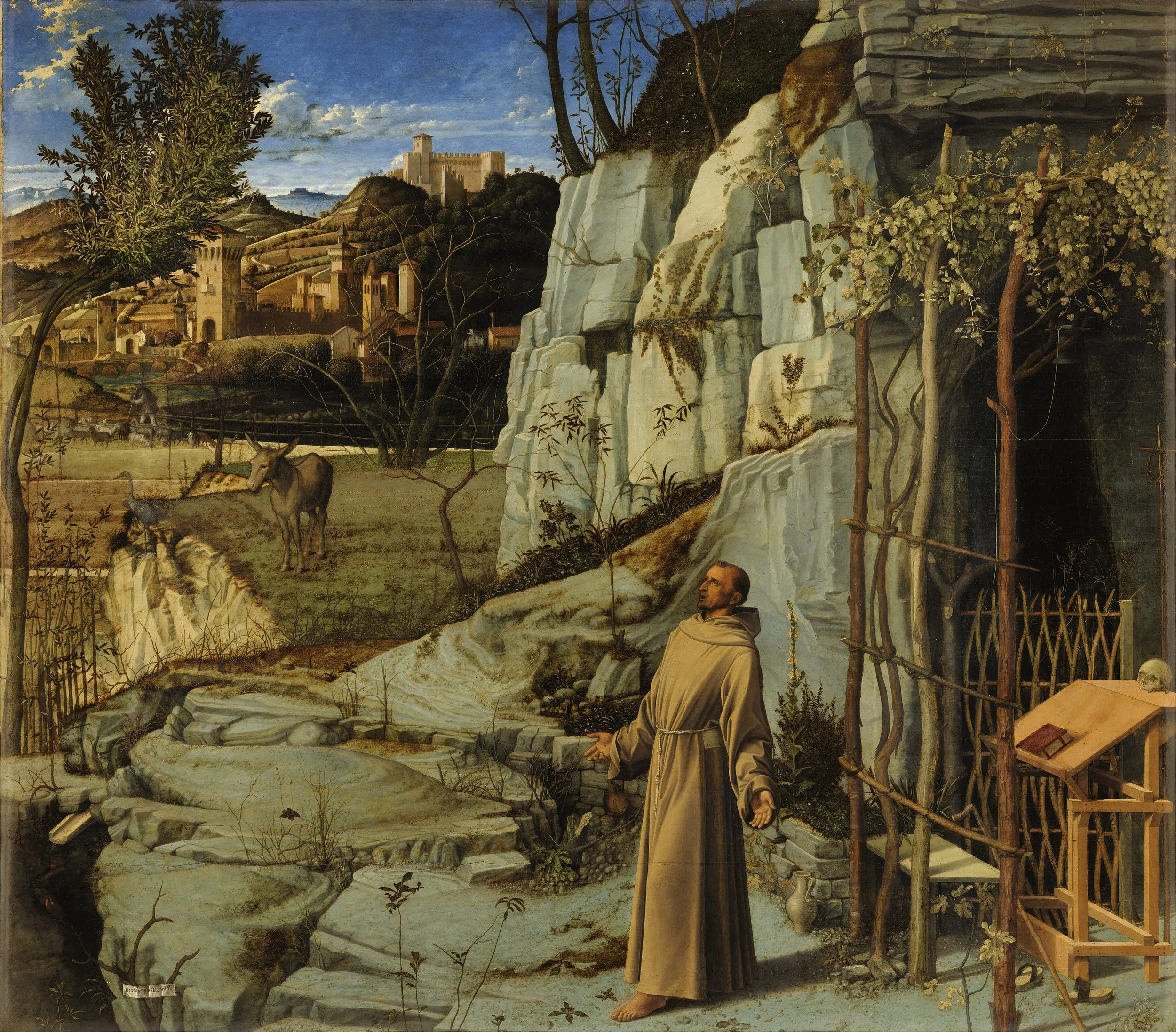
Giovanni Bellini, St. Francis in the Desert, c. 1475-1480, The Frick Collection, Wikimedia Commons, Public Domain
Perhaps no painting captures the life and spirituality of St. Francis of Assisi better than St. Francis in the Desert by Giovanni Bellini (c. 1430/35–1516). Completed around 1480, it may depict Francis receiving the stigmata, although the proper interpretation remains a subject of debate among art historians. Alternatively, the saint may be singing his Canticle of the Sun. Regardless of its exact meaning, the painting is filled with symbolism that communicates to us, the viewers, something about Francis and his faith.
In the foreground, Francis stands on a rocky outcropping, dressed in a simple brown robe. Stepping forward, he lifts his eyes toward the light shining from the upper left corner. He appears to be immersed in a mystical experience (hence the alternate name for the work, St. Francis in Ecstasy). Faint red marks on his hands suggest the stigmata, the wounds of Christ. Is this the moment Francis received the stigmata on Mount La Verna? We do not know. The composition notably lacks the six-winged seraph often found in depictions of Francis receiving the stigmata.
Behind the saint, caught up in his encounter with God, an overhang shelters a wooden lectern holding a book, presumably a Bible. A skull also rests on the structure, evoking mortality and recalling Francis’s reference to death as “Sister Bodily Death.” This setup of the cave, book, and skull recalls portrayals of St. Jerome (c. 342/347–420), who lived as a hermit for part of his life. Francis similarly sought refuge in the wilderness to pray amid the silence and beauty of creation.
The plants and animals interspersed throughout the landscape echo Francis’ deep love for the natural world, which reflected his love for its Creator. Many of the elements in Bellini’s work have been interpreted symbolically. Beginning with the plants, the grapevine hanging over the cave entrance may allude to Francis’ devotion to the Holy Eucharist. The tall laurel tree on the left could represent eternal life, as its foliage remains green year-round.
Some art historians have also related the laurel tree to the burning bush in the Book of Exodus. Bellini may have been familiar with St. Bonaventure’s Major Legend, an influential biography of Francis completed around 1263. In the text, Bonaventure compares Francis descending Mount La Verna bearing the stigmata to Moses descending Mount Sinai with the stone tablets. Bellini may have developed this comparison further in his painting. Notice the sandals lying by the lectern. Like Moses, Francis appears to have removed his footwear in the presence of the Almighty. Although the laurel tree is not a burning bush, it may allude to this divine presence.
The Moses parallel may not end there. In the lower left corner, a waterspout emerges from the rocks beneath the laurel tree. Moses struck water from a rock, and Francis did something similar, according to Bonaventure. In his Major Legend, Bonaventure recounts an occasion when Francis helped a desperately thirsty peasant. The friar prayed and directed the man to a nearby rock, from which water immediately began to flow. Bonaventure wrote that Francis “was made like unto Moses in the drawing of water from the rock.” Giotto di Bondone (c. 1266/67–1337) depicted this miracle in one of his frescoes in the Upper Church of the Basilica of San Francesco in Assisi, Italy.
Bellini’s landscape includes several animals, reflecting the affection that Francis famously showed toward God’s creatures. The donkey standing in the grass may be a nod to Francis’ term for his own body, which he called Brother Ass. He viewed the human body and its passions as something that needed to be disciplined and guided with perseverance. The donkey can also symbolize humility and patience in Renaissance art.
To the left of the donkey, a gray heron perches on a rock. This heron could represent solitude and contemplation, which Francis sought during his retreats into the wilderness. Behind these two creatures is a shepherd and his flock. Is this another reference to Moses, who was tending his sheep when he came across the burning bush? Or perhaps Bellini is highlighting Francis’ pastoral care for human souls and creation. The shepherd and his flock also recall Christ, the Good Shepherd, whom Francis followed unreservedly after giving up his worldly possessions and aspirations.
While St. Francis in the Desert by Giovanni Bellini is a landscape painting, it is also, in a sense, a multi-layered portrait of the great saint and his earthly life. At first glance, the artwork conveys Francis’ sanctity and stewardship of creation. Bellini also seems to have followed Bonaventure in comparing Francis to Moses, weaving this parallel into the work through the empty sandals, laurel tree, water spigot, and the flock of sheep. Like Moses, Francis was chosen and called by God for a special mission. Moses led the Israelites to the Promised Land, while Francis helped renew the Church so that more souls might walk the path to Heaven.