
Advent is a season of hope and waiting. The word “advent” comes from the Latin adventus, meaning “coming” or “arrival.” During the four weeks leading up to Christmas, we anticipate the adventus of Jesus Christ, the Savior of the world. Preparing for His coming usually involves many tasks and traditions: putting up the Christmas tree, hanging decorations, buying gifts for family and friends, baking cookies, and listening to Christmas music. These are all good and fun activities that contribute to the excitement and joy of the season. However, do we also take time for internal preparations? Are our hearts as ready as our homes for Christmas?
One way we can prepare our hearts for Christmas is by reflecting on the story of salvation history, particularly the events immediately preceding Christ’s birth. These include the Annunciation, Visitation, and the dream of St. Joseph. Over the centuries, these stories from the Gospels have inspired countless works of sacred art. Advent provides us with a fitting opportunity to pause and ponder a few of them. While sacred art cannot substitute for reading the Bible itself, depictions of biblical events and figures can complement and enrich our encounters with Scripture. Meditating with sacred art can even become a prayer in itself, known as visio divina.
Here are five paintings for Advent to contemplate as you prepare for Christmas:
1. The Annunciation by Henry Ossawa Tanner
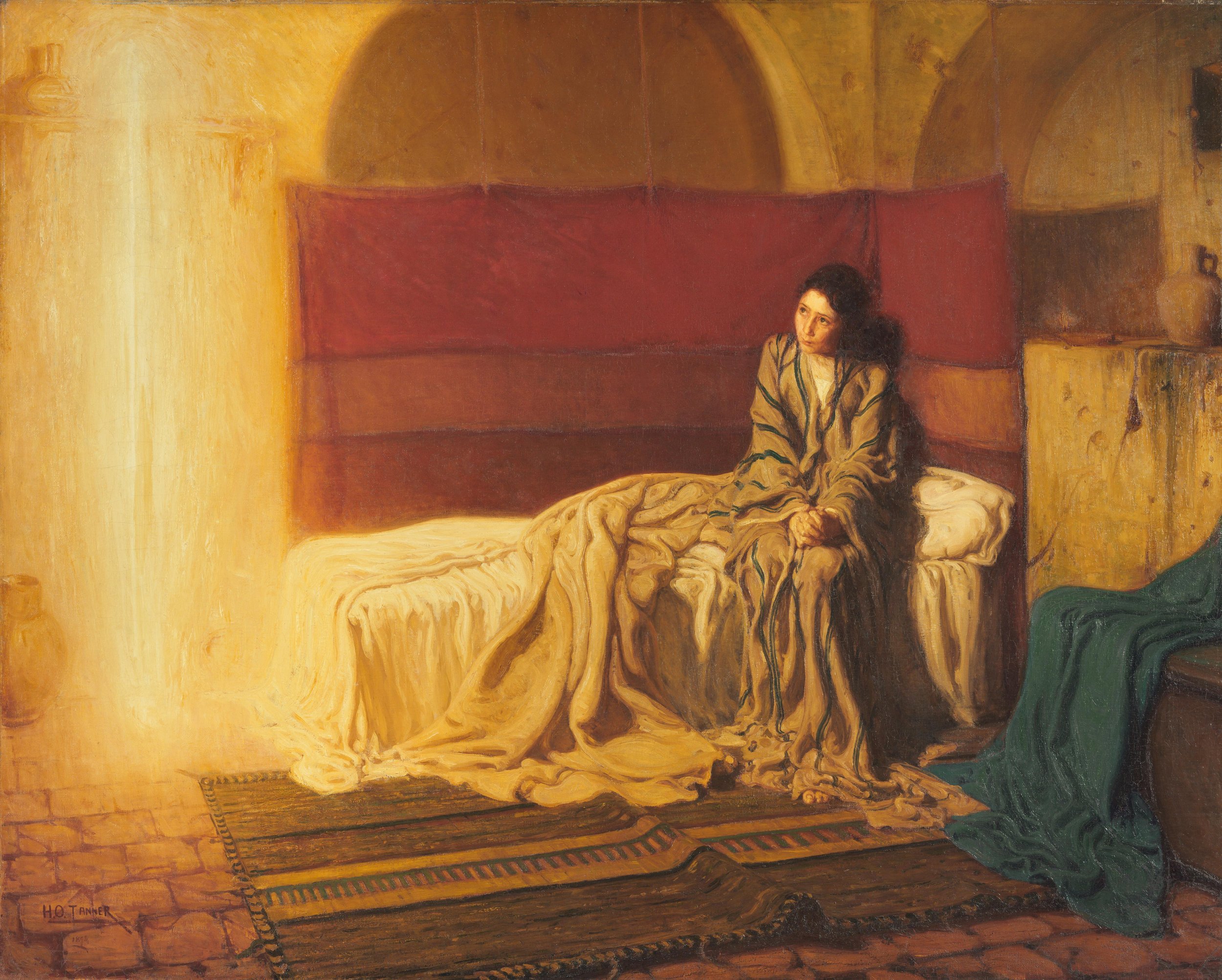
Henry Ossawa Tanner, The Annunciation, 1898, Philadelphia Museum of Art
The Annunciation by Henry Ossawa Tanner is unique among depictions of the angel Gabriel’s visitation to the Blessed Virgin Mary. Throughout art history, painters often adapted the Annunciation to their time and place, situating Mary in an enclosed garden, bedroom, or portico that incorporated medieval or Renaissance architectural features. Tanner takes a different approach. His Annunciation is an attempt to transport the viewer about 2,000 years back in time. The Virgin Mary appears as an adolescent, sitting on the edge of a bed in a small room. She wears the clothing of a Middle Eastern peasant, and the space around her is sparsely furnished. She is ordinary, young, and poor.
How does this humble girl from Nazareth react to her heavenly visitor? Gabriel is not a human figure with wings, but an orb of yellow light that illuminates the room. Mary does not seem afraid, but her slightly parted lips and wide eyes reveal that she is intently caught up in her dialogue with the angel. Gabriel has probably just announced that she will conceive and bear a son named Jesus. Perhaps Mary is asking him, “How can this be, since I have no relations with a man?”
Notice the blue cloth draped over a piece of furniture on the right. Blue is traditionally associated with the Virgin Mary in sacred art, symbolizing her role as the Mother of God and Queen of Heaven. Many artists portray Mary wearing blue in Annunciation paintings. Tanner instead opts for this blue cloth, which may serve as a subtle reference to the vocation Mary is about to embrace as the mother of Jesus.
During Advent, Tanner’s Annunciation invites us to reflect on the importance of simplicity and receptivity. He painted a picture that counters the predominant materialism of our times. His composition suggests both a physical and spiritual simplicity: a lack of excess material goods and a soul disposed toward trusting in God. Devoid of worldly distractions and doubt, Mary’s heart was ready for God. She was prepared to receive the will of the Father and respond to His call. Are there changes that we need to make in our lives to do likewise?
2. Carmignano Visitation by Jacopo Pontormo
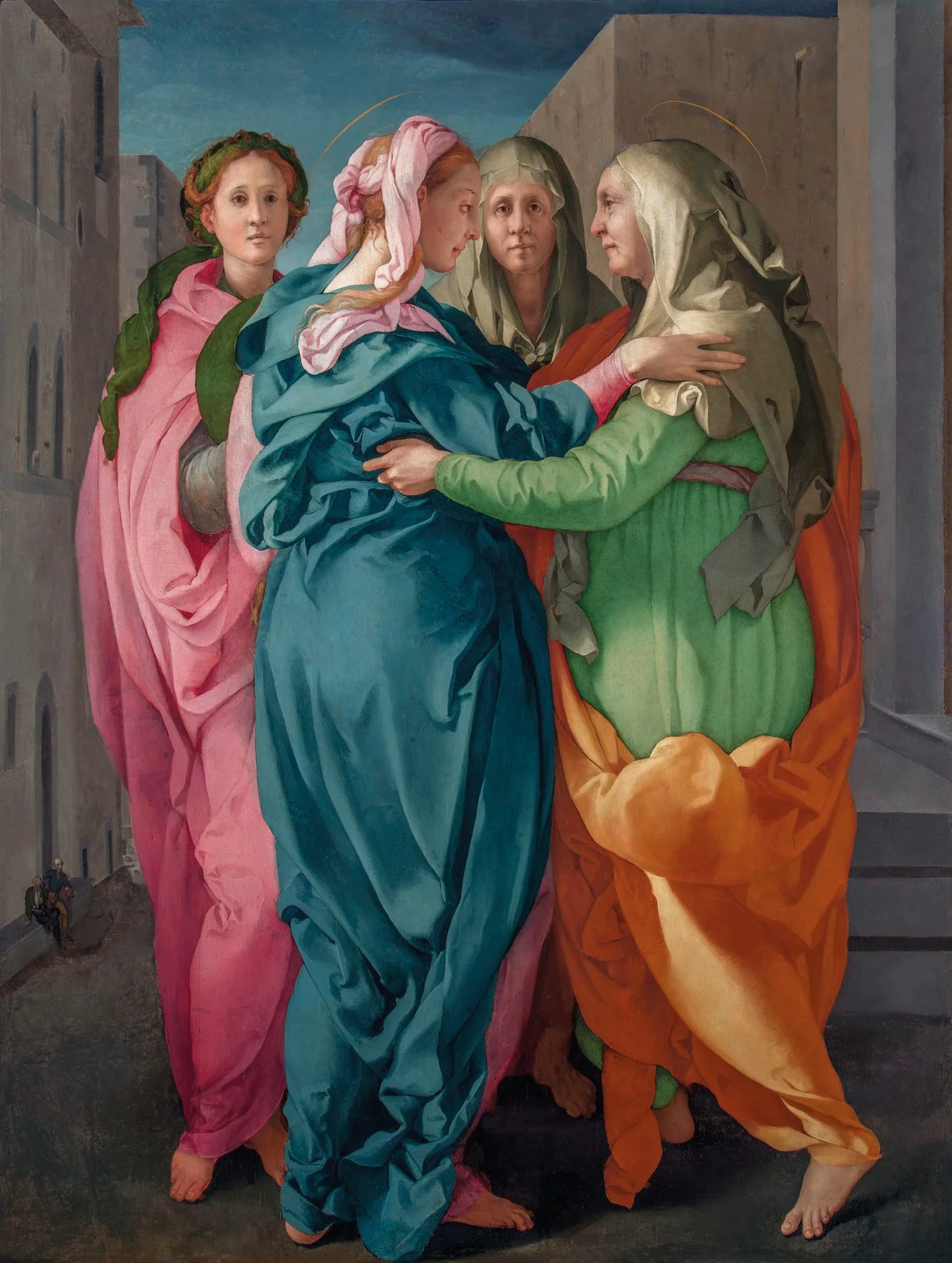
Jacopo Pontormo, Carmignano Visitation, 1528, Wikimedia Commons, Public Domain
True to the Mannerist style, the Italian artist Jacopo Pontormo utilized bright colors and elongated human forms in his Carmignano Visitation. The colors are the first aspect of the painting to catch your attention: pink, blue, green, and orange. Mary and Elizabeth hold one another at arm’s length. Mary has just traveled through the hill country to visit her cousin, who had miraculously conceived a child in her old age. The Gospel of Luke describes how the infant leapt in Elizabeth’s womb at the sound of Mary’s voice, causing Elizabeth to cry out in a loud voice.
However, she is not crying out in Pontormo’s painting. All four women in the composition appear quiet and solemn. The two cousins gaze at each other with intense affection. The pair behind them, who may be handmaids, have a ghost of a smile playing on their lips. The celebration remains interior. Who knows what unspoken thoughts and sentiments are passing between Mary and Elizabeth through their looks? One is the mother of the Savior, and the other of the man who would announce His coming.
I think the Carmignano Visitation imparts the gravity of the situation alongside the joy. While neither mother knew it at the time, both of their sons would undergo unjust persecution and death. In the face of the unknown, a strong and unwavering faith unites the two women. Elizabeth tells Mary, “Blessed are you who believed that what was spoken to you by the Lord would be fulfilled” (Luke 1:45). We must keep in mind that the words apply to the speaker as well.
Pontormo’s work offers us an image of unshakeable faith and inner joy to contemplate during Advent. Mary and Elizabeth followed the will of God with trust and fortitude. Their acts of faith united them, filling their hearts with a joy that surpassed all human understanding. Yes, the road ahead would bring its share of sorrows. But Mary and Elizabeth could still rejoice in the goodness of God, believing that His merciful love guided the course of their lives.
3. The Dream of St. Joseph by Philippe de Champaigne
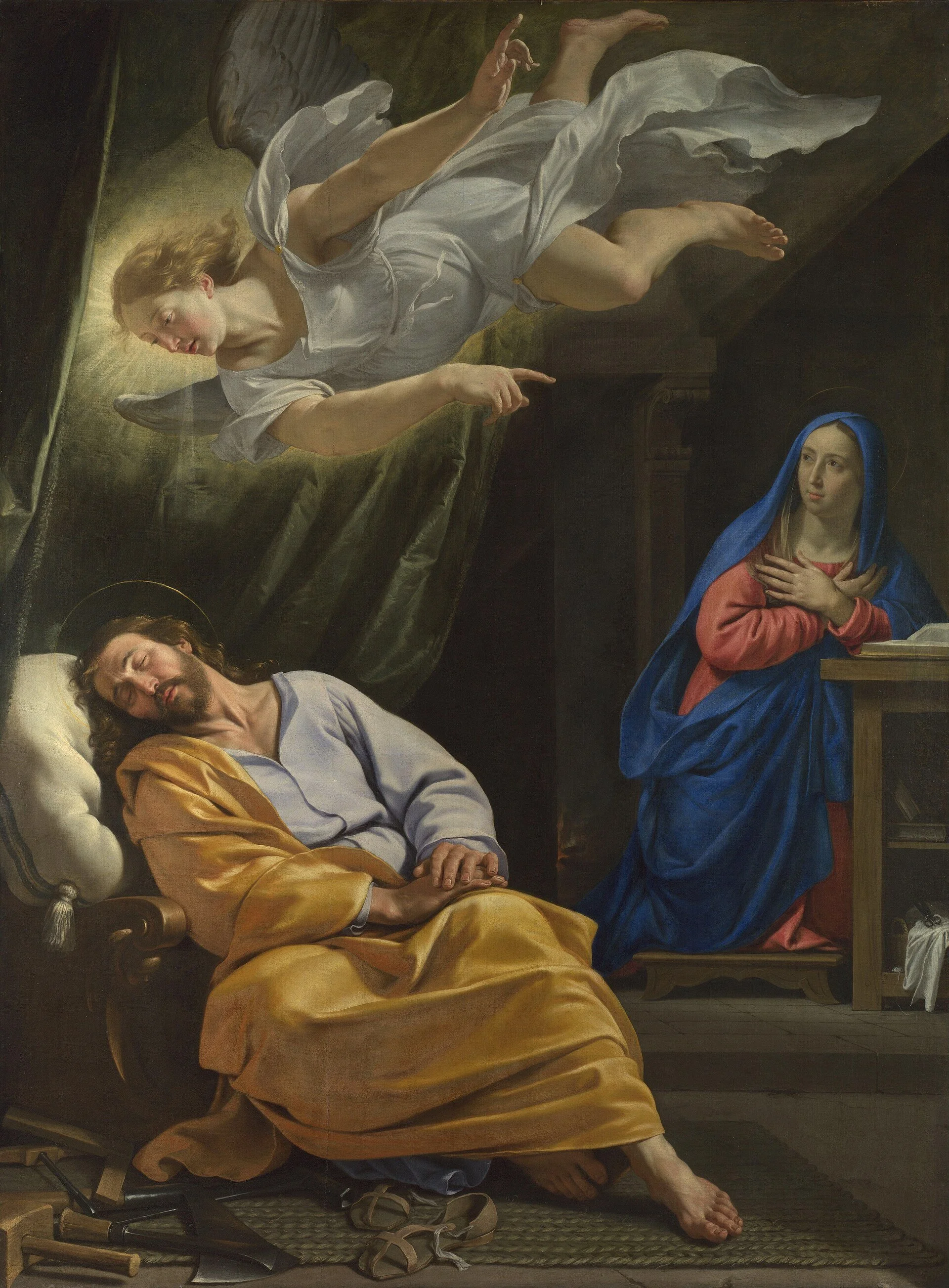
Philippe de Champaigne, The Dream of St. Joseph, 1642–1643, National Gallery, London
The Dream of St. Joseph by Philippe de Champaigne brings before our eyes the humility and obedience of St. Joseph, making it a fitting artwork for Advent. The Baroque masterpiece prompts us to contemplate Joseph’s role in the mystery of the Incarnation. The carpenter from Nazareth is depicted fast asleep, his abandoned tools lying at his feet. As we know from the Gospel of Matthew, Joseph has made the decision to divorce Mary quietly.
According to one theological interpretation, Joseph feared taking Mary as his wife because he knew divine favor rested upon her. In this painting, Mary is shown kneeling near a table that holds an open devotional book. With her arms crossed reverently over her chest, she gazes upward toward the angel speaking to the sleeping St. Joseph. The Virgin painted by Philippe de Champaigne leaves us without a doubt that her beauty, purity, and faith far exceeded those of the average woman. The angel points at Mary with one hand and toward Heaven with the other, confirming Joseph’s suspicions that the child Mary conceived was indeed holy.
Out of humility, Joseph was going to divorce Mary to avoid interfering with God’s divine plan. He sensed his own unworthiness, recognizing that he was unable to offer Mary and the unborn Son of God anything more than a basic, if not poor, way of life supported by his carpentry work.
Yet Joseph had an instrumental part to play in God’s salvific plan. The angel tells him: “Joseph, son of David, do not be afraid to take Mary your wife into your home. For it is through the Holy Spirit that this child has been conceived in her” (Matthew 1:20). This declaration reveals that God desired Joseph’s cooperation despite his perceived weaknesses. A man of faith, Joseph humbly submitted himself to the will of God. How can we imitate Joseph’s humility and obedience, knowing that Christ desires to dwell in the hearts of the humble?
4. On the Eve of the Birth of Christ by Michael Rieser
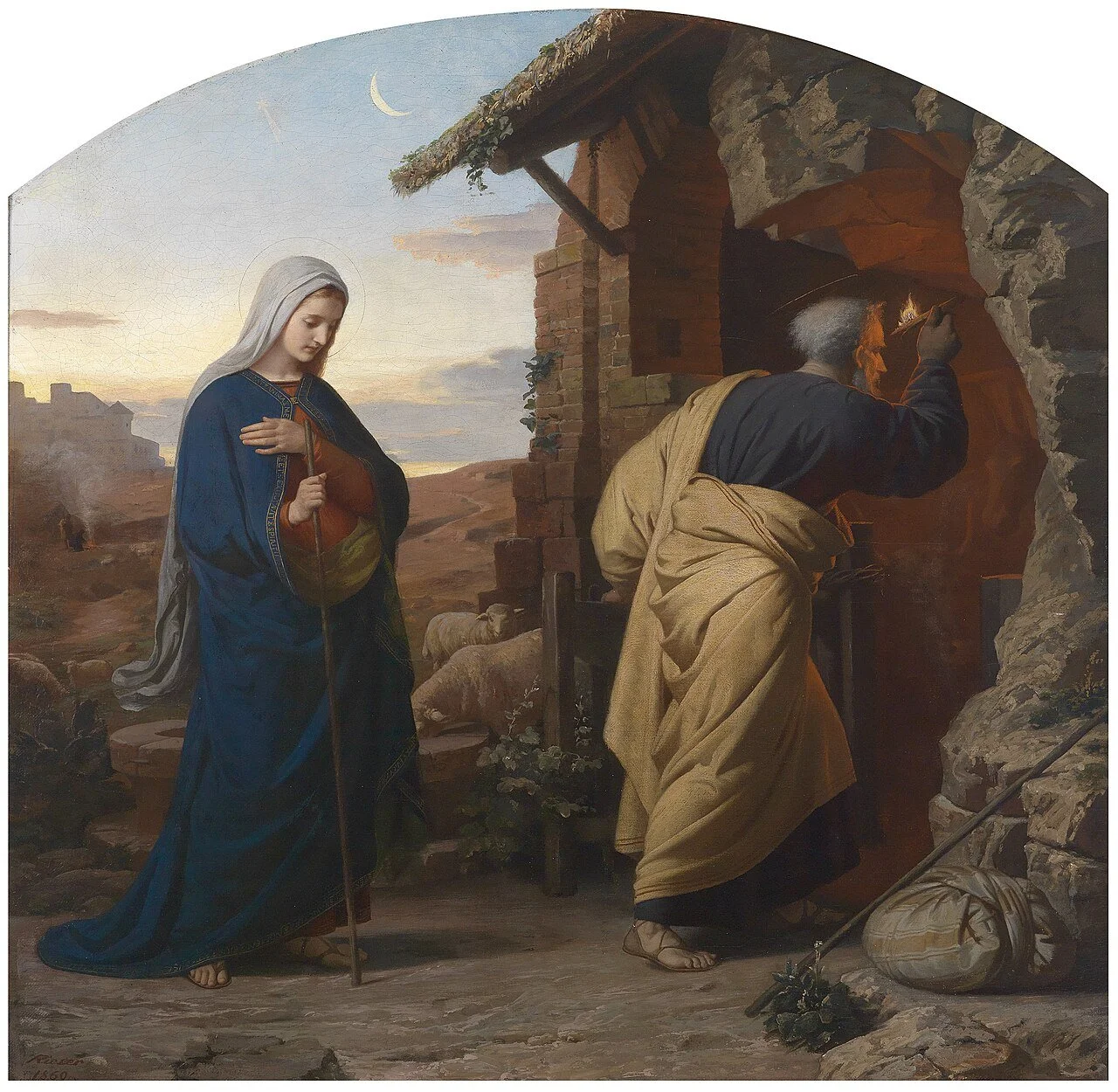
Michael Rieser, On the Eve of the Birth of Christ, 1869, Wikimedia Commons, Public Domain
Our fourth artwork for Advent, On the Eve of the Birth of Christ, is a lovely painting that precedes the Nativity by a few hours. The Star of Bethlehem already flickers faintly in the sky. Michael Rieser, a little-known Austrian artist from the nineteenth century, is responsible for creating this work. The scene shows St. Joseph and Mary seeking shelter outside Bethlehem. The town appears on the horizon to the left, outlined against a late evening sky. The path in the background, coupled with the walking sticks belonging to Mary and Joseph, remind us of the arduous journey they have undergone to arrive here.
As dusk falls, Joseph peers into a stable built with brick and stone. A donkey and ox are inside to greet him, barely visible in the dim but warm glow cast by the small flame in Joseph’s hand. This is the only shelter he can offer Mary tonight. His wife stands by and waits for his assessment. Her robes hide her pregnant belly, and the hem of her blue cloak features gold letters that spell out the Latin words of the Magnificat. Even when reduced to such dire circumstances, Mary may be singing her hymn of praise once more, although this time in the silence of her heart.
With downcast eyes and a bent head, Mary holds one hand over her heart and grips her walking stick with the other for support. Physical fatigue does not prevent her from praying, but it is easy to imagine her exhaustion after traveling so far in the final days of her pregnancy. The birth of the Savior is at hand. The two distant figures to the left may be the shepherds who will adore the newborn Savior that very night.
Rieser’s painting is suitable for Advent because it captures the last moments of waiting before the birth of Christ. Joseph and Mary do not yet know how everything will unfold. Having found no room in the inn, they find themselves entirely reliant on divine providence. During Advent, we can consider with gratitude the ways in which God provides for us amid uncertainty. This includes the greatest gift of all: Jesus Christ, His only begotten Son.
5. Madonna of the Rose by Pascal Dagnan-Bouveret
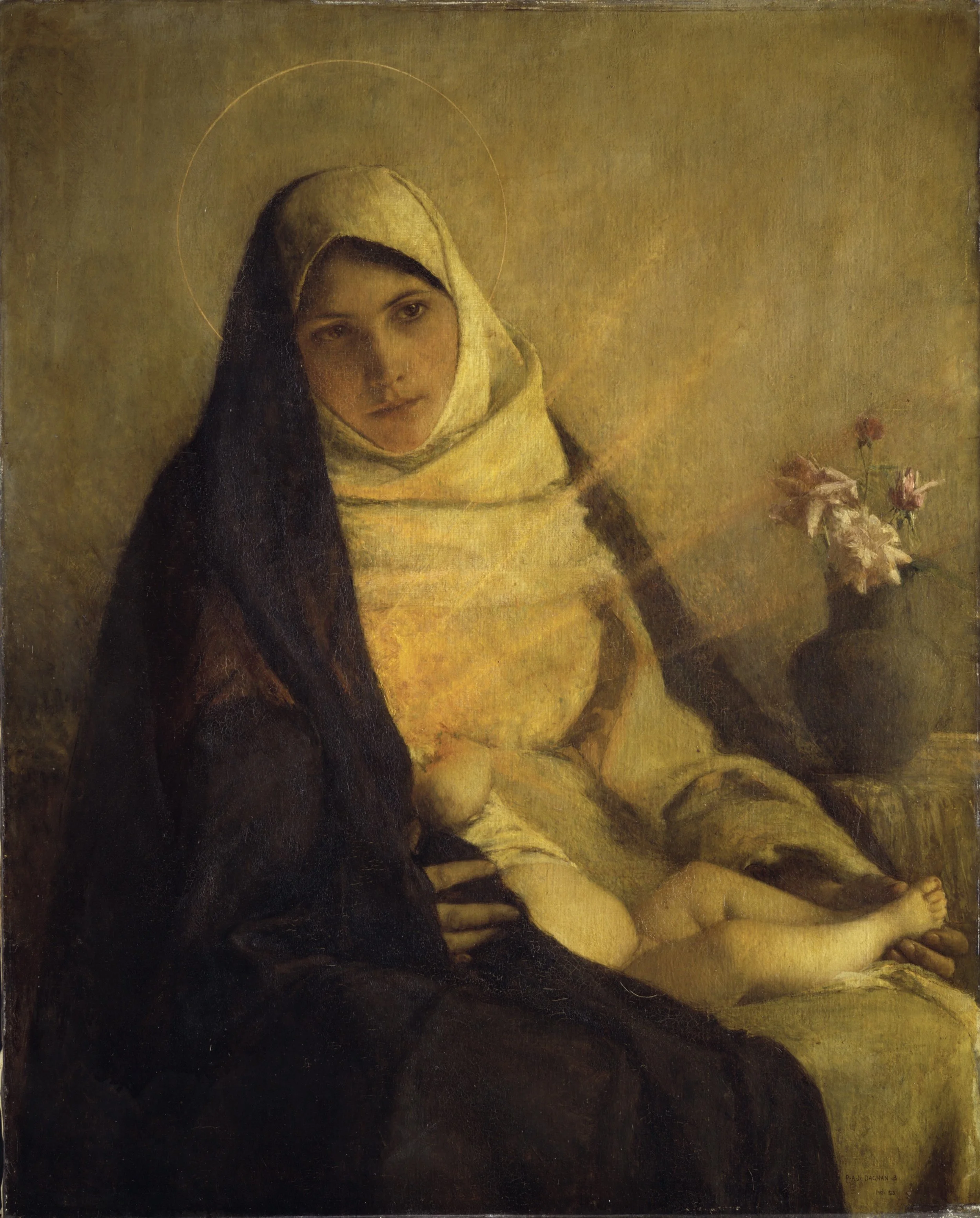
Pascal Dagnan-Bouveret, Madonna of the Rose, 1885, The Met, Wikimedia Commons, Public Domain
In the Madonna of the Rose, we seem to encounter a young Mary much like the girl in Henry Ossawa Tanner’s Annunciation. The French artist Pascal Dagnan-Bouveret portrays a similar Virgin Mary with dark eyes and hair, wearing a simple garment that indicates her poverty. In this painting, she has given birth to the child announced by the angel Gabriel.
Madonna of the Rose is a beautiful painting for the Advent season, since it recalls Christ as the Light of the World. The Infant Jesus reclines on Mary’s lap, His face almost entirely hidden by her mantle. The visible part of His face is rendered indistinct by beams of light radiating outward from His countenance. The concept of Christ as Light remains a central theme of Advent and Christmas. We remember the words of the prophet Isaiah that foretold a Savior who would be a “light for the nations.” There is also the Gospel of John, which contains the theme of light from its prologue to the words of Christ Himself, who stated, “I am the light of the world” (John 8:12).
The light, however, implies darkness. Pascal Dagnan-Bouveret portrays the Virgin not tenderly smiling at her Son, but rather gazing at a distant point outside the composition. It is not a blank stare, but one that reflects a deep interiority. As she caresses Jesus’ tiny feet with her left hand, is Mary thinking about what His future could hold? Three of the roses in the vase next to her have a soft pink hue, possibly referencing Christ’s Passion. The dark coloring of her mantle could also allude to the suffering and death that await her Son. Sacred artists often incorporated subtle hints of Christ’s fate within depictions of the Madonna and Child, so it isn’t far-fetched to assume Pascal Dagnan-Bouveret has continued this tradition in his work.
During Advent, we must remember that the mysteries of the Incarnation and Redemption are one and inseparable. As Blessed Fulton Sheen put it, “If there were no Cross, there would have been no Crib; if there had been no nails, there would have been no straw.” The Light of the World came to cast out darkness, redeeming mankind from its sins through the price of His own Blood. Like Mary, we would do well to ponder these things in our hearts, from the innocence of the newborn Christ to His agony on the Cross. Every moment of His life speaks of His love for us.
Conclusion
I hope that you enjoyed reading about these five works of sacred art for Advent. From Henry Ossawa Tanner’s Annunciation to the Madonna of the Rose, this selection can help us remember the true meaning of the season. As we prepare to welcome Christ into our hearts on Christmas, let us ponder the marvelous way in which God orchestrated the salvation of mankind.