
The Surprising History of Doubting Thomas in Sacred Art
The episode of Doubting Thomas, also known as the Incredulity of St. Thomas, is a well-known scene in religious art. The moment of Thomas touching the wound in Christ’s side has been depicted by various sacred artists, including renowned painters such as Duccio and Caravaggio. However, comparing the artwork to the Scripture passage that inspired these portrayals reveals an apparent discrepancy: St. John the Evangelist never describes Thomas touching Christ’s wounds. How, then, did it come to be pictured in sacred art in the Christian tradition?
Early Interpretations
Rewinding the Gospel story a bit, recall Thomas’ obstinacy in refusing to believe in the Risen Christ until he touches His wounds. A week later, Jesus bypasses locked doors and comes to the apostles, inviting Thomas to carry out his bold proposition. “Put your finger here and see my hands, and bring your hand and put it into my side, and do not be unbelieving, but believe.”
But does Thomas actually touch Him? John doesn’t say. He concludes his account with Thomas’ verbal response and Christ’s admonition. “Thomas answered and said to him, ‘My Lord and my God!’ Jesus said to him, ‘Have you come to believe because you have seen me? Blessed are those who have not seen and have believed’” (John 20:27-29, NABRE).
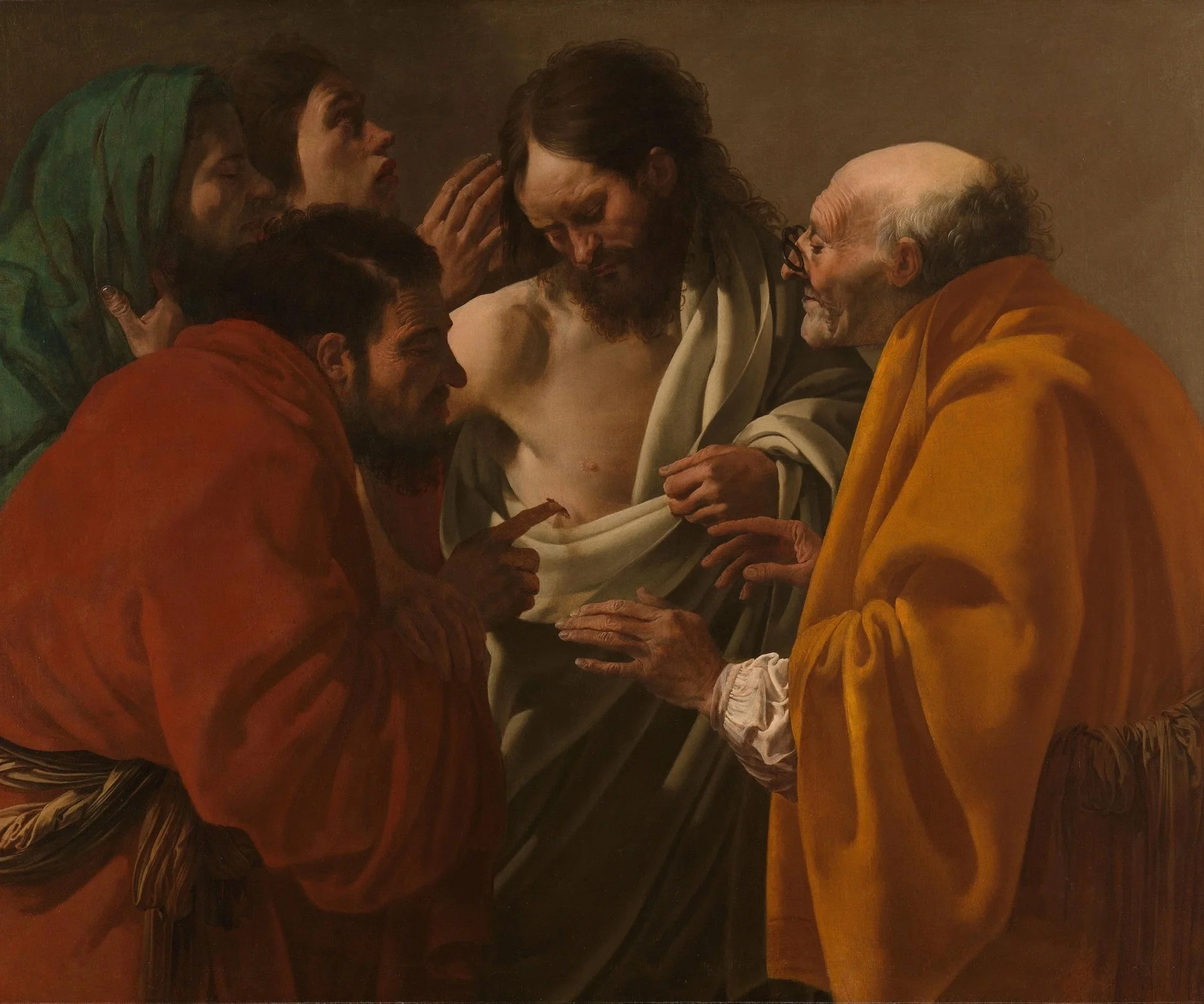
Hendrick ter Brugghen, The Incredulity of St Thomas, c. 1622, Rijksmuseum
In the early Church, theologians such as Tertullian (c. 155-c. 220) and St. Gregory the Great (c. 540-604) asserted that Thomas touched Christ, using the incident as evidence for the bodily resurrection of Jesus. “So the disciple who doubted, then felt Christ’s wounds, [became] a witness to the reality of the resurrection,” pronounced Gregory the Great. Their position countered the gnostic rejection of Christ’s flesh-and-blood resurrection—a perspective that mirrored Thomas’ doubt in whether Christ’s body could really rise from the dead.
In contrast, St. Augustine (354-430) admits in his commentary on John 20 that Jesus doesn’t tell Thomas, “You have touched me.” However, Augustine suggests that in Jesus saying, “You have seen me,” sight can refer to any of the other four senses. For example, we often say, “Try this, and see how this tastes” or “Listen, and see how this sounds.” Augustine concludes that Thomas could either have only gazed at Jesus or touched Him.
The Role of Sacred Art
Sacred art played a significant role in developing the tradition of Doubting Thomas placing his fingers in Christ’s side. A sarcophagus from the late fourth- or early-fifth century is the earliest known artwork of the Incredulity of Thomas. The mosaics in the Basilica of Sant'Apollinare Nuovo in Ravenna, which date to the early sixth century, also feature Doubting Thomas. In the latter, Thomas notably does not touch Christ’s side, making the mosaic an outlier in the Christian iconographic tradition. As we’ll see, the Incredulity of Thomas in sacred art overwhelmingly favors the portrayal of Thomas placing his fingers on or into the wound in Christ’s side. How did the favored depiction of Doubting Thomas emerge?
Sacred art not only served a devotional purpose in early Christianity, but it also educated an illiterate community of believers about biblical stories and mysteries of the faith. Artists probably opted to show Thomas touching Christ’s side because it enabled the faithful to identify the apostle and scriptural passage with certainty. If contemporary pastoral expositions on John 20 were anything like the interpretations made by Augustine and Gregory the Great, these also may have influenced artists.
In any event, the Christian artistic tradition of Doubting Thomas was well-established by the High Middle Ages. Two relevant pieces of art from that period demonstrate that medieval artists focused on following types rather than individualizing their work. The point of creating sacred art did not consist in pursuing uniqueness or novelty, but in passing on the heritage of the faith through pre-existing artistic rubrics. This meant that common features were shared across different renditions of the Incredulity of Thomas.
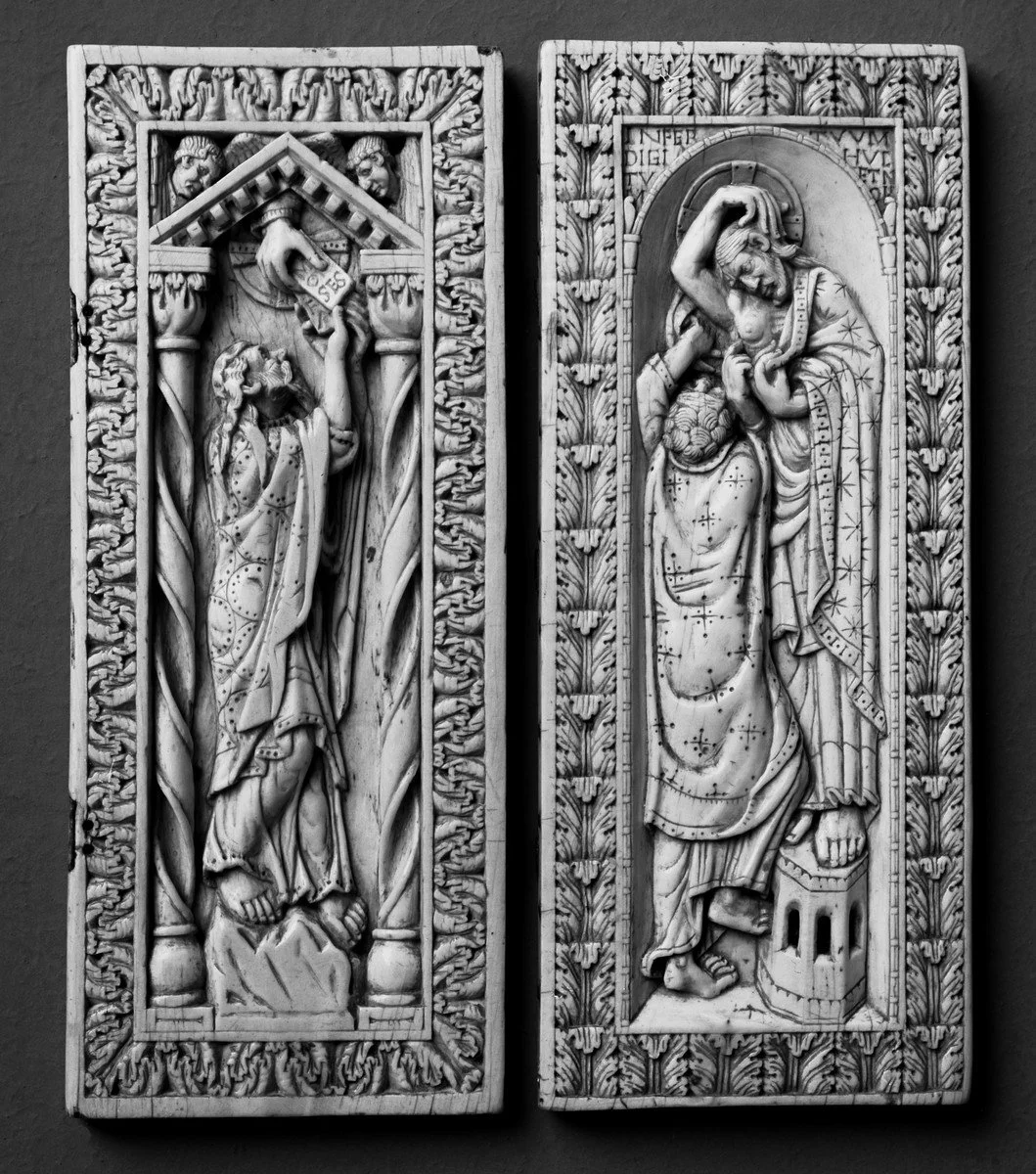
Diptych, Moses Receives the Tablets of the Law and the Unbelieving Thomas, 986/1000, carved ivory, found in Echternach, Bildindex der Kunst & Architektur
The first example is an exquisite ivory diptych of Doubting Thomas from the late 10th or early 11th century. Ivory diptychs were luxury items often used for private devotion. The narrow space of the panel clearly restricted the artist’s freedom in portraying the episode. The right panel of the diptych shows Jesus standing on a stool, elevating Him above Thomas. Jesus raises His right arm to expose His side, and Thomas reaches up to touch the wound. Thomas’ back is to the viewer, and Christ’s bent head forms an arch over both of them that frames the scene, paralleling the arch above His lifted arm.
Jesus’ large hands and defined arm and chest muscles suggest the power and might of His resurrected body. While the close proximity of Jesus and Thomas should convey a sense of intimacy, the discrepancy between their heights and Jesus’ exaggerated strength seems to stand in the way.
A 12th-century Italo-Byzantine mosaic from the Cathedral of Monreale in Sicily also shows Jesus and Thomas in similar poses. Like in the ivory diptych, Thomas is positioned under Christ’s raised right arm. Once again, Thomas ventures to place a finger of his right hand into the wound. Jesus is still taller and larger than Thomas, indicating Christ’s divinity and authority. However, Jesus and Thomas now stand on common ground. The viewer can see Thomas’ face, but it doesn’t vary from the expressions of the other figures. The uniformity of expression and lack of emotion reflect the Byzantine style, as does the gold background that bathes the scene in a supernatural aura.
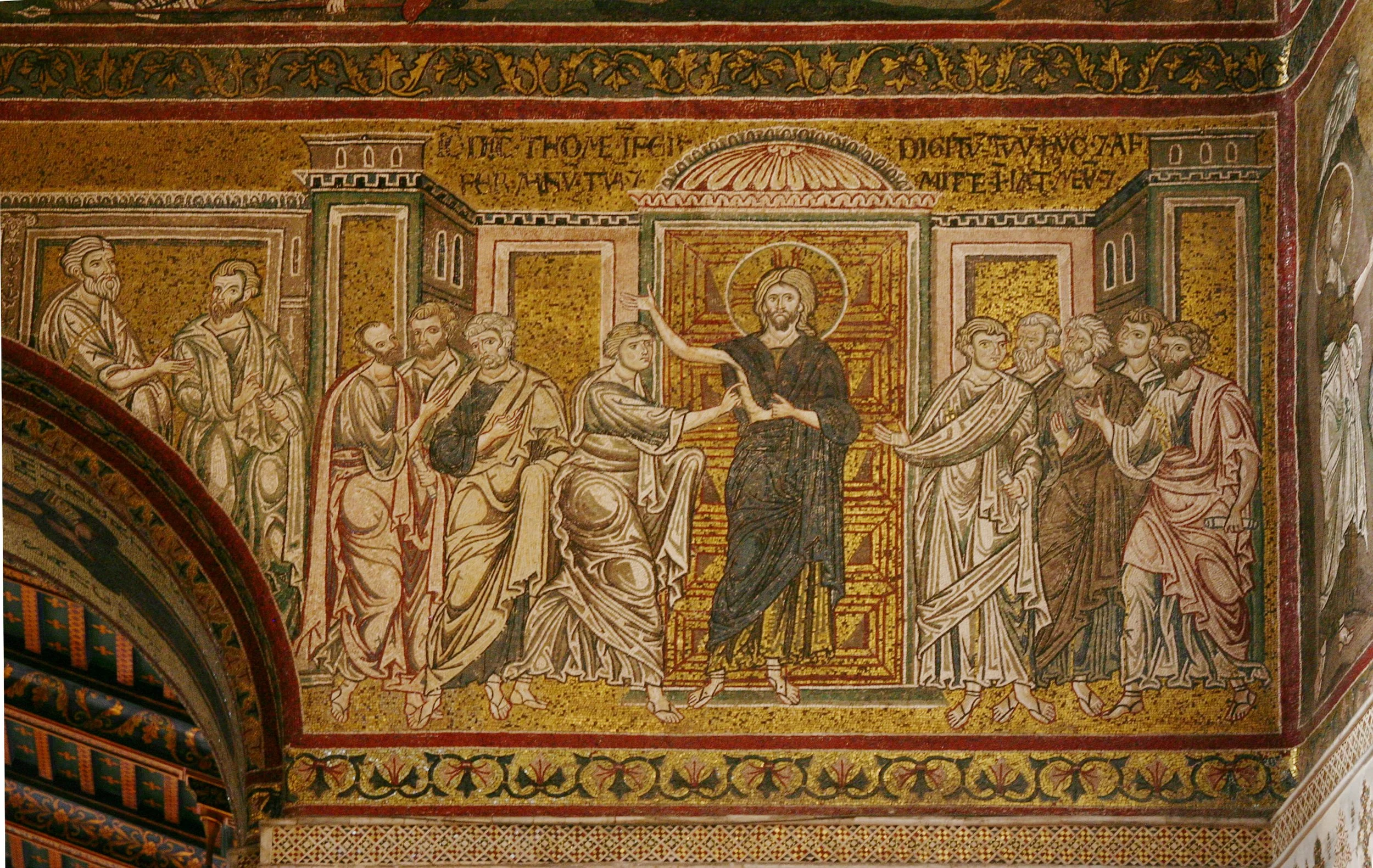
Doubting Thomas, c. 1180 and 1190, Cathedral of Monreale, Italy, mosaic, © José Luiz Bernardes Ribeiro by CC BY-SA 4.0, Wikimedia Commons
In contrast to the ivory diptych, the expanse of the church wall enables the artist to spread out his composition and expand the space. He adds a backdrop and other figures to include details taken from John 20:26: “Now a week later his disciples were again inside and Thomas was with them.” The mosaic depicts the Upper Room, and the pair of closed doors (presumably locked) frames the Risen Christ. Three groups of apostles surround Jesus and Thomas, speaking among themselves and gesturing to the pair in the middle. One is left wondering what they could be saying about Thomas, whose incredulity had probably shocked them all. Now the one who had doubted was touching the side of the Risen Christ—something none of the others had demanded to do.
The Artistic Tradition Continues to Develop
In the Late Middle Ages, artists introduced variations of the Incredulity of Thomas that reflected an increased interest in naturalism and portraying emotion. Duccio’s famous 14th-century Italian altarpiece, the Maestà, includes a panel of the Incredulity of Thomas on its back side. It shares several features with the anonymous Italo-Byzantine mosaic from the Cathedral of Monreale. Note the position of Thomas’ feet, the drapery of Christ’s robe, and the cluster of five apostles on the right side. Jesus again stands in front of locked double doors.
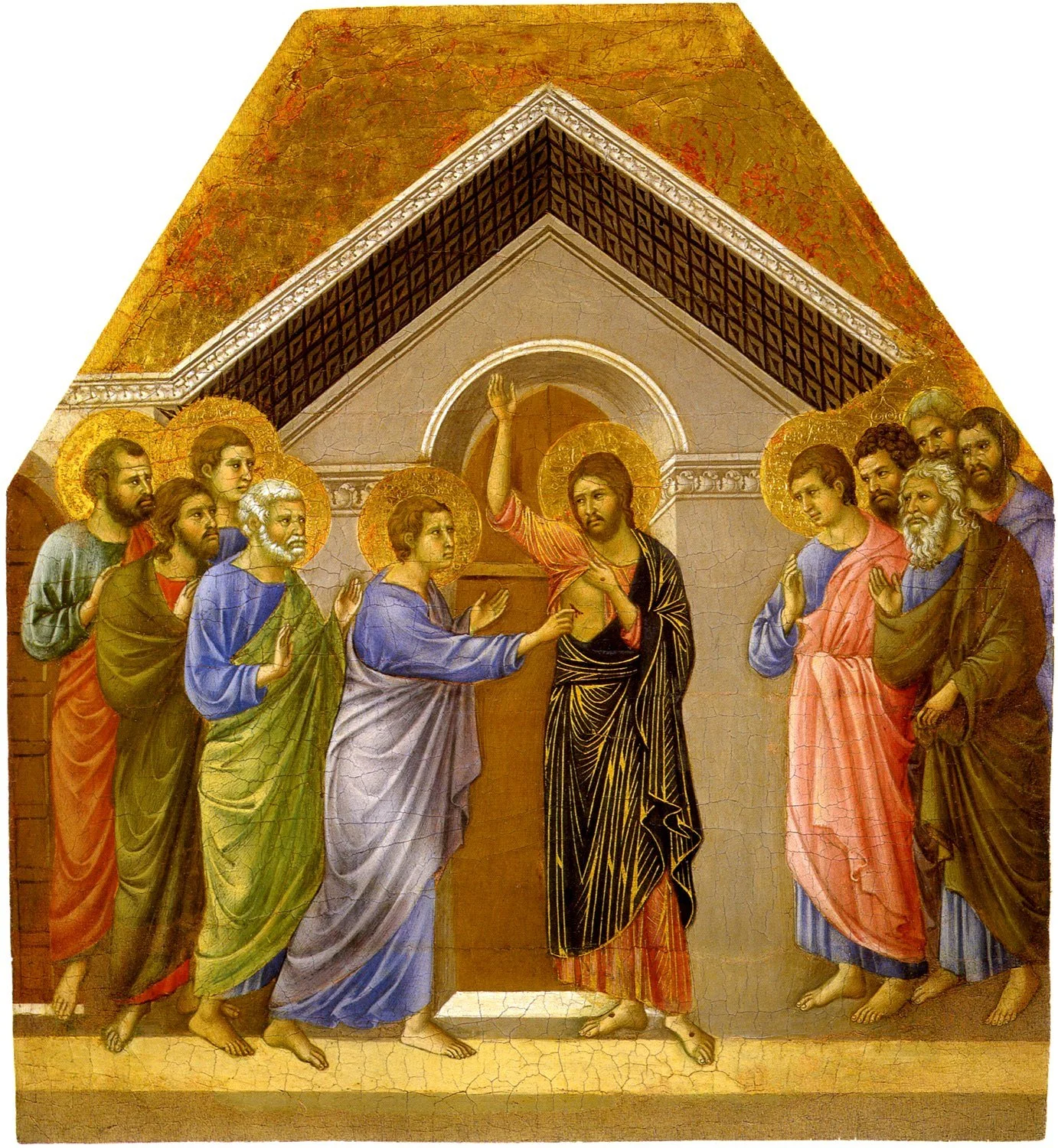
Duccio, The Incredulity of St. Thomas from the Maestà Altarpiece, c. 1308–1311, tempera and gold leaf on large wood panels, Wikimedia Commons, Public Domain
Some Byzantine elements remain, such as the gold background and evident symmetry of the piece. Yet 120 years of artistic developments have produced a marked contrast between the mosaic and Duccio’s panel. The figures in the latter appear more lifelike and three-dimensional—we can almost feel the suspense and amazement conveyed by their raised hands and intent looks. Christ gazes at Thomas with an animated expression, and Thomas directs his eyes back at Him. It has become an encounter between two flesh-and-blood individuals, not merely representations of them.
The next work of art also comes from an altarpiece, this time from a French Dominican church. The renowned Alsatian engraver and painter Martin Schongauer produced this eye-catching panel with his workshop in the late 15th century. Schongauer’s rendition of Doubting Thomas departs from tradition in several remarkable ways. For instance, it isolates Jesus and Thomas from the other apostles, recalling the composition of the diptych. But vibrant color has replaced cold ivory, and a room provides a concrete setting for the scene. Even more significantly, rather than raise His right arm, Jesus grips Thomas' wrist and holds it up to His wound. Christ’s loving and tender gaze meets His apostle’s upturned face. Unlike the diptych, the encounter feels more intimate and real.
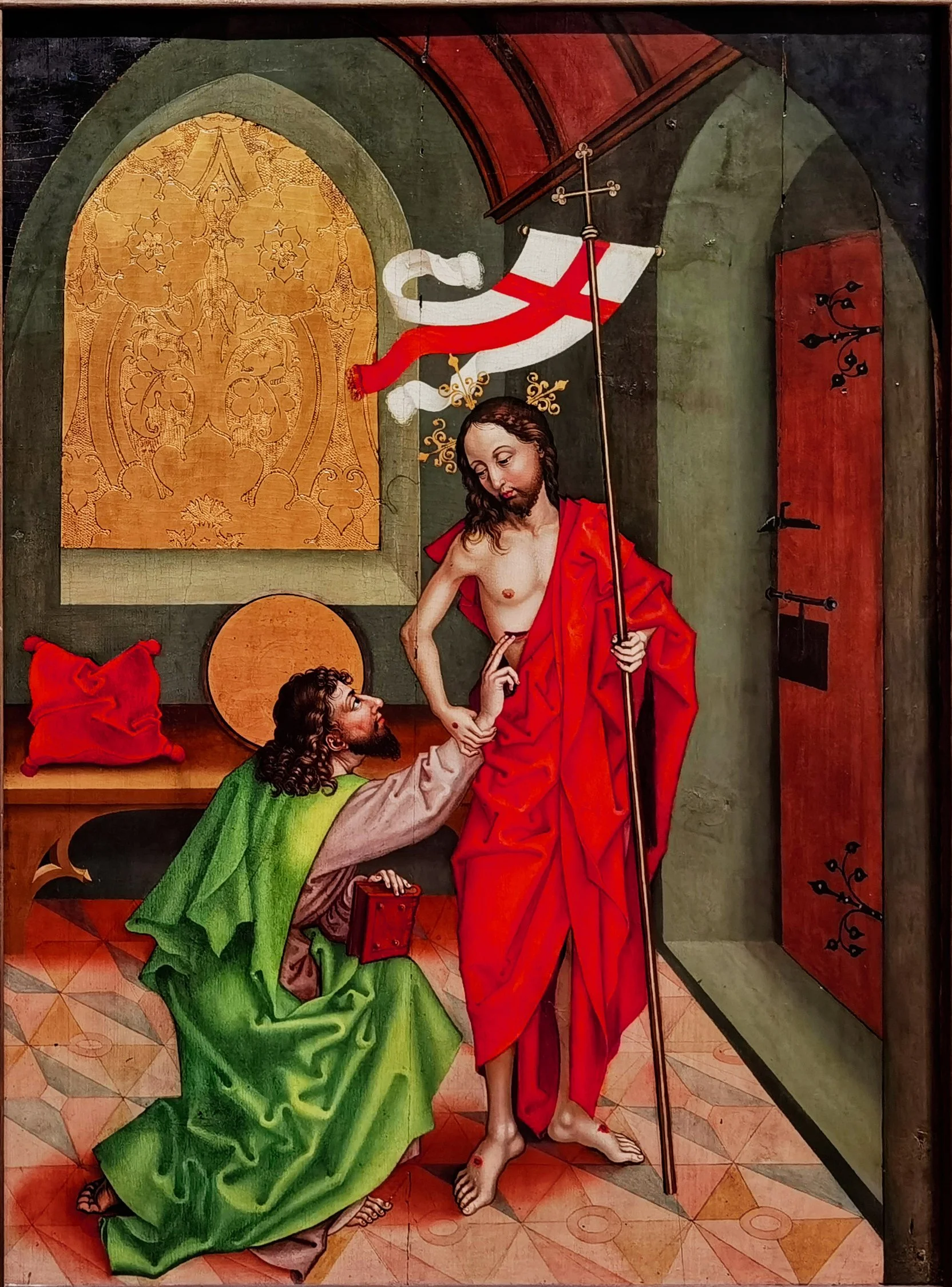
Martin Schongauer and his workshop, Doubting Thomas from the Dominican Altarpiece: Childhood and Passion of Christ, c. 1480, oil on wood panel, Unterlinden Museum, Colmar, France, Wikimedia Commons, licensed under CC BY-SA 4.0 by Txllxt TxllxT
The standard with a red cross held by Christ signals His victory over sin and death, but it also symbolizes His victory over Thomas’ doubt—Christ’s love has defeated Thomas’ doubt and transformed it into a gift of faith. Thomas, in turn, holds a book, symbolizing his future role in spreading the Gospel, for which Christ is even now preparing him. The red pillow on the bench in the background might seem like a random addition at first. However, its vivid red color could symbolize the blood of Christ, meaning that Christ is inviting Thomas to spiritually rest in His five wounds. This new emphasis on contemplating the wounds of Christ makes sense in the context of the devotion to His wounds that became popular in the Middle Ages, especially based on the revelations given to St. Bridget of Sweden in the 14th century.
The Counter-Reformation
The Christian tradition of an incredulous Thomas touching the wounds of Christ continued uncontested until the Protestant Reformation. The Protestant belief in sola fide (faith alone) led some of its adherents to question whether Thomas really touched the side of Christ. After all, the Gospel never said that he did. Admitting that Thomas touched Christ would be equivalent to admitting that works, alongside faith, are necessary for salvation.
During the Counter-Reformation, Catholic artists reinforced the Christian artistic tradition of showing Thomas putting his fingers into the side wound of Christ. The most well-known painting of Doubting Thomas comes from this period: The Incredulity of St. Thomas by Caravaggio. Once seen, the painting is unforgettable, both due to Caravaggio’s distinctive chiaroscuro and the graphic probing of Christ’s wound by Thomas’s right pointer finger. Caravaggio thus adopts a long-standing tradition in sacred art while also placing his personal mark on the scene.
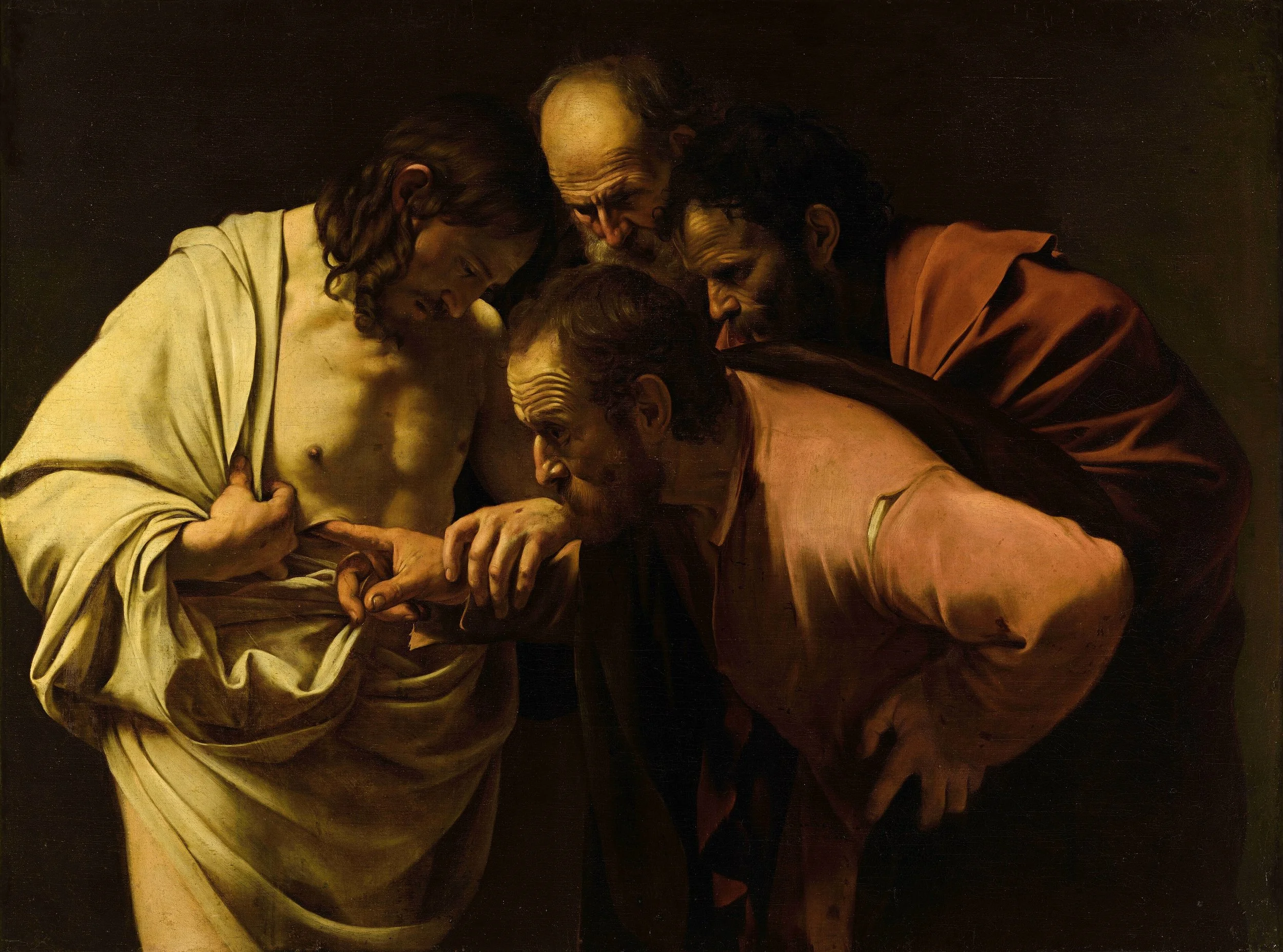
Michelangelo Merisi da Caravaggio, The Incredulity of St. Thomas, c. 1601–1602, Sanssuuci Picture Gallery, Wikimedia Commons, Public Domain
The realistic figures and up-close perspective bring the scene to life with unprecedented intensity and emotion. Jesus and Thomas stand in the foreground, while two apostles—likely St. Peter and St. John the Evangelist—witness the event from behind. Caravaggio dresses Thomas in the torn tunic of a peasant, and close observation reveals the dirtiness of his fingernails. While the unashamed realism of Caravaggio’s paintings sometimes elicited harsh criticism during his time, it ultimately shows how Christ enters into the messiness of ordinary human life and transforms it. The Incredulity of St. Thomas is a prime example of this contact between the human and divine.
In The Incredulity of St. Thomas, Caravaggio masterfully uses chiaroscuro and the arrangement of the figures to place the central focus on Thomas’ finger penetrating the open slit in Christ’s side. Notice the play between light and dark—Thomas emerges from the darkness of the shadows behind him, representing the doubt that he is leaving behind. He steps into the light, which primarily falls on the glorified body of the Risen Christ. Thomas has found the light of faith. The cluster of four heads leads the viewer to look at what they are all beholding with reverent awe. The three heads of the apostles also roughly form a right angle with the horizontal line of Christ and Peter’s hands, framing the main focus of the scene.
The most interesting aspect of Caravaggio’s Incredulity of St. Thomas is that he chooses to portray Jesus’ left hand holding Thomas’s wrist and guiding the finger into the wound. Rather than raise His right arm, Jesus pulls back his garment to reveal His side. As shown earlier by Schongauer’s panel, the artistic tradition had undergone a split between Christ raising His arm and grasping Thomas’ wrist. In the Counter-Reformation period, Caravaggio emphasizes that Christ Himself guided Thomas’ hand. His painting communicates that Christ’s words to Thomas weren’t so much an invitation as a command, which He helped Thomas to fulfill.
Caravaggio's depiction of Doubting Thomas served as a milestone in the Christian artistic tradition. The Incredulity of St. Thomas had a widespread impact on other painters at the time—at least 22 copies were created in the 17th century. For example, Caravaggio and non-Italian followers of his style influenced Matthias Stom, a Dutch painter during the Baroque period. Stom produced two paintings of The Incredulity of Saint Thomas during his residency in Sicily. One of these works is currently housed at the Museo del Prado, and the other at the Baron Scotti collection in Bergamo.
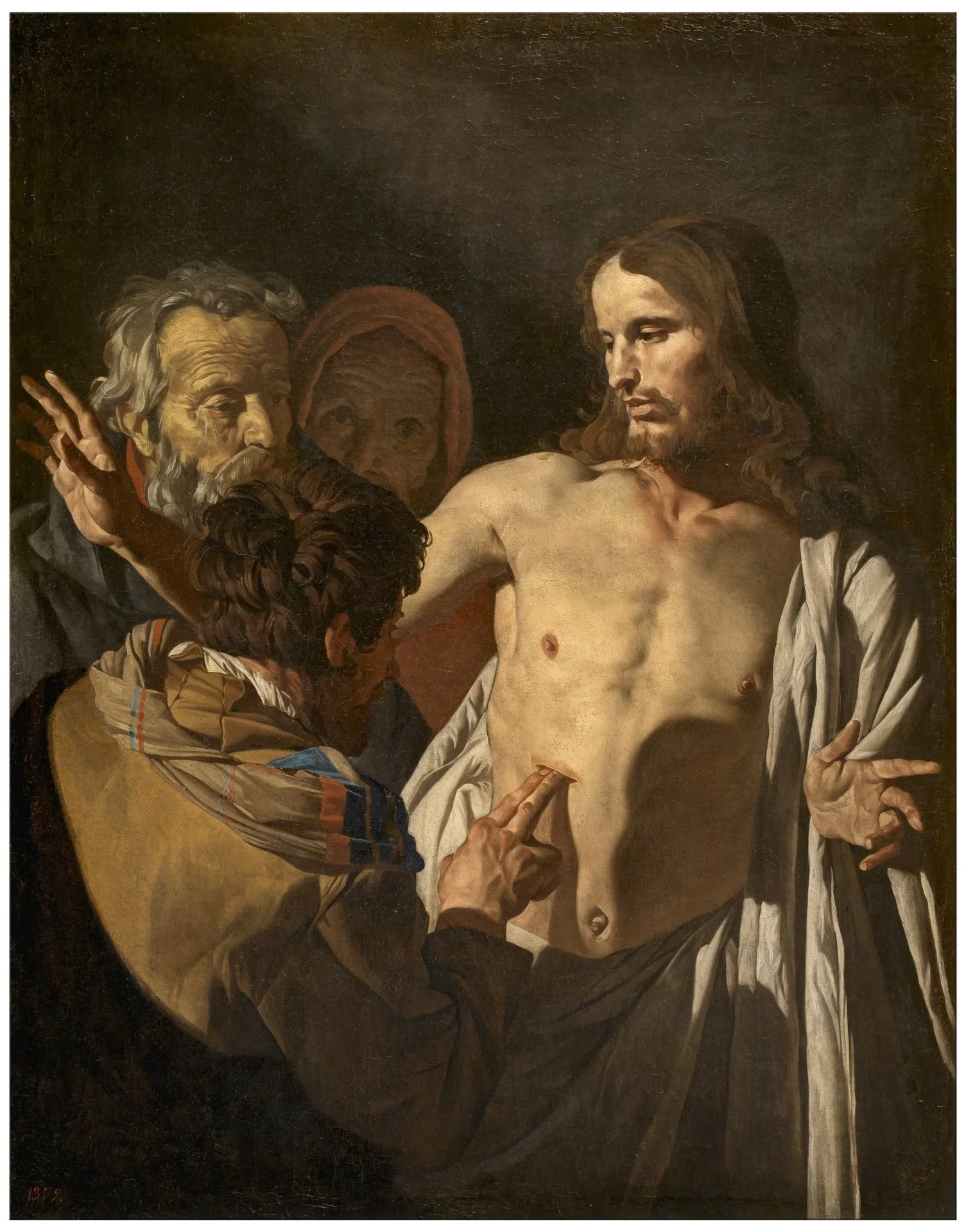
Matthias Stom, The Incredulity of Saint Thomas, 1641-1649, Museo del Prado
In contrast to Caravaggio, Stom places Christ on the viewer’s right, reflecting the arrangement of another painting likely studied by Stom, The Incredulity of Thomas by Hendrick ter Burgghen (the first painting shown in this article). Thomas emerges from the shadows like in Caravaggio’s painting, but in a less dramatic fashion. Stom’s beam of light highlights Christ’s resurrected body, making it the most prominent part of the painting and revealing the influence of a work by Peter Paul Rubens. Stom notably opts for a variant on the older tradition of Christ raising His right arm. In this case, Jesus raises both arms about halfway in the air. He seems set apart from the three apostles, presenting His resurrected body for Thomas to examine on his own. The doubting apostle inserts two fingers into the small slit in Christ’s side—a more closed and neat wound than Caravaggio’s suggestion of depth with a heavy fold of skin.
Without Christ’s bent head and grip on Thomas’ wrist, the encounter may appear to lack the emotion and intimacy suggested by Caravaggio. However, the warmth of the light filtering into the interior space negates any aloofness that might be implied by Christ’s posture. Stom balances the impression of Christ’s divinity with the reality of His love for Thomas—the soft expression on Jesus’ face and the falling light can mean nothing else. Christ does not stand like a cold, marble statue, but in His living and breathing glorified body, which He offers to Thomas as He offered His Body at the Last Supper and on the Cross.
As evidenced by these two examples from the Baroque period, the Christian artistic tradition of Doubting Thomas survived the Protestant Reformation. It also reached new heights in works by artists such as Caravaggio and Stom, who painted up-close and realistic depictions of the Incredulity of St. Thomas.
A Personal Invitation
Sacred art played a crucial role in how the episode of Doubting Thomas was understood throughout the history of Christianity. St. John the Evangelist never clearly stated in John 20 whether Thomas actually touched the side of Christ, yet the vast majority of artwork affirms that this occurred. Is sacred art misleading, then, and the result of an awkward misunderstanding that got passed down through the centuries? Furthermore, does claiming that Thomas had to touch the Risen Christ, and not merely see Him, serve to slight Thomas or mar his reputation as an apostle?
Perhaps the most important takeaway from the Incredulity of Thomas is Jesus’ final words: “Have you come to believe because you have seen me? Blessed are those who have not seen and have believed.” Faith means that we shouldn’t have to see Jesus to believe in Him. St. Paul accordingly tells us that faith is the “evidence of things not seen” (Hebrews 11:1). Even so, Christ didn’t leave us with nothing. He left us with something that we can see, feel, and even taste: His Body and Blood in the Holy Eucharist. We can see the Eucharist, yet we still have to believe in something that we cannot see: the substance of Christ’s flesh and blood hidden under the appearance of bread and wine. In a mysterious way, we both see and don’t see.
Christ beckons us to touch His wounds physically just as He invited Thomas. The Incredulity of Thomas as portrayed in sacred art has a Eucharistic meaning. Showing Thomas making physical contact with Christ’s side communicates to us that we aren’t just supposed to stand and see Christ’s Body in the Eucharist. We are meant to touch His Precious Body and Blood with our mouths and consume Him. Early Christians who relied on sacred art for catechesis probably had an easier time discerning this deeper meaning, realizing that they, too, could touch the Risen Lord in Holy Communion. They could also believe without seeing the whole person of Christ, but at the same time they could believe by seeing Him in the Eucharist.
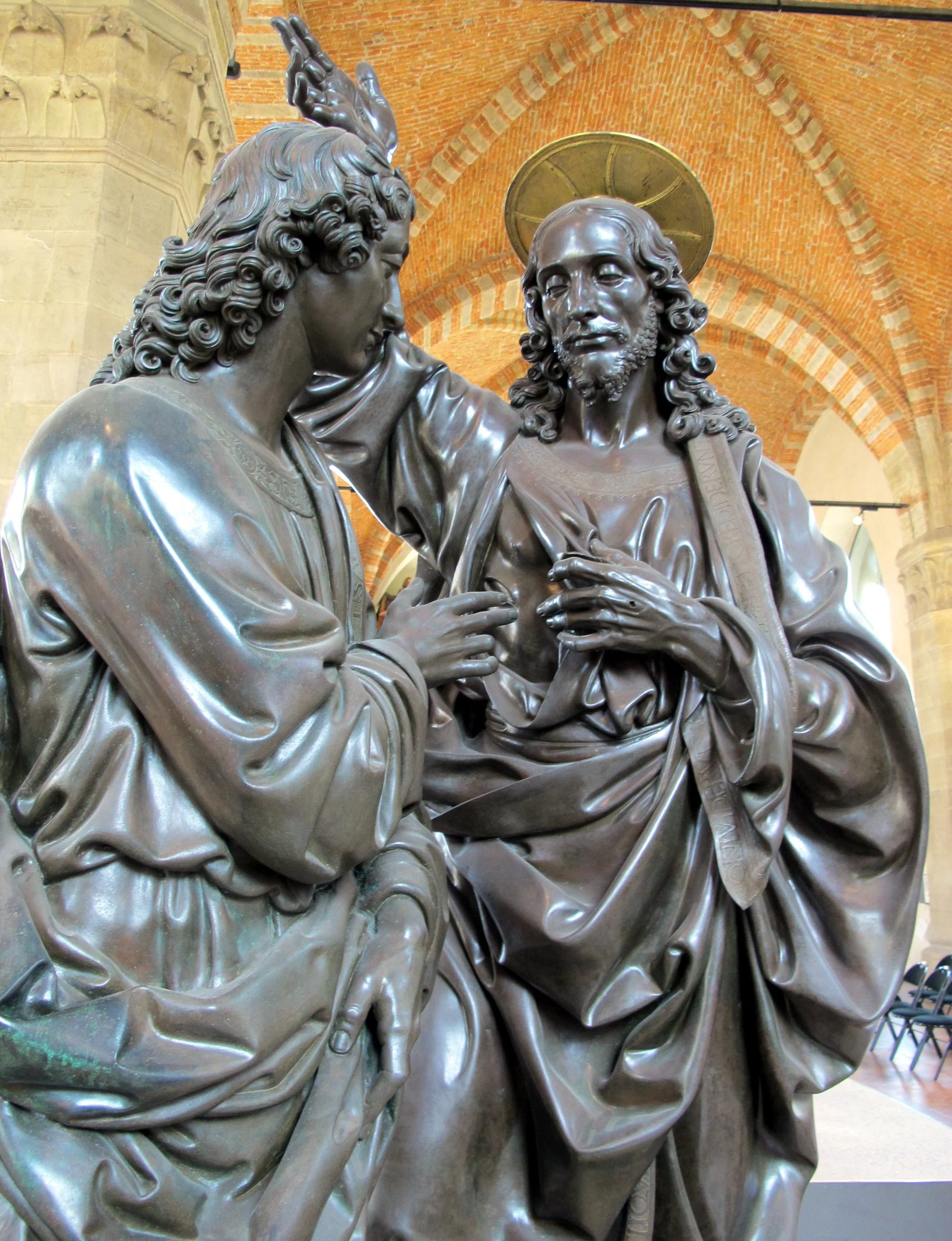


Andrea del Verrocchio, The Incredulity of Saint Thomas, 15th century, Orsanmichele Church and Museum, Florence, Italy, Wikimedia Commons, licensed by Sailko under CC BY-SA 3.0

Christ calls each one of us to also contemplate His wounds spiritually. The bronze statue of The Incredulity of Saint Thomas by Andrea del Verrocchio embodies this personal invitation. We can picture ourselves in the place of St. Thomas, standing next to Christ. Both here and in many other works of Doubting Thomas, Christ seems to say to Thomas through His body language: “Look at what I did for you. Consider these wounds that bled for you and paid the price of your redemption.” The sight of those wounds led Thomas to cry out, “My Lord and my God!” Will we take the time to ponder those wounds like Thomas, so that we may cry out like him?
Throughout the centuries, multiple saints have encouraged devotion to the wounds of Christ, and many of them attained such sanctity precisely because of this devotion. Some of the saints even bore the wounds on their own bodies as stigmatists, such as St. Francis of Assisi, St. Gemma Galgani, and St. Padre Pio. This signals to us that Thomas, although his determination to touch Christ stemmed from doubt, might have got something right. Contemplating the wounds of Christ strengthens our faith and leads us to greater holiness. The tradition of Doubting Thomas in sacred art thus conveys a deeper truth. Jesus’ words to Thomas reveal that He wants us to meditate on His wounds and spiritually enter into them. We should follow the example of St. Bernard of Clairvaux, who said, “I will take from the wounds of my Lord what I lack, for through them mercy flows abundantly.”