
7 Things You Didn’t Know About the Ghent Altarpiece
Hubert and Jan van Eyck’s Ghent Altarpiece stands as a monumental achievement in the history of sacred art. Measuring approximately 11 feet high and 17 feet wide when opened, the Ghent Altarpiece is the largest surviving 15th-century Flemish polyptych, a type of multi-paneled religious painting commonly used as an altarpiece during the Middle Ages and Renaissance.
The Ghent Altarpiece is not just renowned for its gigantic proportions, but also for the oil painting technique that was employed to the point of perfection. Art historians credit Hubert van Eyck with planning the overall structure of the painting, but his brother Jan earns the honor of being responsible for the masterful oil paintings. Inspecting the paintings up close reveals attention to the minutest of details, from the hair on the horses’ manes to the sheen of rich fabrics. Jan van Eyck set a high standard for oil painting, a new technique at the time, that would inspire artists for generations.
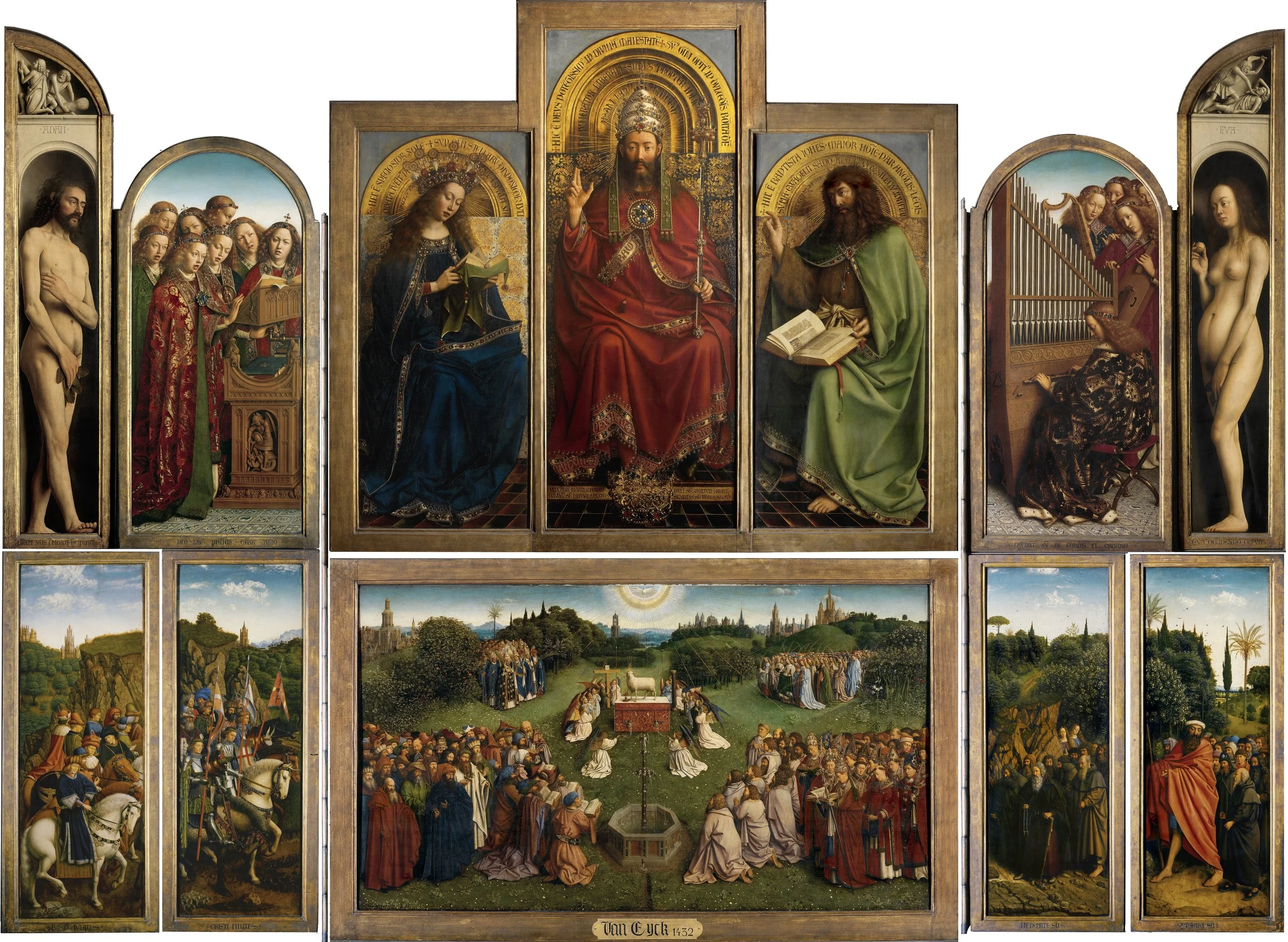
Hubert and Jan van Eyck, Ghent Altarpiece (Open), 1432, Wikimedia Commons, Public Domain
As a work of sacred art, the Ghent Altarpiece served a liturgical function after its completion in 1432. It stood behind an altar in Vijd Chapel, a private chapel in St. Bavo’s Cathedral. The polyptych was typically only opened on Sundays and special feast days. The interior panels depict the adoration of Christ the Lamb by crowds of saints, angels, and martyrs described in Revelation 7 and 22. God the Father sits enthroned above this scene, flanked by the Blessed Virgin Mary and St. John the Baptist on either side. A naked Adam and Eve occupy the outermost panels on the upper right and left.
While the faithful were deprived of these glorious interior paintings during most weekdays, the Ghent Altarpiece nevertheless offered another fine view when closed. The outside panels lack the color and expansive landscape of the inside panels, but they portray one of the most significant events in salvation history (and thus in sacred art): the Annunciation. The donors, the wealthy Ghent merchant and mayor Joos Vijd and his wife Lysbette Borluut, kneel in prayer on the lowest level. The patron saints of St. Bavo’s Cathedral, St. John the Baptist and St. John the Evangelist, stand statuelike in the alcoves between the couple.
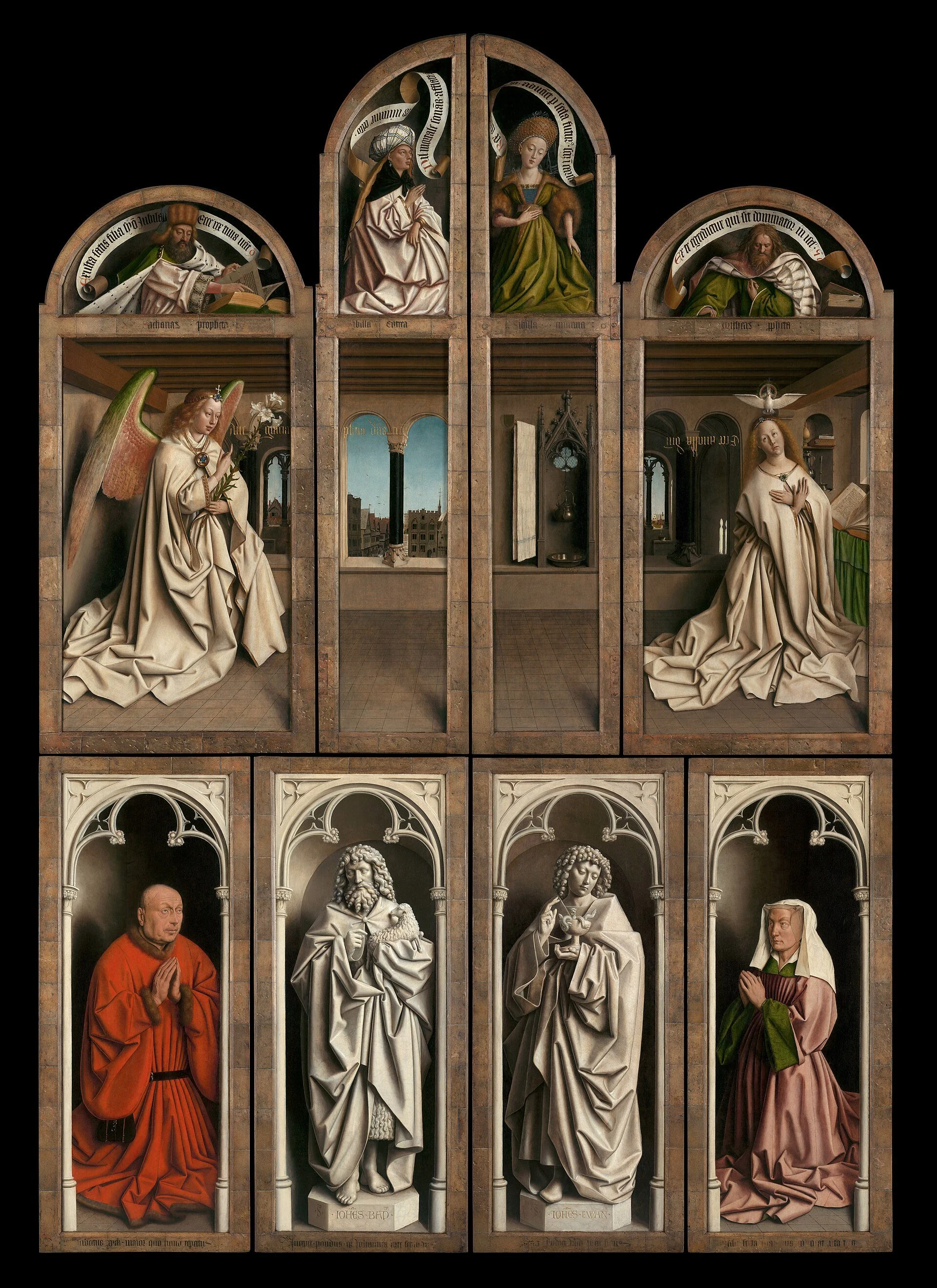
Hubert and Jan van Eyck, Ghent Altarpiece (Closed), 1432, Wikimedia Commons, Public Domain
The unique history and magnificent craftsmanship of the Ghent Altarpiece make it a fascinating example of sacred art from the 15th century. Here are seven things that you may not know about it:
1. The Ghent Altarpiece is the only known work made by Jan van Eyck (1390-1441) for public devotion. The other 20 to 25 paintings attributed to him consist of portraits, such as his famous Arnolfini Portrait, and religious paintings meant for private devotion.
2. The original, ornately decorated frame of the Ghent Altarpiece is missing. In 1556, church officials hid the altarpiece from Calvinist iconoclasts who were destroying sacred art during the Protestant Reformation. The officials detached the frame while taking apart the Ghent Altarpiece in order to store it all temporarily in a safe place. When the Ghent Altarpiece was reinstalled in 1587, no one could find the frame. This unfortunately deprived all subsequent viewers of enjoying the added effects of the original frame, which was considered an important piece of the composition as in the case of other contemporary paintings.
3. One of the original panels of the Ghent Altarpiece is also missing. A local broker reportedly stole the Just Judges panel (bottom left) in April 1934 along with the St. John the Baptist panel. In exchange for an enormous ransom, the second panel was eventually returned by the thief, who later confessed on his deathbed that only he knew the location of the Just Judges panel. However, he did not disclose the location before he died. After extensive investigations and a full X-ray scan of St. Bavo’s Cathedral, the panel remains missing to this day and is rumored to be somewhere in Ghent. A copy made in the 1940s by painter Jef Van der Veken replaces the original in the cathedral.
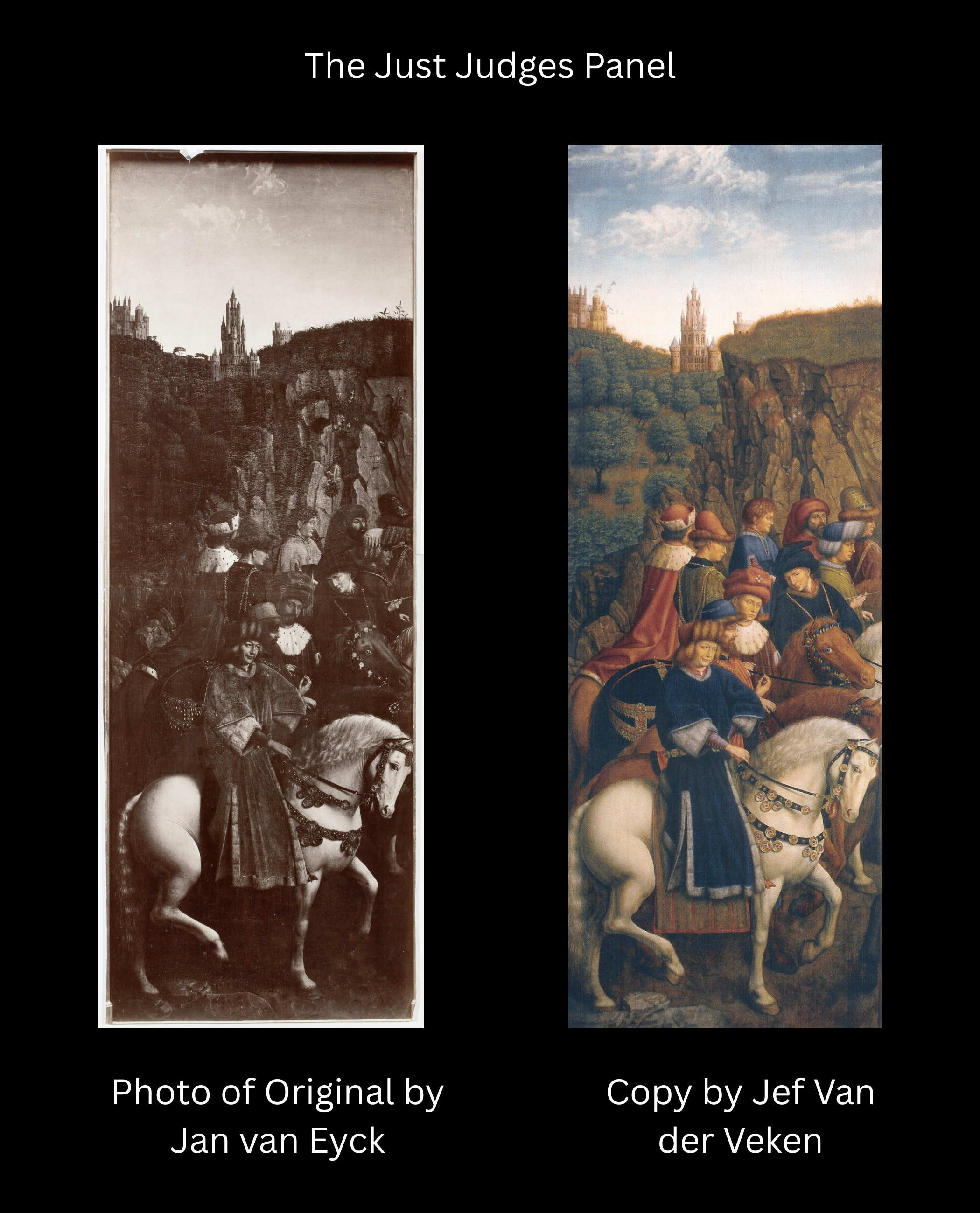
Comparison of the Just Judges Panels, Jan van Eyck and Jef Van der Veken, Ghent Altarpiece (Open), Images from Wikimedia Commons, Public Domain
3. The 1936 heist was only one out of seven major thefts that involved the Ghent Altarpiece, making it the most stolen artwork of all time. This number takes into account the attempt by Calvinists to burn it in 1556. Other notable incidents include Napoleon’s army stealing four panels in 1794 and the Nazis hiding the altarpiece in an Austrian salt mine during World War II.
4. God the Father is not just wearing any crown, but the three-tiered papal tiara called the triregnum. Popes were commonly presented with one or more triregnums from the 12th century until the mid-20th century. The three tiers traditionally signified the pope’s threefold role as father of kings, governor of the world, and vicar of Christ. The threefold symbolism is also associated with the Church Militant, the Church Suffering, and the Church Triumphant. The Ghent Altarpiece depicts God the Father wearing a costly and bejeweled triregnum to represent His absolute divine sovereignty over all of existence. Another crown lays at His feet to specifically indicate God’s authority over the earth.
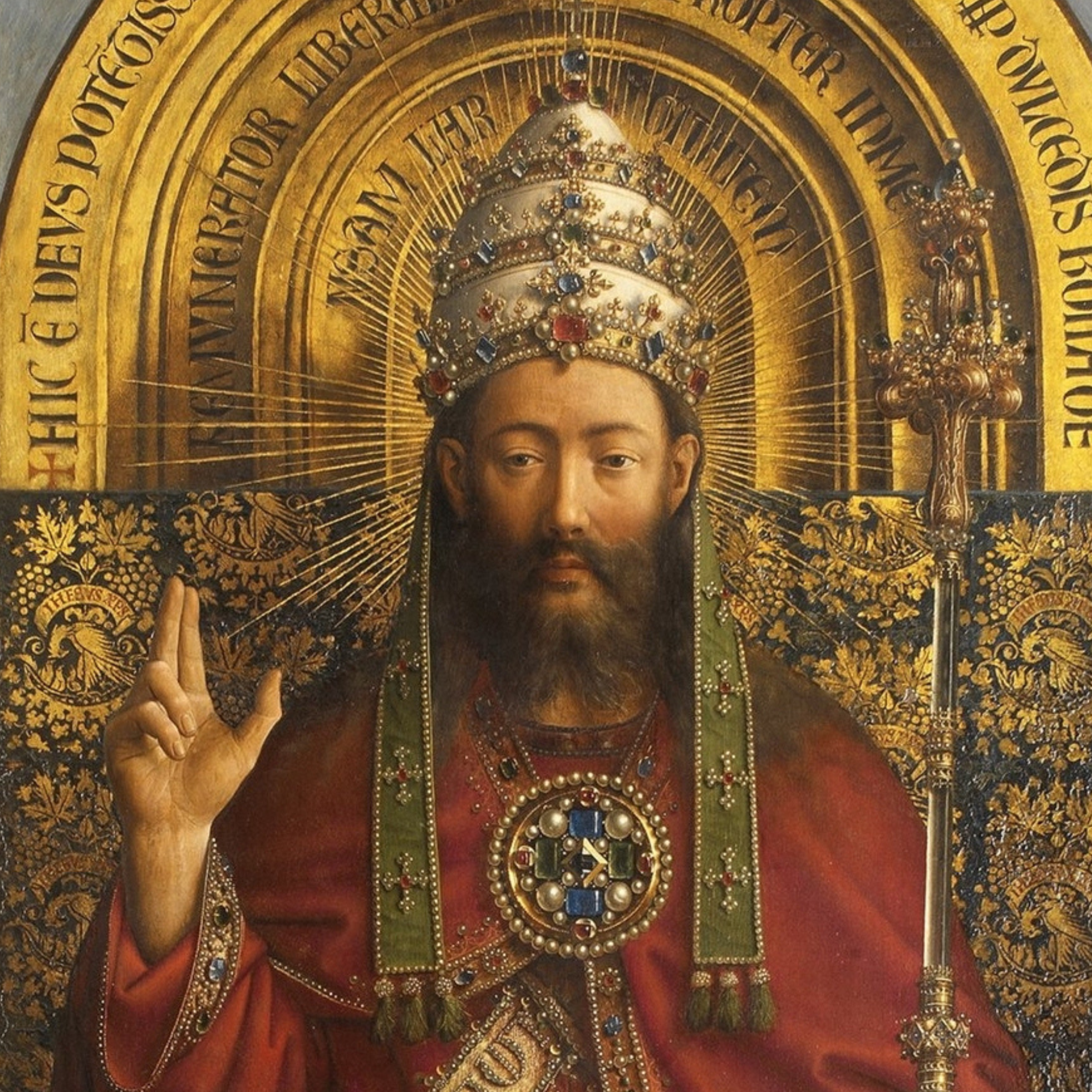
Detail of God the Father's Three-Tiered Crown, Hubert and Jan van Eyck, Ghent Altarpiece (Open), 1432, Wikimedia Commons, Public Domain
5. The depictions of Adam and Ede are among the first and most realistic nudes painted in the West since antiquity. Their downcast eyes and the leaves in their hands suggest that the Fall has already occurred. Eve also holds a citrus fruit in her right hand. The lifelike portrayal of the naked human body has been an object of criticism for centuries. When the Holy Roman Emperor Joseph II visited Ghent in 1781, he demanded the removal of the two panels. In the 19th century, the original panels were replaced for a time by paintings of Adam and Eve wearing animal pelts, which are still displayed in St. Bavo’s Cathedral.
6. Mary’s words in the exterior Annunciation panel are upside down and backwards. The Latin words Ecce ancilla D(omi)ni (“Behold the handmaid of the Lord”) are painted in delicate gold lettering to the left of Mary’s face. Their unusual upside-down position, along with Mary’s upturned eyes, imply that Mary is speaking to God rather than to the angel Gabriel.


.jpg)
Detail of Mary’s Words, Hubert and Jan van Eyck, Ghent Altarpiece (Open), 1432, Wikimedia Commons, Public Domain
7. Several significant martyrs make an appearance in the Adoration of the Mystic Lamb. The twelve apostles kneel on the right side of the panel, and a group of male martyrs clothed in burgundy-red garments stand behind them. St. Stephen carries stones within his garment, and St. Livinius holds a pair of tongs gripping a disturbingly realistic tongue. The procession of female martyrs pictured above the male martyrs includes St. Agnes (with a lamb), St. Barbara (with a tower), St. Dorothy (with a basket of flowers and fruit), and St. Ursula (with an arrow).
Famous for both its turbulent history and Jan van Eyck’s groundbreaking accomplishments in oil painting, the Ghent Altarpiece remains as awe-inspiring and splendid as when it was first unveiled in St. Bavo’s Cathedral on May 6, 1432.