
The Religious Paintings of Vincent Van Gogh
Sunflowers, wheat fields, and swirling night skies—these are usually what come to mind when one thinks of Vincent Van Gogh. The majority of his paintings fall outside the category of religious art. However, some analysts argue that much of his artwork contains underlying Christian symbolism and themes. For instance, could The Sower point to anything other than the Parable of the Sower from the Gospel? His paintings of fields and flowers also suggest the existence of a Creator who fashioned such a beautiful world.
Van Gogh was a Christian, and his religious beliefs influenced his work throughout his artistic career, culminating with three paintings created in the last year of his life.
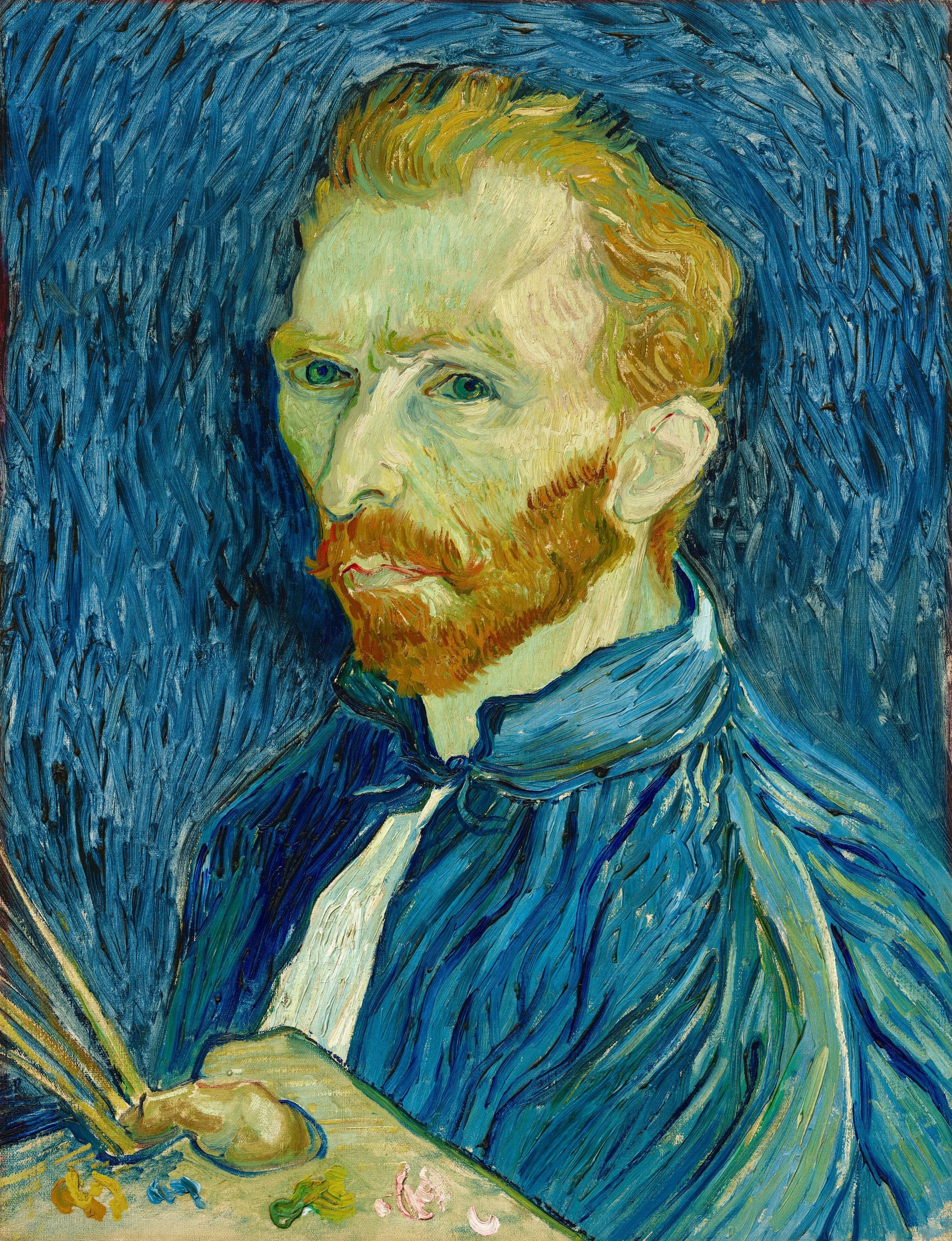
Self-Portrait, Vincent van Gogh, 1889, National Gallery of Art, Washington, D.C., Public Domain.
Roots of Faith
Born in the Netherlands in 1853, Vincent van Gogh was raised in the Dutch Reformed Church, a Protestant offshoot of Calvinism. Both his father and grandfather were ministers, and Van Gogh wanted to follow in their footsteps. As a young adult, Van Gogh rigorously studied for the University of Amsterdam theology entrance exams, which he then failed. Rather than give up his religious pursuits entirely, Van Gogh tried another approach: missionary work.
In 1879, Van Gogh moved to Belgium and lived among impoverished coal miners. He sacrificed his lodgings and gave away most of his possessions to the local population, choosing to partake in their poor standard of living. Religious leaders disliked Van Gogh’s irregular methods of evangelizing and ultimately fired him from the position.
Pursuing Art
Having exhausted two different career paths in the church, Van Gogh turned to art. He had some exposure to the art world as a youth—his mother encouraged him to draw and he had two uncles who were art dealers. Van Gogh had also worked for an art gallery as a teenager and young adult. Finally, his brother Theo became an art dealer with whom he frequently corresponded.
It wasn’t until after his failed attempt at becoming a missionary that Van Gogh pursued his artistic calling in earnest. He produced over 2,000 artworks in ten years, including over 700 oil paintings and 35 self-portraits. Van Gogh’s work was not widely appreciated during his lifetime, but he is now recognized as one of the greatest Post-Impressionist painters.
A Man of Faith
Van Gogh’s Christian faith survived his tumultuous experience with the church, but he distanced himself from religious institutions after his failed missionary endeavors. While he sometimes struggled with accepting his faith, Van Gogh evidently incorporated his belief in God into his artwork. He saw the fingerprints of God all over creation. From The Starry Night to Wheat Field with Cypresses, Van Gogh captured the beauty of the natural world and, in doing so, honored the Creator who made it.
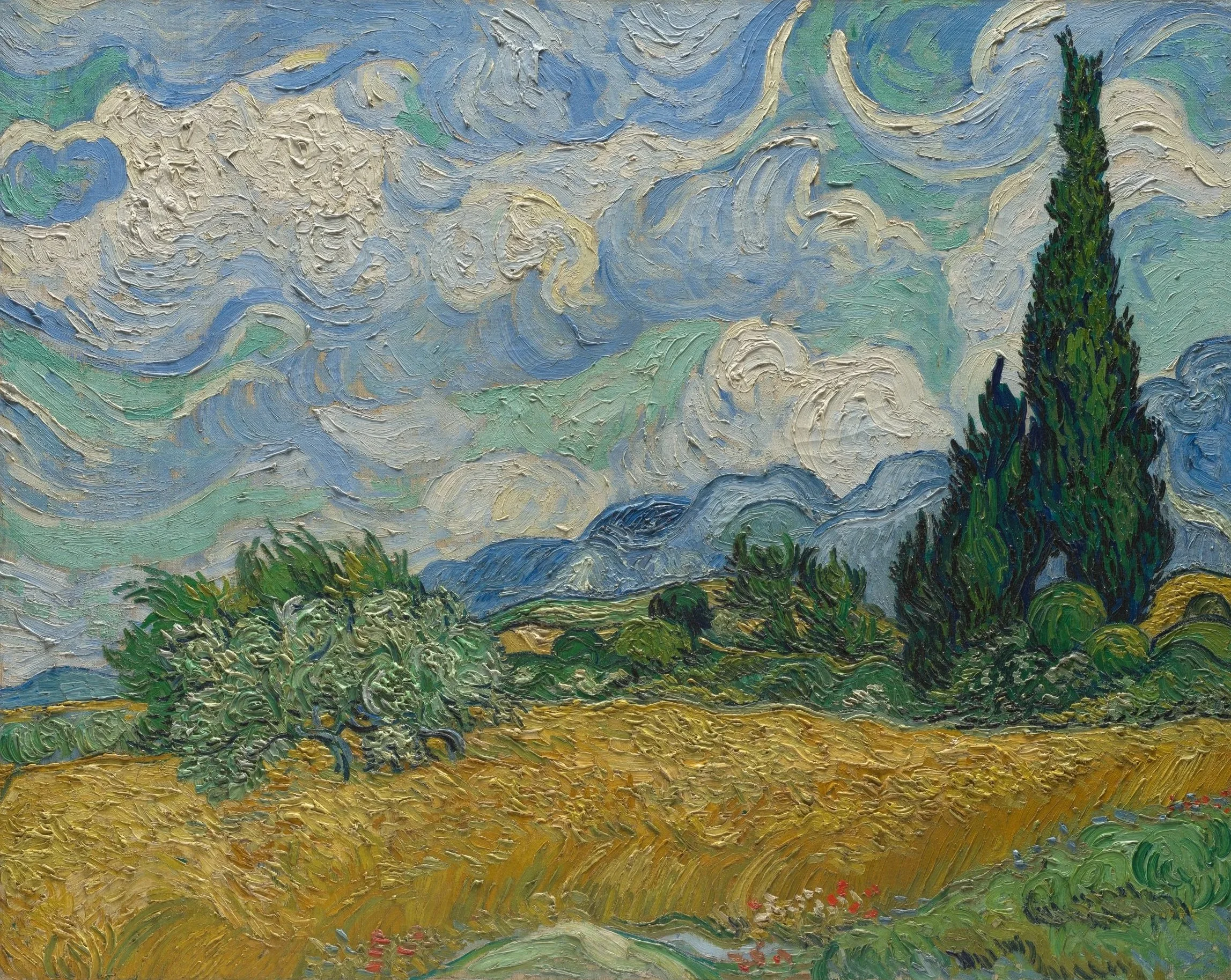
Wheat Field with Cypresses, Vincent van Gogh, 1889, The Metropolitan Museum of Art, Public Domain.
Three Religious Paintings
Artwork aside, Van Gogh also left a tragic legacy of his poor health and apparent suicide. Historians have debated about the exact nature of the mental illness that afflicted Van Gogh during the last two years of his life, citing anything from epilepsy to bipolar disorder. He cut off his ear during a psychotic episode on December 23, 1888 and was hospitalized in Arles.
In May 1889, Van Gogh checked himself into a psychiatric hospital in Saint-Rémy-de-Provence. He made 150 paintings during his year-long stay at the renovated monastery, including three religious paintings: Pietà, The Good Samaritan, and The Raising of Lazarus.
Van Gogh based two of his major religious artworks on paintings by Eugène Delacroix (1798-1863), a French Romantic artist who used vivid colors and greatly inspired the Impressionists. Van Gogh numbered among his admirers, and he particularly liked the way in which Delacroix depicted Christ. In a letter to his friend Émile Henri Bernard, a fellow Post-Impressionist painter, Van Gogh wrote: “Only Delacroix and Rembrandt have painted the face of Christ in such a way that I can feel him.”
Pietà
Van Gogh’s first religious painting based on Delacroix apparently resulted from an accident. In September 1889, Van Gogh related the following to Theo in a letter:
“Thus this time during my illness a misfortune happened to me—that lithograph of Delacroix, the Pietà, with other sheets had fallen into some oil and paint and got spoiled…I was sad about it—then in the meantime I occupied myself painting it, and you’ll see it one day, on a no. 5 or 6 canvas I’ve made a copy of it which I think has feeling.”
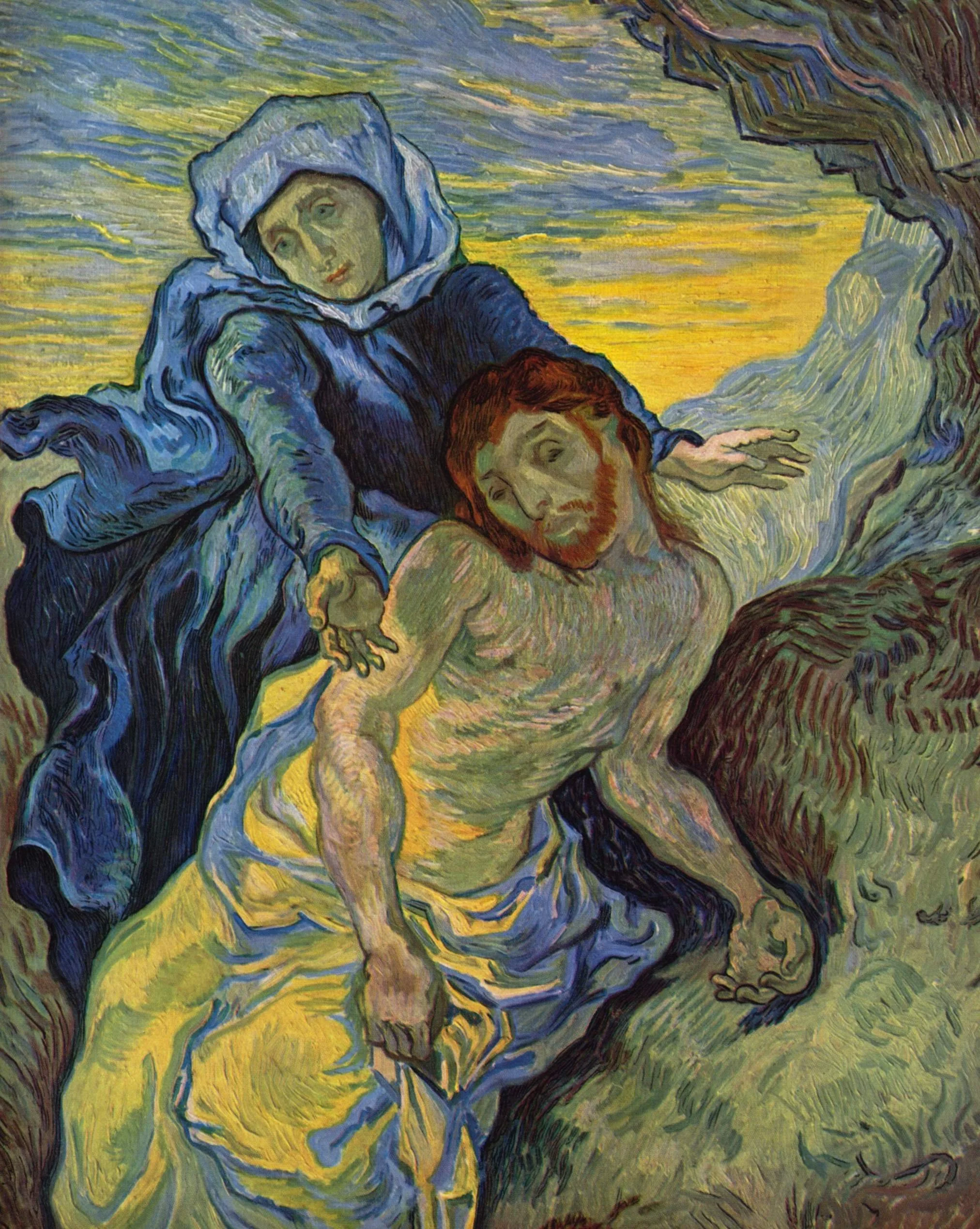
Pietà (after Delacroix), Vincent van Gogh, September 1889, Van Gogh Museum, Wikimedia Commons, Public Domain.
Van Gogh transformed his mistake into a masterpiece. His Pietà is a mirror image of Delacroix’s. Notably, Van Gogh portrays Christ with red hair. Could this be a self-portrait? Maybe Van Gogh identified with Christ, who had undergone such cruel torments and intense suffering. This isn’t a far reach considering the mental trials that Van Gogh was experiencing at the time. He may have felt encouraged in knowing that the resurrection awaited Christ and looked forward to a release from his own anguish.
The Good Samaritan
In May 1890, Van Gogh completed The Good Samaritan (after Delacroix) based on the parable from the Gospel of Luke. Van Gogh and Delacroix both depict the moment when the Good Samaritan lifts the ailing man onto his own animal in Luke 10:24.
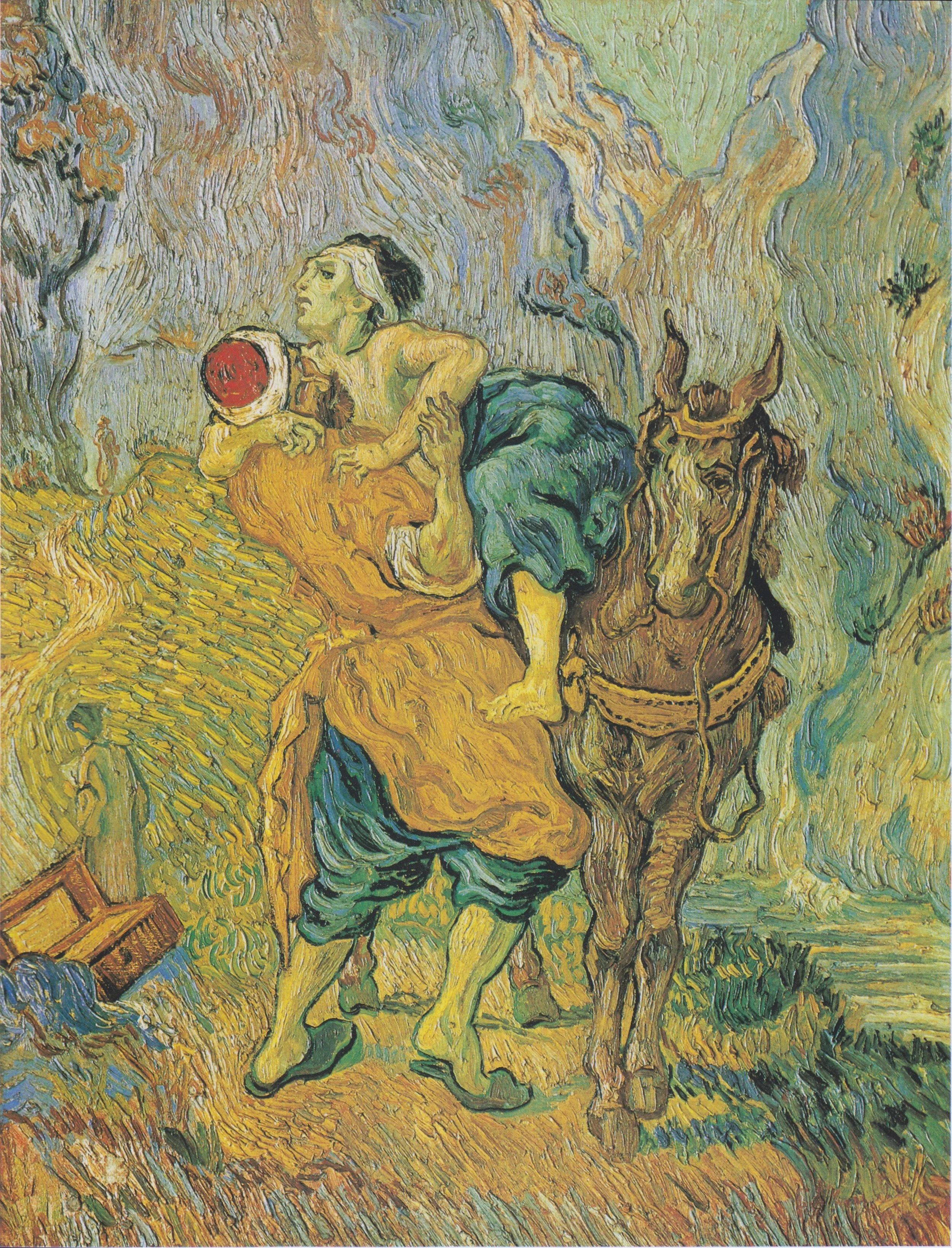
The Good Samaritan (after Delacroix), Vincent van Gogh, May 1890, Kröller-Müller Museum, Wikimedia Commons, Public Domain.
In The Good Samaritan, Van Gogh explores the meaning of suffering and love once again, repeating themes from his Pietà. Like the Pietà, this painting shows two figures that contrast sharply with each other: a healthy individual and one who is limp and helpless. The Good Samaritan exhibits a profound and genuine love shown by caring for a stranger in distress. The painting reflects some thoughts on love that Van Gogh expressed to Theo a decade earlier:
“But without intending it, I’m always inclined to believe that the best way of knowing God is to love a great deal. Love that friend, that person, that thing, whatever you like, you’ll be on the right path to knowing more thoroughly, afterwards; that’s what I say to myself. But you must love with a high, serious intimate sympathy, with a will, with intelligence, and you must always seek to know more thoroughly, better, and more. That leads to God, that leads to unshakeable faith.”
The Raising of Lazarus
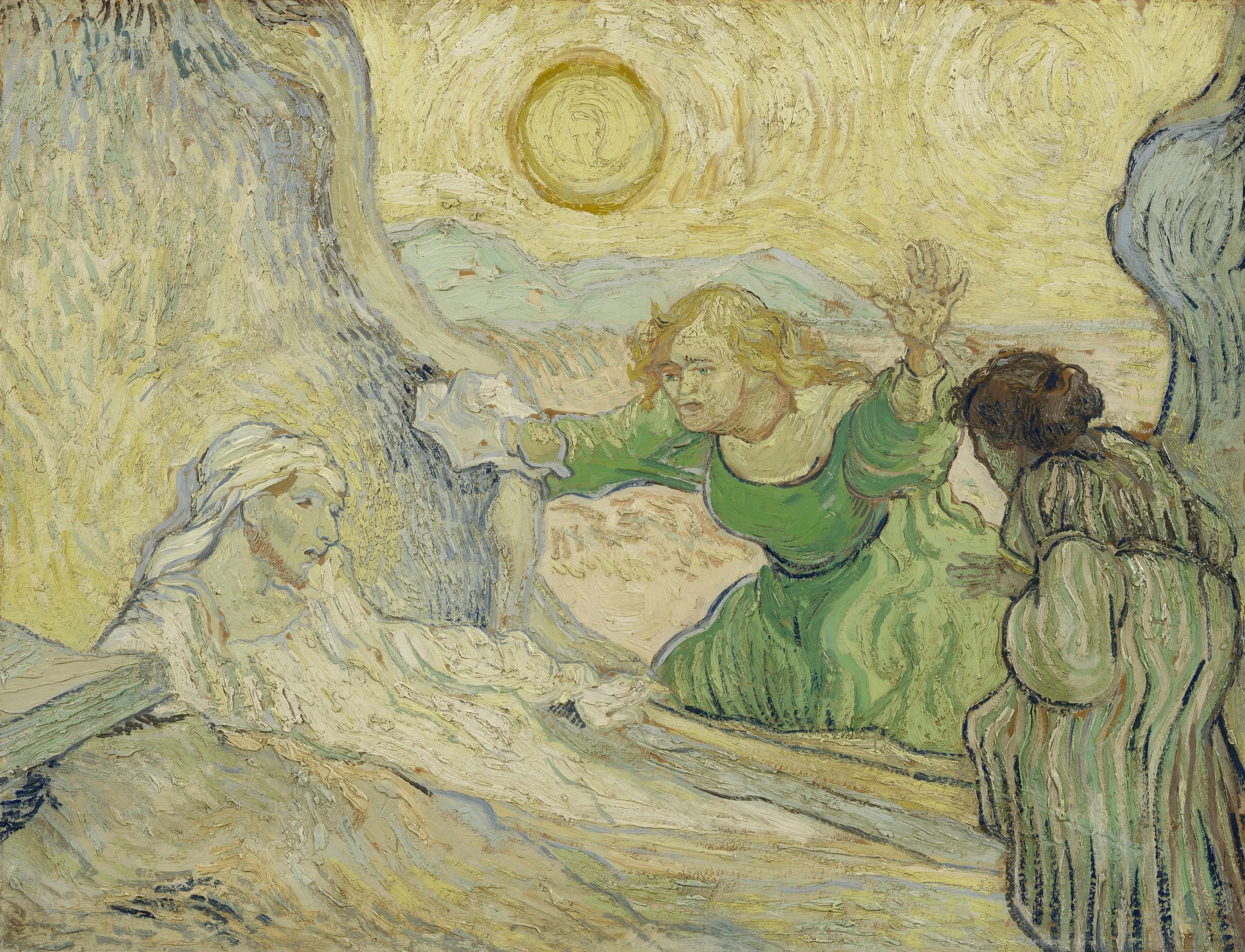
Van Gogh finished another religious painting in May 1890, and this time he copied the work of Rembrandt (1606-1669), a Dutch Golden Age painter who made dozens of biblical scenes. In The Raising of Lazarus, Van Gogh emphasizes the reaction of Lazarus’ sister—either Martha or Mary—by leaving out the figure of Christ, who features prominently in Rembrandt’s rendition.

.jpg)

The Raising of Lazarus (after Rembrandt), Vincent van Gogh, May 1890, Van Gogh Museum, Wikimedia Commons, Public Domain.
_-_s0169V1962_-_Van_Gogh_Museum.jpg)
Van Gogh gives Lazarus red hair just like Jesus in his Pietà, revealing another possible self-portrait. Perhaps the artist desired the sudden and miraculous transition from joy to sorrow for himself. In all three of his religious paintings, Van Gogh seems to communicate a deep-seated desire for transformation and deliverance from his afflictions.
The Artist Greater Than All Artists
Van Gogh’s life ended two months after his stay at Saint-Rémy-de-Provence. Most historians agree that he took his own life at age 37, although some assert that murder remains a possibility until proven otherwise. In any event, it is significant that Van Gogh turned to religious subjects in the last year of his life, searching for meaning and a source of hope. Based on his letters and artwork, Van Gogh remained faithful to his Christian upbringing to the end, despite cutting the ties with an organized church and adopting a personal approach to religion.
One of the greatest proofs of Van Gogh’s persistent faith comes from a letter written two years before his death. In a letter to Emile Bernard, Van Gogh discloses who he thinks is the greatest artist of all time:
“Christ alone, of all the philosophers, magicians, etc., has affirmed eternal life as the most important certainty, the infinity of time, the futility of death, the necessity and purpose of serenity and devotion. He lived serenely, as an artist greater than all other artists, scorning marble and clay and paint, working in the living flesh. In other words, this peerless artist, scarcely conceivable with the blunt instrument of our modern, nervous and obtuse brains, made neither statues nor paintings nor books. He maintained in no uncertain terms that he made…living men, immortals.”
Van Gogh couldn’t be a pastor or missionary, but his artistic career to a certain extent reflected the work of the Great Artist, who created the universe and mankind.