
The Seven Sorrows Rosary: The Complete Guide
The Seven Sorrows Rosary is a chaplet dedicated to the sorrows endured by the Blessed Virgin Mary as the Mother of Jesus Christ, the Redeemer of Mankind. Also known as the Servite Rosary, this Catholic prayer involves reflecting on the Seven Sorrows of Mary. The devotion to the Seven Sorrows originated in the thirteenth century, and it has since then become an established part of Catholic tradition. In this article, discover the history and purpose of the Seven Sorrows Rosary, as well as a step-by-step guide on how to pray it.
Contents
What Is the Seven Sorrows Rosary?
Promises of the Seven Sorrows Rosary
Who Should Pray the Seven Sorrows Rosary?
When Should I Pray the Seven Sorrows Rosary?

What Is the Seven Sorrows Rosary?
The Seven Sorrows Rosary is a Catholic chaplet centered on the Seven Sorrows of Mary. It is also known as the Servite Rosary, since it was developed and spread by the Servite Order (or Servants of Mary) beginning in the thirteenth century. It gained further popularity through revelations attributed to St. Bridget of Sweden (1303-1373), in which Our Lady is said to have made seven promises to those who meditate on her sorrows.
In the 1980s, the Marian apparitions at Kibeho brought renewed attention to the Seven Sorrows Rosary. Our Lady of Kibeho encouraged the faithful to pray the chaplet, while also noting that it does not replace the daily recitation of the traditional Rosary.
The Seven Sorrows of Mary
The Seven Sorrows of Mary are major events from the life of Mary that caused her great suffering. They are also known as the Seven Dolors or Dolours, terms deriving from the Latin word meaning “sorrows” or “pains.”
Catholic tradition considers the Seven Sorrows to be the fulfillment of Simeon’s prophecy in the Gospel of Luke. When Joseph and Mary brought the infant Jesus to the Temple in Jerusalem, Simeon told Mary: “And you yourself a sword will pierce” (Luke 2:35). This foreshadowed the grief that she would endure as the Mother of Christ.
In the late fifteenth century, the Seven Sorrows of Mary began appearing in Catholic sacred art. The most famous example from this period is Albrecht Dürer’s Seven Sorrows Altarpiece (c. 1496-1500). Sacred art helped to establish the specific Seven Sorrows in Catholic devotion.

Master of the Half Lengths, Virgin of the Seven Sorrows, late 16th century, Museu Nacional d'Art de Catalunya, Wikimedia Commons, Public Domain
The Seven Sorrows of Mary:
The Prophecy of Simeon (Luke 2:34-35)
The Flight into Egypt (Matthew 2:13-21)
The Loss of Jesus in the Temple: (Luke 2:41-50)
Mary Meets Jesus on the Way to Calvary (Luke 23:27-31)
The Crucifixion of Jesus (John 19:25-30)
Jesus Is Taken Down from the Cross (John 19:38)
The Burial of Jesus (John 19:41-42)
Promises of the Seven Sorrows Rosary
The Seven Sorrows Rosary is often associated with the seven promises attributed to revelations received by St. Bridget of Sweden, a mystic whose spiritual experiences fueled Catholic devotion during the Middle Ages. According to tradition, St. Bridget received promises from the Virgin Mary for those who meditate on her sorrows. Our Lady did not specifically attach these promises to the Seven Sorrows Rosary, but this chaplet can be understood to fulfill her request when prayed with reverence and fidelity. Here are the seven promises given to Our Lady to St. Bridget regarding those who reflect on her sorrows:
1. “I will grant peace to their families.”
2. “They will be enlightened about the divine Mysteries.”
3. “I will console them in their pains and will accompany them in their work.”
4. “I will give them as much as they ask for as long as it does not oppose the adorable will of my divine Son or the sanctification of their souls.”
5. “I will defend them in their spiritual battles with the infernal enemy and I will protect them at every instant of their lives.”
6. “I will visibly help them at the moment of their death—they will see the face of their mother.”
7. “I have obtained this grace from my divine Son, that those who propagate this devotion to my tears and dolors will be taken directly from this earthly life to eternal happiness, since all their sins will be forgiven and my Son will be their eternal consolation and joy.”
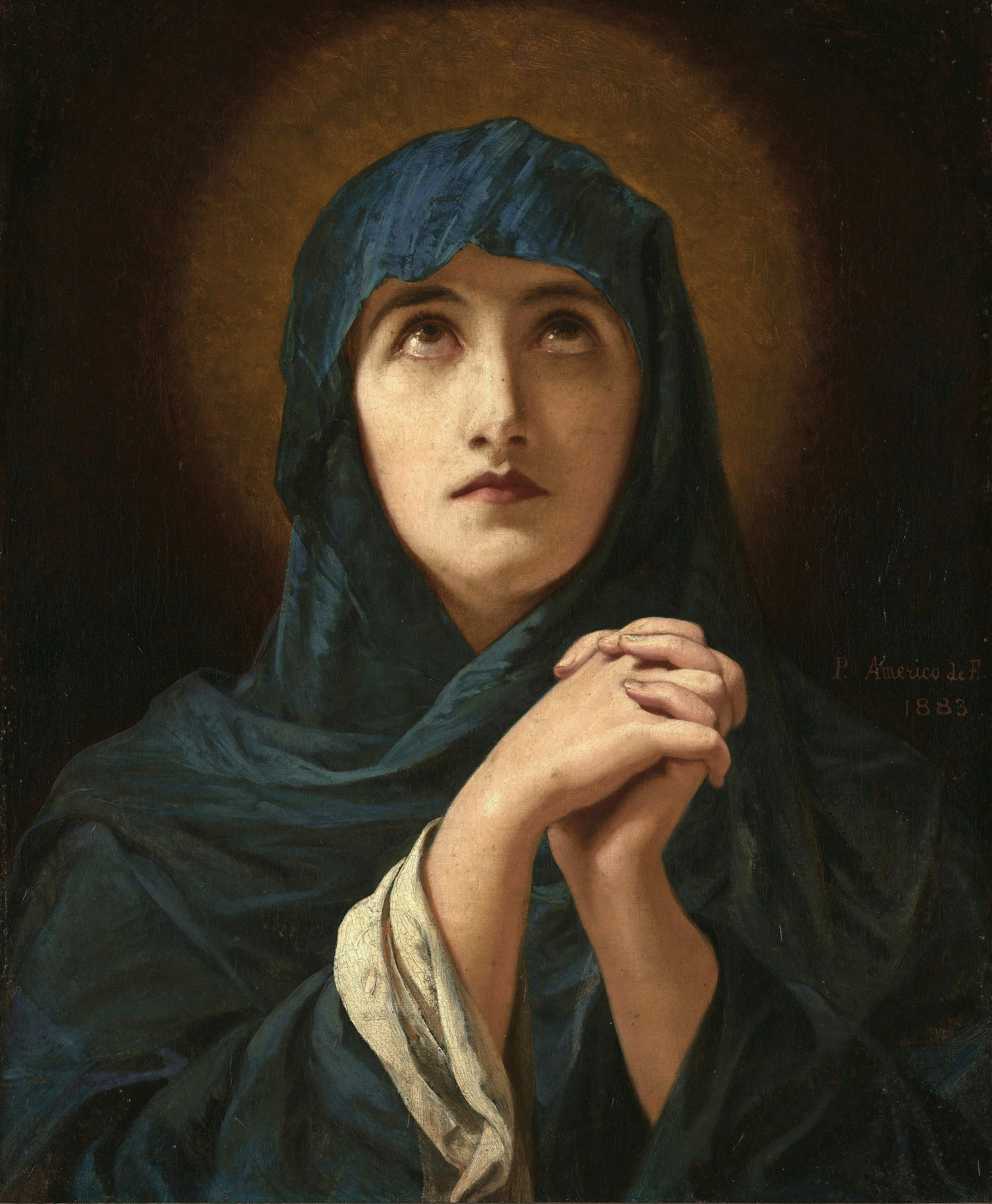
Pedro Américo, Our Lady of Sorrows, 1883, Museu Nacional de Belas Artes, Wikimedia Commons, Public Domain
In more recent times, Our Lady of Kibeho named several fruits of praying the Seven Sorrows Rosary. The Church-approved apparitions in Kibeho, Rwanda, occurred in the 1980s when Mary appeared to three young female visionaries. The apparitions have led to a renewed focus on the chaplet in modern times, and it has especially been championed by Immaculée Ilibagiza, a survivor of the Rwandan genocide. Our Lady of Kibeho said that the following effects come from praying the Seven Sorrows Rosary:
The conversion of the hardest hearts
Freedom from addictions
True repentance
A deeper personal awareness of weaknesses that lead to sin
Who Should Pray the Seven Sorrows Rosary?
The Seven Sorrows Rosary can be prayed by anyone seeking to grow closer to Christ through Marian devotion. While hanging on the Cross, one of Jesus’s last acts was to give us Mary as our Mother (see John 19:26-27). He desires us to look to her as a guide in our spiritual life. By reflecting on the Seven Sorrows of Mary, we enter into her experience as the Mother of the Redeemer. The focus is always on Christ, enabling us to ponder the meaning of suffering alongside Mary within the context of His Passion and death.
For those facing a difficult trial in life, the Seven Sorrows Rosary provides a way to find the strength to carry their cross with love and perseverance. Any kind of suffering often brings feelings of anger, loneliness, sorrow, and even despair. We begin asking questions like “Why me?” or “Does this suffering even have a purpose?” When we meditate on the Seven Sorrows of Mary, we are reminded that our suffering is not meaningless. Mary likely felt profound grief at various moments throughout the life and Passion of her Son, yet it was not for nothing. She chose to participate in the mystery of redemption by remaining united to Christ in faith and love. We can do the same, knowing that God uses all things for good for those who love Him (see Romans 8:28).
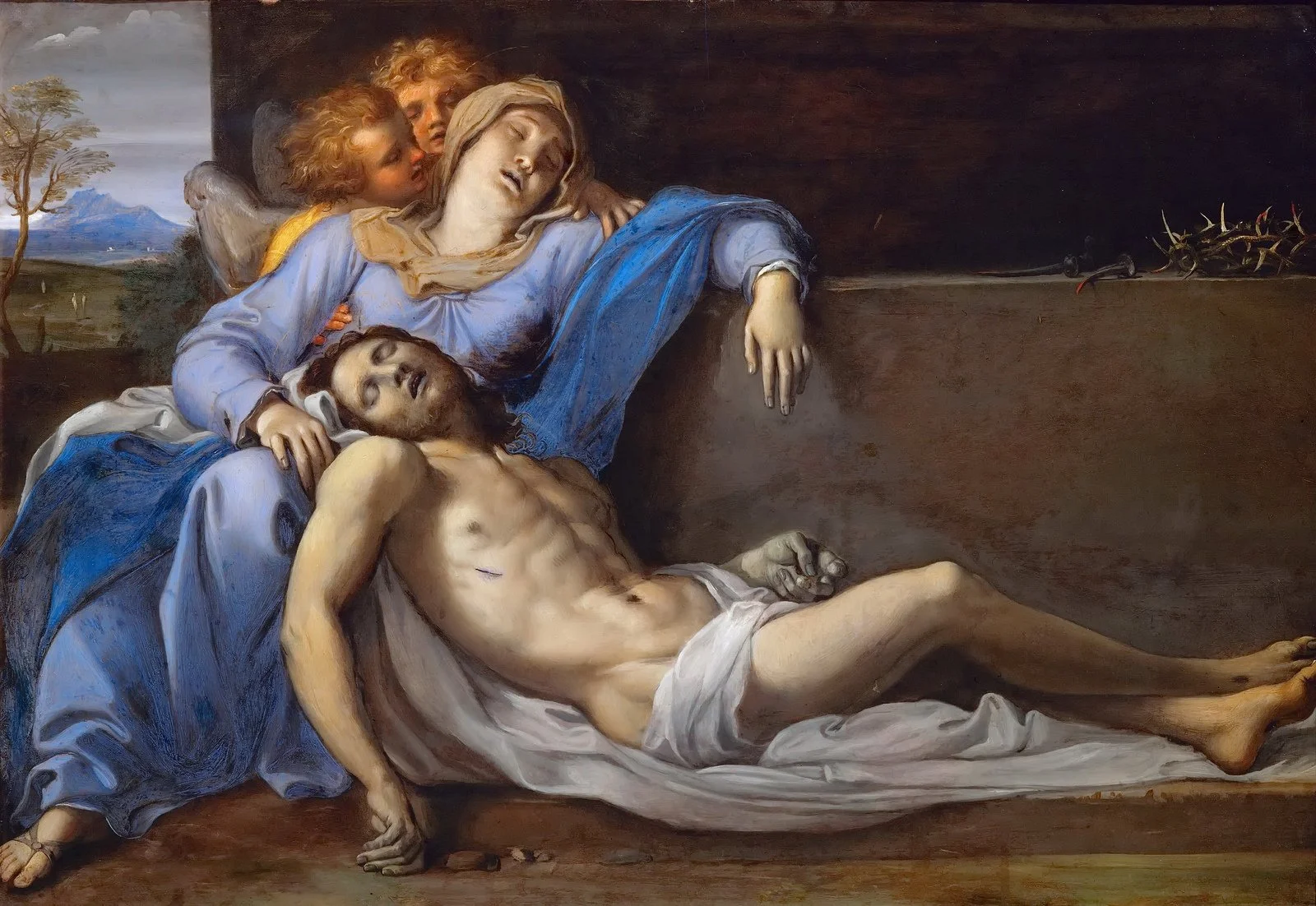
Annibale Carracci, Pietà, c. 1603, Kunsthistorisches Museum Vienna, Wikimedia Commons, Public Domain
The Seven Sorrows Rosary thus reminds us that our suffering can be redemptive and helps us unite it to Christ through prayer. We can ask Mary to intercede for the grace to accept hardship as she did—with perfect humility and trust in God. When we imitate her example, our trial becomes a channel of grace for ourselves and others. Of course, we can also ask God to take away the suffering when He wills. The Seven Sorrows Rosary can also serve as a prayer of petition for relief from whatever is causing us sorrow. Accepting suffering does not mean ceasing to seek for healing.
When Should I Pray the Seven Sorrows Rosary?
The Seven Sorrows Rosary may be prayed at any time, since it offers many spiritual benefits. However, there are a few occasions that may be considered particularly suitable for reciting this chaplet.
Tuesdays and Fridays
According to the messages associated with Our Lady of Kibeho, the faithful were encouraged to pray the Seven Sorrows Rosary on Tuesdays and Fridays.
The month of September
In Catholic devotion, September is dedicated to Our Lady of Sorrows. Her memorial is celebrated on September 15—a fitting date considering the Exaltation of the Cross falls the day before, on September 14.
Periods of intense suffering
The Seven Sorrows Rosary may offer hope and healing to those undergoing a season of life marked by hardship. Whether your trial is physical, mental, emotional, or spiritual, Our Lady desires to help you obtain graces that will strengthen you during the journey, including fortitude and peace.
Lent
Four of the Seven Sorrows of Mary pertain to the Passion and death of Christ, making the Seven Sorrows Rosary a meaningful addition to your Lenten prayer.
How to Pray the Seven Sorrows Rosary
The Seven Sorrows Rosary has a similar structure to the traditional Rosary. It has 52 beads, mainly arranged into seven groups of seven beads each. See below for step-by-step instructions on how to pray the Seven Sorrows Rosary. If you would like a print copy, this guide is also available in The Seven Sorrows Rosary with Sacred Art.
1. Start with the Sign of the Cross.
In the name of the Father, and of the Son, and of the Holy Spirit. Amen.
2. Pray the Introductory Prayer and the Act of Contrition.
My God, I offer You this Rosary for Your glory, so I can honor Your Holy Mother, the Blessed Virgin, so I can share and meditate upon her suffering. I humbly beg You to give me true repentance for all my sins. Give me wisdom and humility, so that I may receive all the indulgences contained in this prayer.
O my God, I am heartily sorry for having offended You, and I detest all my sins because of Your just punishments, but most of all because they offend You, my God, who are all good and deserving of all my love. I firmly resolve with the help of Your grace to sin no more and to avoid the near occasion of sin. Amen.
3. Pray three Hail Marys.
Hail Mary, full of grace, the Lord is with thee; blessed art thou among women, and blessed is the fruit of thy womb, Jesus. Holy Mary, Mother of God, pray for us sinners now and at the hour of our death. Amen.
4. Pray the Most Merciful Mother Prayer.
Most Merciful Mother, remind us always about the Sorrows of your Son, Jesus.
5. Announce the first Sorrow. (Optional: read the accompanying prayer approved by Pope Pius VII.)
The Seven Sorrows of Mary
1. The Prophecy of Simeon (Luke 2:34-35)
Optional prayer: I grieve for you, O Mary, most sorrowful, in the affliction of your tender heart at the prophecy of the holy and aged Simeon. Dear Mother, by your heart so afflicted, obtain for me the virtue of humility and the gift of the holy fear of God.
2. The Flight into Egypt (Matthew 2:13-21)
Optional prayer: I grieve for you, O Mary most sorrowful, in the anguish of your most affectionate heart during the flight into Egypt and your sojourn there. Dear Mother, by your heart so troubled, obtain for me the virtue of generosity, especially toward the poor, and the gift of piety.
3. The Loss of Jesus in the Temple: (Luke 2:41-50)
Optional prayer: I grieve for you, O Mary most sorrowful, in those anxieties which tried your troubled heart at the loss of your dear Jesus. Dear Mother, by your heart so full of anguish, obtain for me the virtue of chastity and the gift of knowledge.
4. Mary Meets Jesus on the Way to Calvary (Luke 23:27-31)
Optional prayer: I grieve for you, O Mary most sorrowful, in the consternation of your heart at meeting Jesus as He carried His cross. Dear Mother, by your heart so troubled, obtain for me the virtue of patience and the gift of fortitude.
5. The Crucifixion of Jesus (John 19:25-30)
Optional prayer: I grieve for you, O Mary most sorrowful, in the martyrdom which your generous heart endured in standing near Jesus in His agony. Dear Mother, by your afflicted heart, obtain for me the virtue of temperance and the gift of counsel.
6. Jesus Is Taken Down from the Cross (John 19:38)
Optional prayer: I grieve for you, O Mary most sorrowful, in the wounding of your compassionate heart, when the side of Jesus was struck by the lance before His Body was removed from the cross. Dear Mother, by your heart thus transfixed, obtain for me the virtue of fraternal charity and the gift of understanding.
7. The Burial of Jesus (John 19:41-42)
Optional prayer: I grieve for you, O Mary most sorrowful, for the pangs that wrenched your most loving heart at the burial of Jesus. Dear Mother, by your heart sunk in the bitterness of desolation, obtain for me the virtue of diligence and the gift of wisdom.
6. Pray one Our Father and seven Hail Marys while meditating on the first Sorrow.
Our Father, who art in heaven, hallowed be thy name; thy kingdom come; thy will be done on earth as it is in heaven. Give us this day our daily bread; and forgive us our trespasses as we forgive those who trespass against us; and lead us not into temptation, but deliver us from evil. Amen.
7. Say the Most Merciful Mother Prayer.
8. Repeat steps 5-7 for the next six Sorrows.
9. Pray the Concluding Prayer.
Queen of Martyrs, your heart suffered so much. I beg you, by the merits of the tears you shed in these terrible and sorrowful times, to obtain for me and all the sinners of the world the grace of complete sincerity and repentance. Amen.
Mary, who was conceived without sin and who suffered for us, pray for us. (Repeat three times)
10. End with the Sign of the Cross.
Conclusion
The Seven Sorrows Rosary is a beautiful Catholic prayer that centers on the maternal suffering of Mary, the Mother of Jesus Christ. It involves reflecting on the Seven Sorrows of Mary, which cover seven key events from her life found in Scripture. The Seven Sorrows Rosary offers us a way to obtain grace amid the trials of life, enabling us to unite our suffering with that of Jesus and Mary. Our Lady of Sorrows, pray for us.