
August Sacred Artwork of the Month: St. Augustine by Philippe de Champaigne
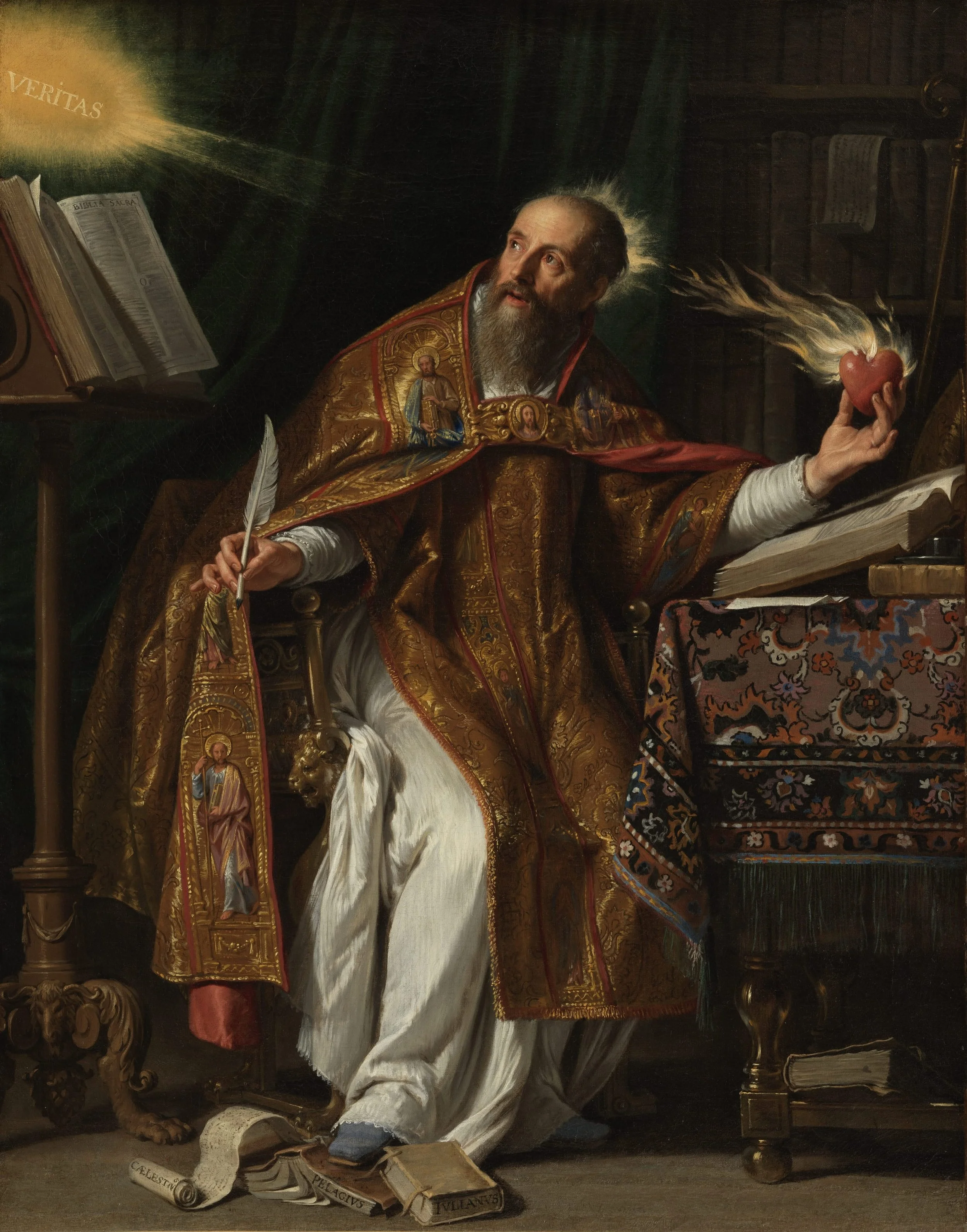
Philippe de Champaigne, Saint Augustine, c. 1645, Los Angeles County Museum of Art, Gift of The Ahmanson Foundation, photo © Museum Associates/LACMA
In the 1640s, the French Baroque artist Philippe de Champaigne (1602-1674) became increasingly involved with Jansenist circles. At the time, he was one of the leading painters of royal portraits and religious subjects in France. Champaigne was heavily influenced by the community at Port-Royal Abbey, a spiritual center of Jansenism that drew heavily upon Augustinian theology. Perhaps it was this connection that led Champaigne to create a magnificent portrait of St. Augustine of Hippo around 1645.
Ironically, Champaigne depicted a saint who had once been deeply immersed in Manichaeism even as he himself was caught up in a heretical movement later condemned by the Church. Separated by more than one thousand years, Manichaeism and Jansenism both promoted ideas that conflicted with Catholic teaching. Pope Innocent X declared five propositions attributed to Jansenism heretical in 1653—about eight years after the completion of this artwork.
Champaigne’s association with Jansenism should not deter us from contemplating his portrait of Augustine. The painting captures the saint’s passionate love for God and relentless search for truth, expressed so eloquently in his Confessions. Reading Augustine’s autobiography is an unforgettable experience, from the spiritually rich prose to its account of his remarkable conversion from Manichaeism to Christianity. Viewing Champaigne’s painting is almost like seeing a visual representation of Confessions, as it conveys how God transformed a sinner into a great saint.
This painting portrays Augustine in his later years, wearing ornate vestments. His attire reflects the dignity of his position as Bishop of Hippo, an office he held from 395 until his death in 430. At the center of his chest hangs a gold pendant featuring the head of Christ. Saints Peter and Paul rest on his shoulders, while images of other saints, likely including the four Evangelists, adorn the rest of the garment.
These embroidered details recall St. Paul’s description of the Church as being “built on the foundation of the apostles and prophets, with Christ Jesus himself as the chief cornerstone” (Ephesians 2:20). Through the imagery and elegance of Augustine’s vestments, Champaigne emphasizes the theologian’s own contribution to the Church’s intellectual and spiritual foundation. Augustine helped strengthen this foundation by defending, explaining, and developing Catholic doctrine.
As viewers of the painting, we have intruded on a moment of intense study and prayer. Augustine is evidently hard at work. His right hand grips a quill, while a half-written page of a thick manuscript lies open on the desk before him. But he has been interrupted. He turns around in his chair, gazing toward a light in the upper left corner. This light contains the word veritas, the Latin word for “truth.” It shines above an open Bible, reminding us of Jesus Christ, the Word of God, who said, “I am the way, the truth, and the life” (John 14:6).
Two rays of this glowing apparition reach out toward Augustine. The light of truth illuminates his mind, as indicated by the flames encircling the back of his head. This calls to mind the tongues of fire that descended upon the disciples on Pentecost. Like the disciples, Augustine was open to the promptings of the Holy Spirit, allowing the Spirit of Truth to inspire and enlighten him. He is often credited with writing a short prayer to the Holy Spirit, which expresses complete trust in and docility toward Him.
In his left hand, Augustine holds a burning heart. The heart forms a diagonal with the illuminated veritas and Augustine’s wonderstruck gaze. Through an encounter with truth, Augustine’s heart has been ignited with a consuming love and desire for God. Truth sparks and feeds these flames. The fire surrounding the heart appears to reach toward the light, directing Augustine toward its divine source. He is drawn toward God.
The spiritual experience shown here recalls a passage from Confessions: “I tasted you, and I feel but hunger and thirst for you. You touched me, and I am set on fire to attain the peace which is yours.” God has awakened a desire within Augustine that only He can satisfy.
It was this deep interior life that enabled Augustine to boldly proclaim the truth and combat heresy. At the bottom of the painting, Champaigne reminds us of Augustine’s role in refuting Pelagianism. The saint’s right foot rests on three manuscripts. The first is a scroll attributed to Caelestius, a follower of Pelagius. The second is a book authored by Pelagius himself, who taught that individuals are born without original sin and could achieve moral perfection through their own efforts. The third is a closed book bearing the name of “Iulianus,” or Julian of Eclanum, an Italian bishop who defended Pelagius and whose views Augustine opposed in his writings.
Philippe de Champaigne’s painting of St. Augustine remains a lasting tribute to this great saint. Through this work of sacred art, Champaigne captures Augustine’s spirituality and points us toward the only place where the human heart can find an answer to its deepest longings: God Himself. “You have made us for yourself, O Lord, and our heart is restless until it rests in you.” Through the pursuit of truth, Augustine sought God, only to discover that God had been seeking him first. Will we, like Augustine, respond to God’s call and find our rest in Him?