
The Sacred Heart of Jesus in Catholic Art
The Sacred Heart of Jesus is one of the most common devotional images seen in Catholic churches and homes. The apparitions received by St. Margaret Mary Alacoque greatly shaped depictions of the Sacred Heart in Christian art history. However, the history of the devotion itself extends much farther back, finding its roots in the Scriptural account of the lance piercing the side of Christ.
The Pierced Side of Christ
According to longstanding Catholic tradition, the lance that penetrated Christ’s side also pierced His Heart. The Gospel of John states, “But when they came to Jesus and saw that he was already dead, they did not break his legs, but one soldier thrust his lance into his side, and immediately blood and water flowed out” (NABRE, John 19:33-34).
The Sacred Heart of Jesus in art can thus be traced back to early renditions of this scene, such as in an illustration from the Rabbula Gospels, a Syrian illuminated manuscript dating to the year 586.
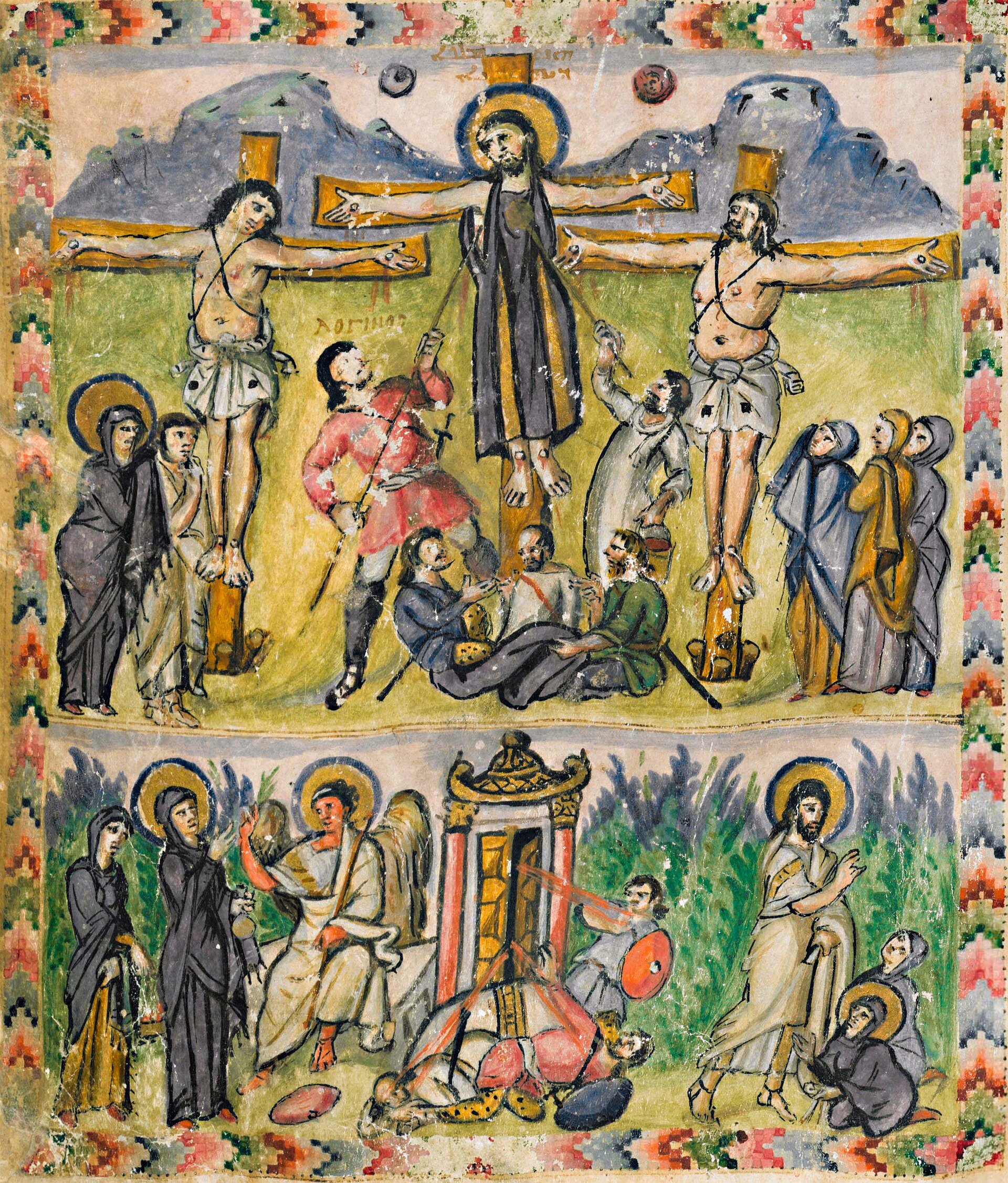
An illustration of the lance piercing Christ’s side from the Rabbula Gospel, 586 AD, Wikimedia Commons, Public Domain.
The Five Wounds
Devotion to the Five Wounds of Christ became more widespread during the Middle Ages. The mystical experiences of St. Bernard of Clairvaux, St. Francis of Assisi, and St. Bridget of Sweden contributed to this development. Increased devotion to the Five Wounds can be seen in paintings of Doubting Thomas, which began to portray Christ Himself directing Thomas’s hand into His side wound.
During the medieval period, the Sacred Heart also started appearing in art as an independent organ alongside Christ’s hand and foot wounds. In a 16th-century illuminated manuscript by Simon Bening, a group of clergy and aristocrats adore the Five Wounds, including a depiction of the pierced Sacred Heart.
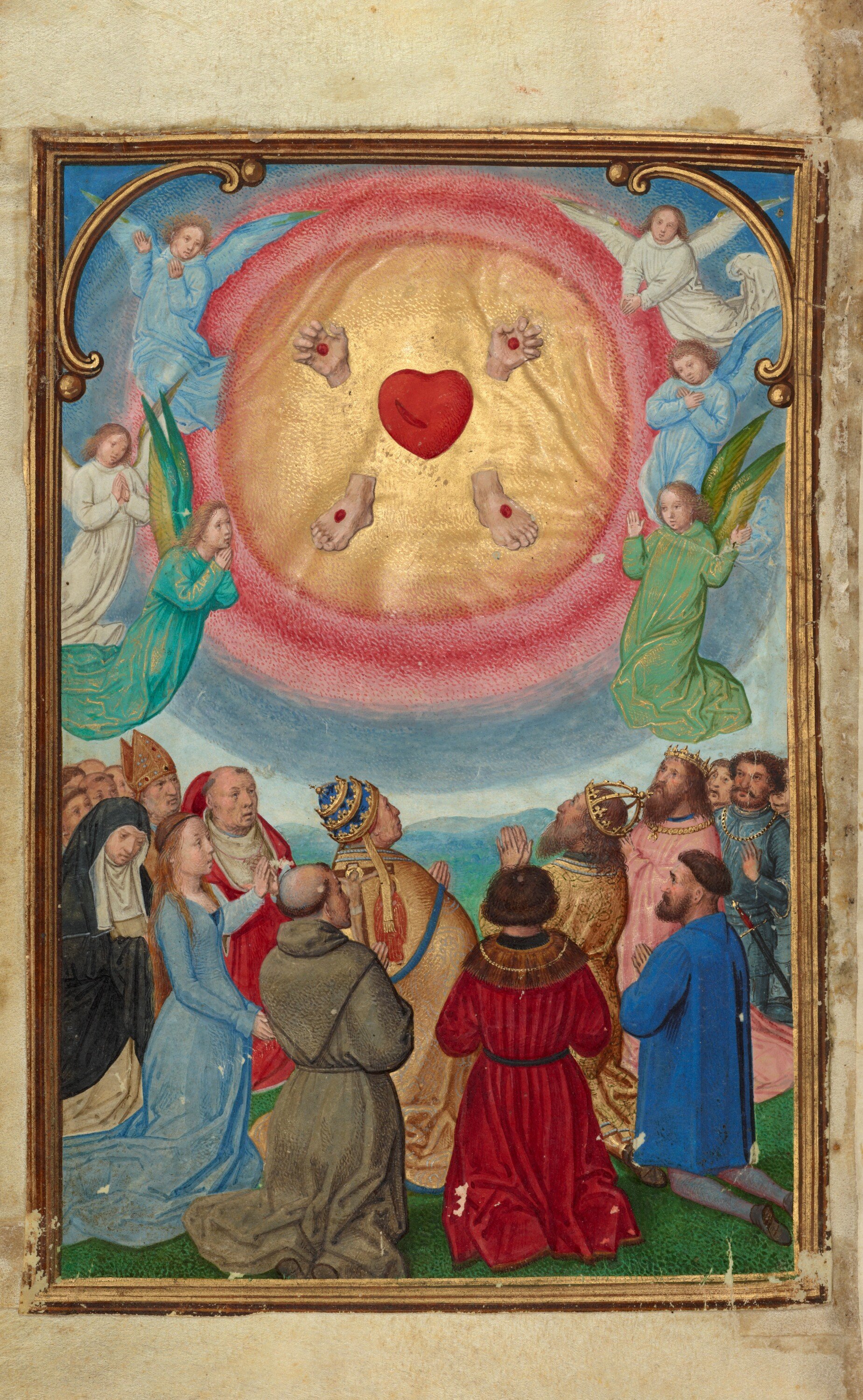
Simon Bening, The Worship of the Five Wounds, c. 1525-1530, J. Paul Getty Museum, Public Domain.
The Apparitions to St. Margaret Mary Alacoque
Between 1673 and 1675, Christ revealed His Sacred Heart in a series of apparitions to St. Margaret Mary Alacoque, a French nun. These apparitions profoundly influenced how the Sacred Heart would later be depicted in art. Margaret Mary described the appearance of the Sacred Heart in the following passage from her autobiography:
“The Divine Heart was presented to me in a throne of flames, more resplendent than a sun, transparent as crystal, with this adorable wound. And it was surrounded with a crown of thorns, signifying the punctures made in it by our sins, and a cross above signifying that from the first instant of His Incarnation, that is to say, from the moment He was conceived in the womb of His Blessed Mother, the Cross was planted in His Heart; and from that time He suffered continually for the love of men.”
Margaret Mary’s visions of the Sacred Heart inspired subsequent paintings, with artists adding the flames, crown of thorns, and cross to their depictions. A painting by an Italian artist, created about a century after the apparitions, shows Margaret Mary contemplating the Sacred Heart with all three of these features.

Corrado Giaquinto, St. Margaret Mary Alacoque Contemplating the Sacred Heart of Jesus, c. 1765, Wikimedia Commons, Public Domain.
Pompeo Batoni’s Sacred Heart
The Italian painter Pompeo Batoni is credited with creating one of the most famous paintings of the Sacred Heart of Jesus. His artwork was installed in the Church of the Gesù, the mother church of the Jesuit order in Rome, in 1767.
This small devotional image depicts Christ holding His Sacred Heart in the palm of His hand and extending It toward the viewer. Jesus is clothed in red and blue robes—the red signifying His humanity and the blue signifying His divinity.
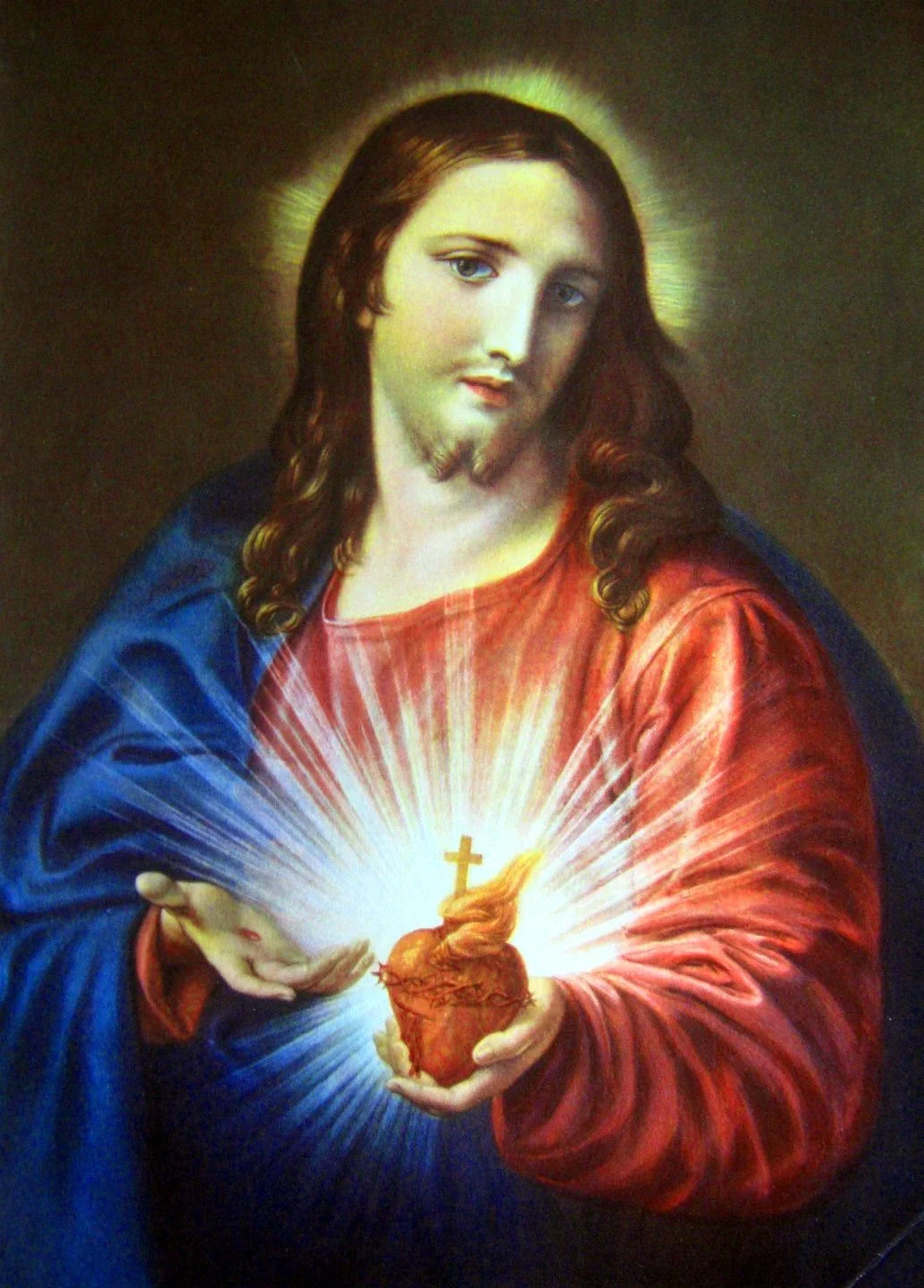
Pompeo Batoni, Sacred Heart of Jesus, 1767, Wikimedia Commons, CC0 1.0.
Batoni’s Sacred Heart became a defining image within the Catholic artistic tradition. According to the Catholic media outlet Aleteia, artists continued drawing upon Batoni’s precedent into the 19th century while also making two notable changes. First, the Sacred Heart shifted from Christ’s hand to His chest. Second, Christ either pulled back His garment to reveal His Heart or pointed toward it. These elements characterize many Sacred Heart paintings today.
The Sacred Heart in Catholic Art
Originally inspired by the piercing of Christ’s side in the Gospel of John, the depiction of the Sacred Heart of Jesus in Catholic art evolved over the centuries. During the Middle Ages, devotion to the Five Wounds contributed to the portrayal of the Sacred Heart as a separate organ. Following the apparitions of Christ to St. Margaret Mary Alacoque, Pompeo Batoni’s Sacred Heart painting played a major role in shaping later artistic representations of the devotion.
The Sacred Heart as a devotional image is meant to deepen meditation on the love of Christ, which burns for every soul. In one revelation to Margaret Mary, Christ said, “Behold this Heart which has so loved men that It spared nothing, even going so far as to exhaust and consume Itself, to prove to them Its love.” Images of the Sacred Heart placed in churches and homes serve as reminders of Christ’s love and an invitation to receive the mercy He desires to pour out upon sinners.
To deepen your devotion to the Sacred Heart, you can find a traditional prayer and downloadable prayer card here.