
June Sacred Artwork of the Month: Saints Peter and Paul by Carlo Crivelli
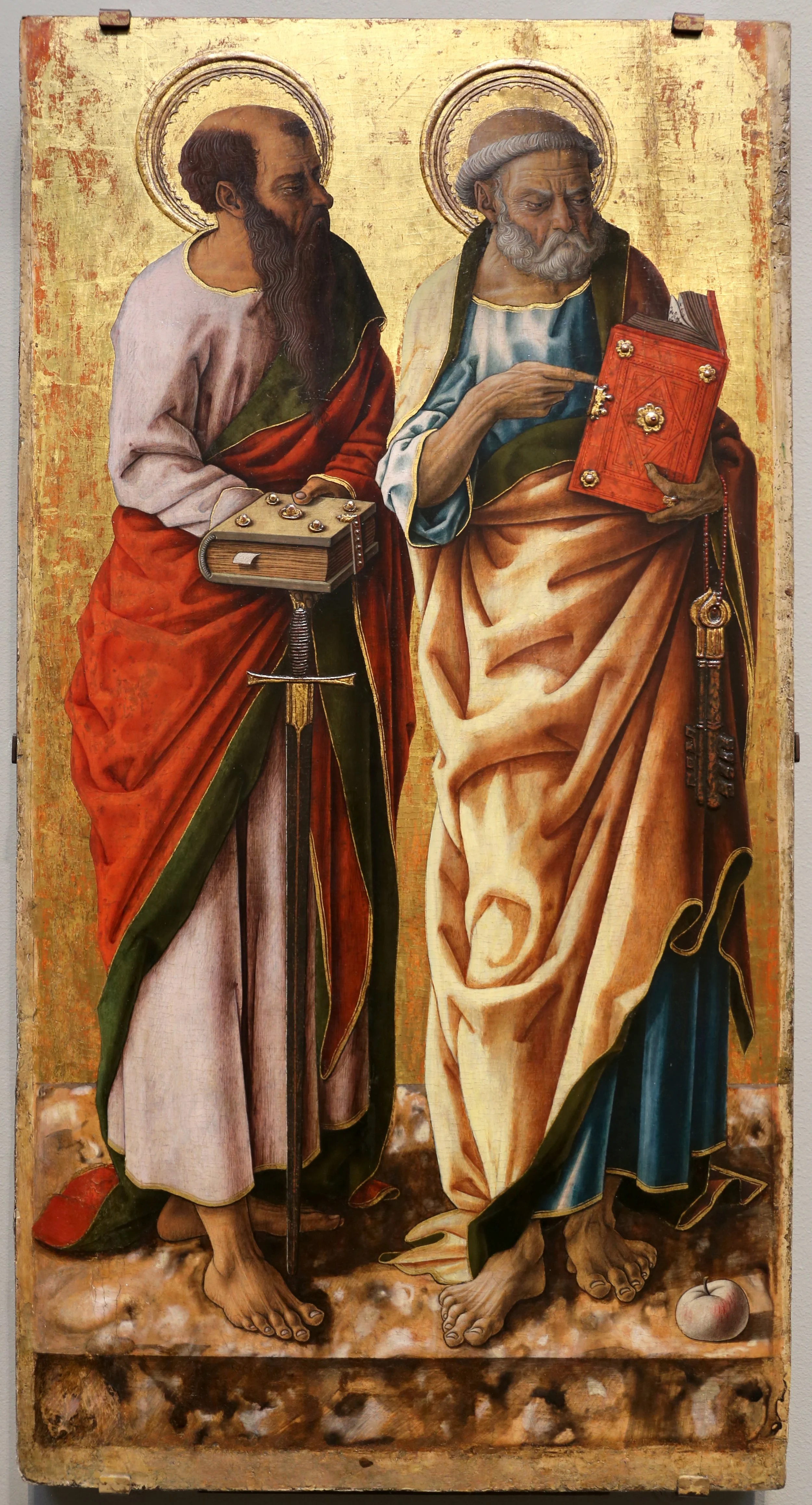
Carlo Crivelli, Saints Peter and Paul, c. 1470s, National Gallery, London, Wikimedia Commons, Public Domain.
Almost two millennia after their deaths, it can be somewhat easy to take Saints Peter and Paul for granted. Yes, St. Peter is remembered as the first pope, and St. Paul for his conversion. Both of them wrote epistles that the faithful still read today. Yet they sometimes seem to fade into the realm of history rather than remain present to us as living intercessors. Catholic sacred art during the Middle Ages and Renaissance frequently depicted Peter and Paul as the pillars of the Church. But how often do we come across artwork of them today, whether on prayer cards or hanging in churches?
The Italian painter Carlo Crivelli created one such work in the 1470s. He portrayed Peter and Paul as part of a polyptych (an altarpiece with multiple panels) for the high altar of a parish church in Fermo, a city on the east coast of Italy. In Crivelli’s Saints Peter and Paul, the pair seems to be discussing a Scripture passage that Peter is pointing at. Paul stands on the left and holds his own book and a sword, the latter representing the means of his martyrdom. On the right, a chain with two keys is looped around Peter’s left wrist, symbolizing his authority as the visible head of the Church on earth.
Crivelli notably depicts Peter and Paul with a certain degree of realism, marking a transition from the medieval tradition to the Renaissance. The gold background and long, flowing figures remain somewhat stylized, but Peter's lined and weathered face suggests the life of a fisherman who spent countless hours beneath the hot sun. His veined hands and gnarled feet complete the picture of an aged man. Paul appears younger by comparison, with a long brown beard and less wrinkled face.
In one sense, Peter’s seniority emphasizes his authority over Paul and the entire Church. Paul’s attentive gaze and deferential posture suggest Peter’s preeminence among the apostles. Painting in the wake of debates over papal supremacy, Crivelli seems to align himself with those who upheld the primacy of Peter and his successors.
However, Crivelli’s representation of Peter and Paul also possesses a deeper meaning. The Italian painter grants them their due as saints through the golden halos and richly colored garments, but he simultaneously portrays them as ordinary men conversing about matters of the faith. His depiction reminds us of what we can easily forget after so many centuries. A danger exists of elevating Peter and Paul to unreachable heights, acknowledging their significant contributions to the Church without approaching them as intercessors and companions on the journey to heaven. Their extraordinary feats sometimes seem to set them apart even from other saints. After all, Peter and Paul are credited with literally laying the foundation of the Church through their writing, preaching, leadership, and even the shedding of their own blood.
Peter and Paul are certainly among the greatest saints in Church history. This is affirmed by the liturgical calendar, which commemorates their feast day as a solemnity on June 29th. But whether due to the passage of time or the almost legendary quality of their achievements, Peter and Paul perhaps receive less attention today than they did in previous eras.
Crivelli’s panel presents a different picture, challenging us to ponder the lives of Peter and Paul once more. Their greatness only derived from grace—at the end of the day, Peter was a fisherman and Paul a tentmaker who heard Christ’s voice and followed Him. What can we learn from their example? How might they intercede for us?