
Why Fra Carnevale’s Annunciation Painting Is Unique
Amid the surge of religious art during the Renaissance, the Annunciation emerged as one of the most frequently depicted scenes in sacred art. A significant contribution of Annunciation artwork occurred during the Early Renaissance in the 15th century, including paintings by Fra Angelico and Leonardo da Vinci.
Many of the Annunciation paintings from the Early Renaissance shared similar compositional elements. One glance at Fra Carnevale’s Annunciation immediately reveals that something is different. While most of his contemporaries portray the Virgin Mary sitting or kneeling within an interior space, in Carnevale’s painting she is standing outside in a street or courtyard.
The aesthetic color palette of the Annunciation also attracts the eye without relying on the use of gold, which other artists commonly employed to indicate the descent of the divine to earth during the moment of the Incarnation. Carnevale opts for a simple yet elegant color palette: brown, blue, white, green, and a distinctive salmon shade of pink.
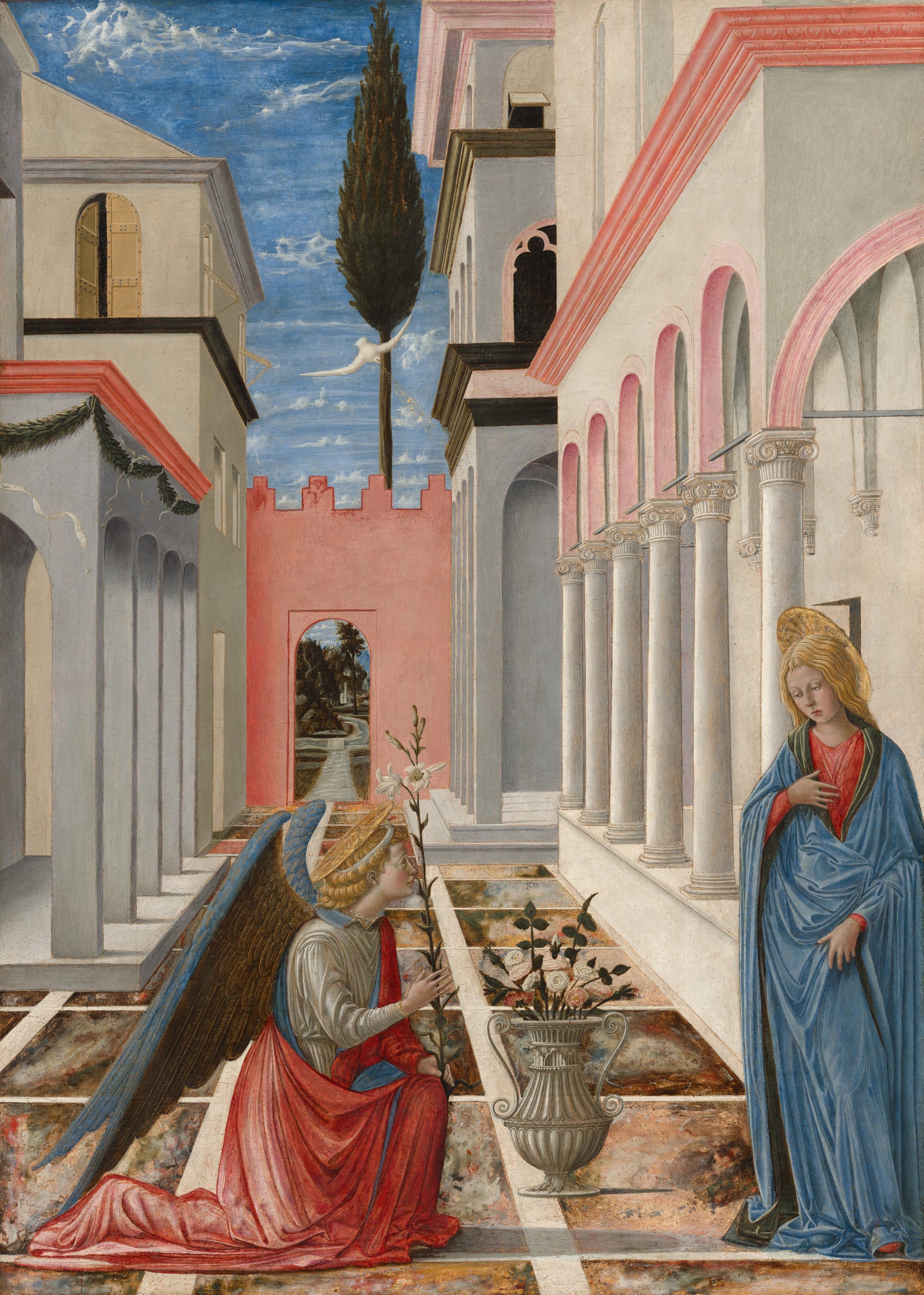
The Annunciation by Fra Carnevale, c. 1445/1450, National Gallery of Art Washington, D.C.
“Brother Lent”
Carnevale was born as Bartolomeo di Giovanni Corradini in the early 1420s. He left his hometown of Urbino, Italy to study art in Florence as a young man, refining his skills in the workshop of the Carmelite friar Fra Filippo Lippi. In 1449, Corradini became a Dominican friar and was subsequently known as Fra Carnevale, which literally translates to “Brother Lent.”
Returning to Urbino around 1450, Carnevale practiced his artistic abilities in local architectural projects and painting commissions. Today, art historians can only attribute nine works to Carnevale, most notably The Birth of the Virgin altarpiece from the Santa Maria della Bella, a small church in Urbino.
Setting the Scene
Carnevale likely painted his Annunciation in Florence between 1445 and 1450. As in his other known artworks, Carnevale uses his architectural knowledge to set the scene. He chooses to paint a street flanked by two buildings, which converge on a narrow-arched opening in a wall. The tall building on the viewer’s right features vaulted archways supported by rounded columns, contrasting nicely with the shorter building resting on squared columns directly across from it.
The classical architectural backdrop chosen by Carnevale varies from the domestic scenes depicted in other Annunciation paintings, setting it apart from its contemporaries. However, Carnevale’s architectural elements advantageously contribute to the tone of the artwork, suggesting an overall sense of order and purity. The slim columns and multistoried buildings soar upward gracefully, bestowing the painting with an air of neatness and serenity. Taken altogether, the composition reflects the interior beauty of Mary, whose soul has never been disturbed or tainted by the stain of Original Sin.
The Virgin and the Angel
The central figures in the Annunciation—the Virgin Mary and angel Gabriel—appear in the foreground. Carnevale borrows their poses from two paintings by his teacher, Fra Filippo Lippi. Carnevale follows his mentor in departing from the traditional depiction of Mary as kneeling or sitting when approached by Gabriel. Other Renaissance versions of the Annunciation also sometimes portrayed Mary as reading Scripture. In Carnevale’s rendition, Mary stands on the right with a bowed head and downcast eyes.
Holding her hand over her heart, Mary’s relaxed but reverent posture bespeaks humility. Mary has said her fiat, since the Holy Spirit—her Divine Spouse—descends with tiny rays of light from above. Now it is possible to identify the look in Gabriel’s eyes. He kneels to Mary’s right, tilting his head to look up at her. His eyes gaze at Mary with a certain tenderness and awe, contemplating this most beautiful among women. She is becoming the Mother of God at this very moment. Finally, Gabriel’s wings nod to the breathtaking majesty of this angelic creature.
A Garden Enclosed
Despite his evident differences, Carnevale incorporates symbols repeated in many Renaissance paintings of the Annunciation. The leading lines of the two parallel buildings draw the viewer’s eye to the archway in the wall. The aperture reveals a path leading into a garden. A simple bridge crosses over a small stream, beyond which lay a rocky outcropping and distant vegetation. The garden motif is completed by a large tree that stands prominently against the azure sky at the top of the painting.
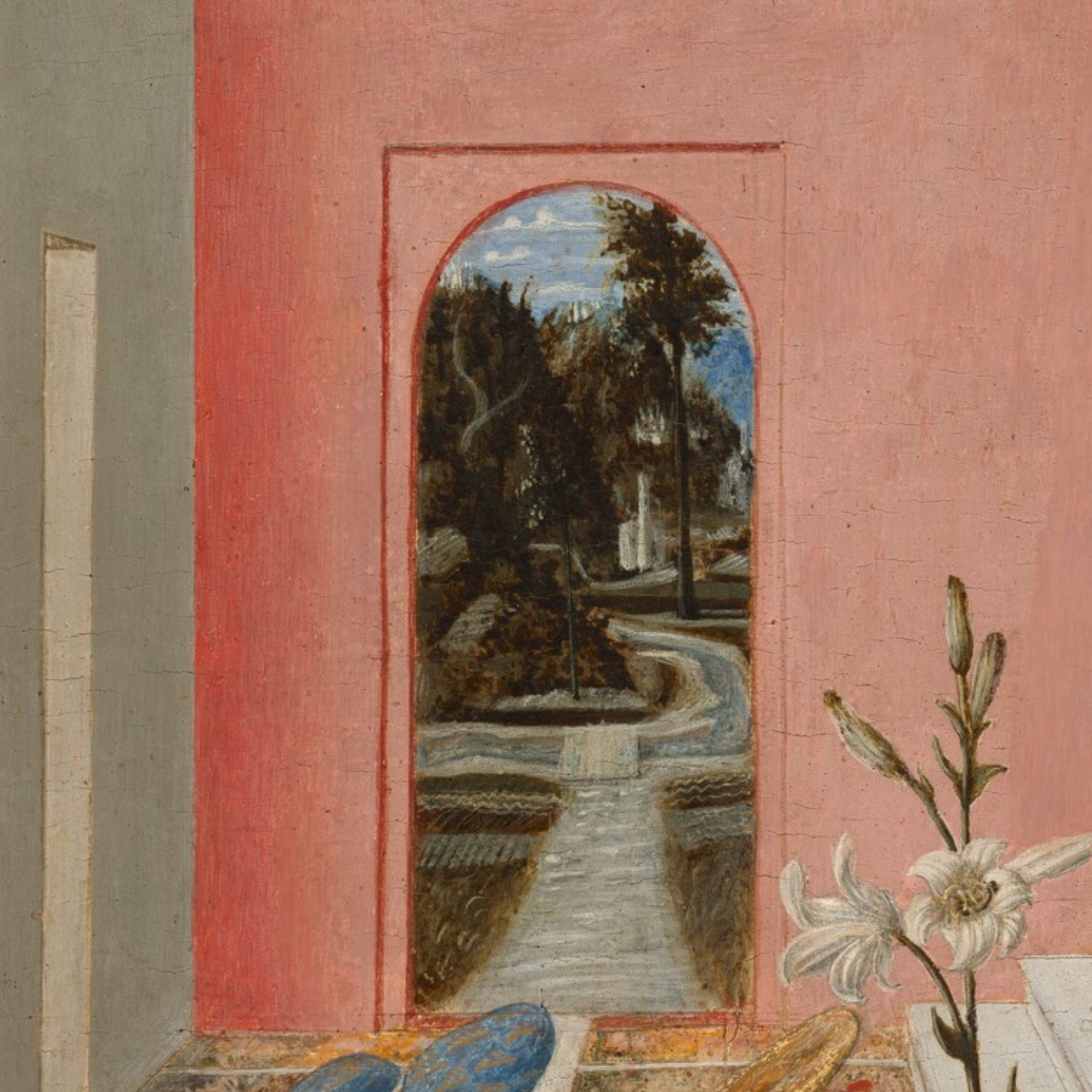
Detail of The Annunciation by Fra Carnevale, c. 1445/1450, National Gallery of Art Washington, D.C.
The garden shown in the Annunciation contains several layers of meaning. First, it attributes a title from Song of Songs 4:12 to Mary: Hortus Conclusus, or “Enclosed Garden.” The preserved isolation of the space by a wall symbolizes Mary’s virginity and purity.
Second, the garden refers back to the Garden of Eden, with the large tree symbolizing the Tree of Life. The Catholic theological tradition identifies both Mary and Jesus as the new Tree of Life for different reasons. In the Annunciation, it is appropriate to consider Mary as the new Tree of Life, since she has agreed to bear the fruit of Jesus Christ in her womb.
Gate of Heaven
Carnevale emphasizes another title of Mary not once, but five times in the Annunciation. The door directly behind Mary’s head stands slightly ajar, as do four windows on the upper stories of the two buildings. These open portals symbolize Mary as the Porta Caeli, or “Gate of Heaven.” Mary’s obedience is the key to unlocking the doors of paradise, which Eve shut through her disobedience. Through Mary a Savior will be born who will reopen these gates once and for all.
In light of this interpretation, the garden in the background may also represent the new Eden—the glorious paradise that now awaits mankind thanks to the sacrifice of Christ on the Cross. Carnevale identifies Mary as the New Eve, foreshadowing the moment when she will participate in the redemptive act of her Son, the New Adam.
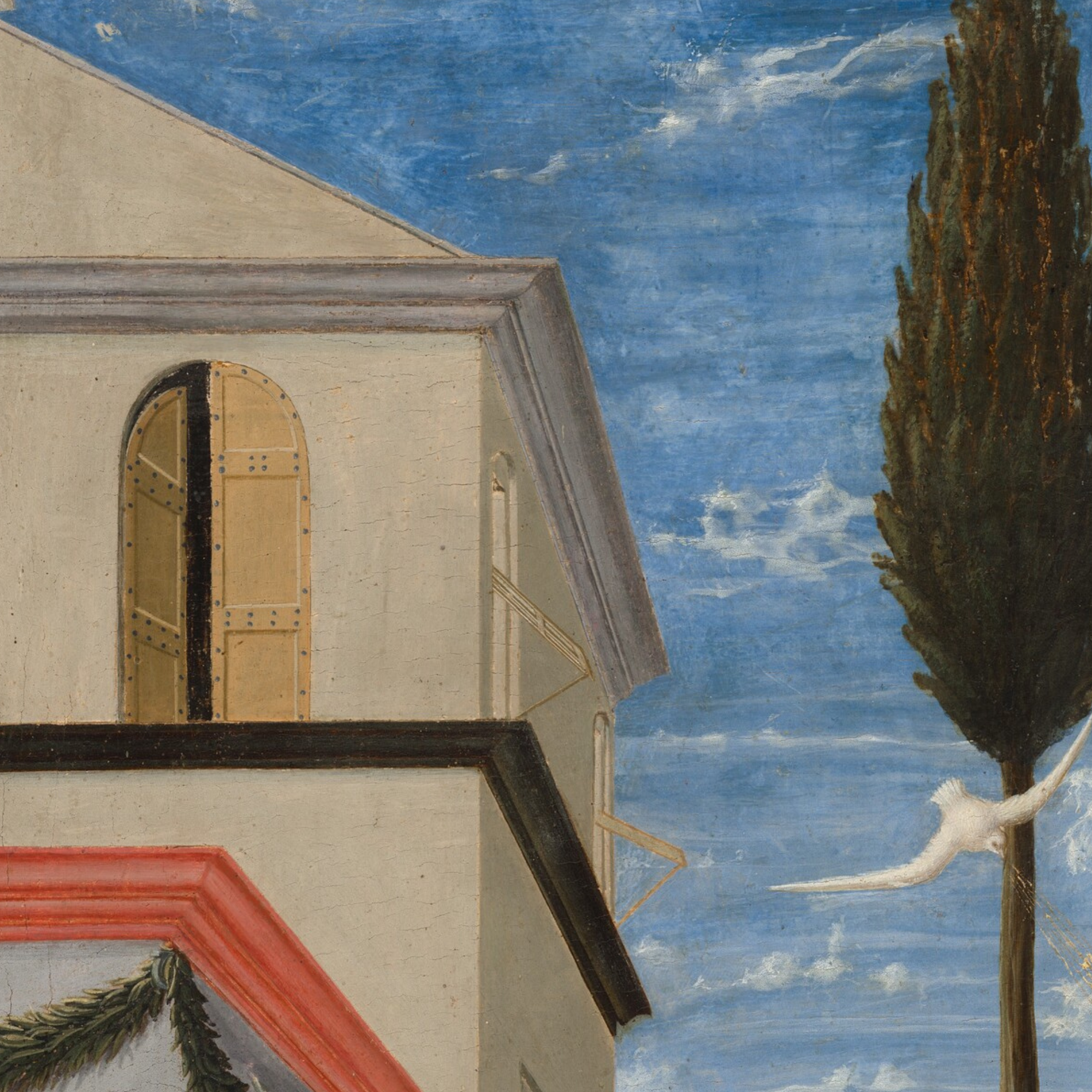
Detail of The Annunciation by Fra Carnevale, c. 1445/1450, National Gallery of Art Washington, D.C.
Mystical Rose
Carnevale also adopts floral symbolism to communicate Mary’s perfect purity and love. In the 12th century, St. Bernard of Clairvaux referred to Mary as the “violet of humility, the lily of chastity, and the rose of charity.” Carnevale includes two of these three flowers in his painting: the lily and the rose.
In the Annunciation, the angel Gabriel holds a bouquet of lilies to symbolize Mary’s innocence. By a special grace from God, her soul is not tainted by Original Sin. The white roses in a nearby vase likewise symbolize her purity. The pink roses foreshadow the suffering that Mary will have to endure, as Simeon prophesies later in the temple. She will have to watch the agony of her own Son as He sheds His Blood for the salvation of the world.
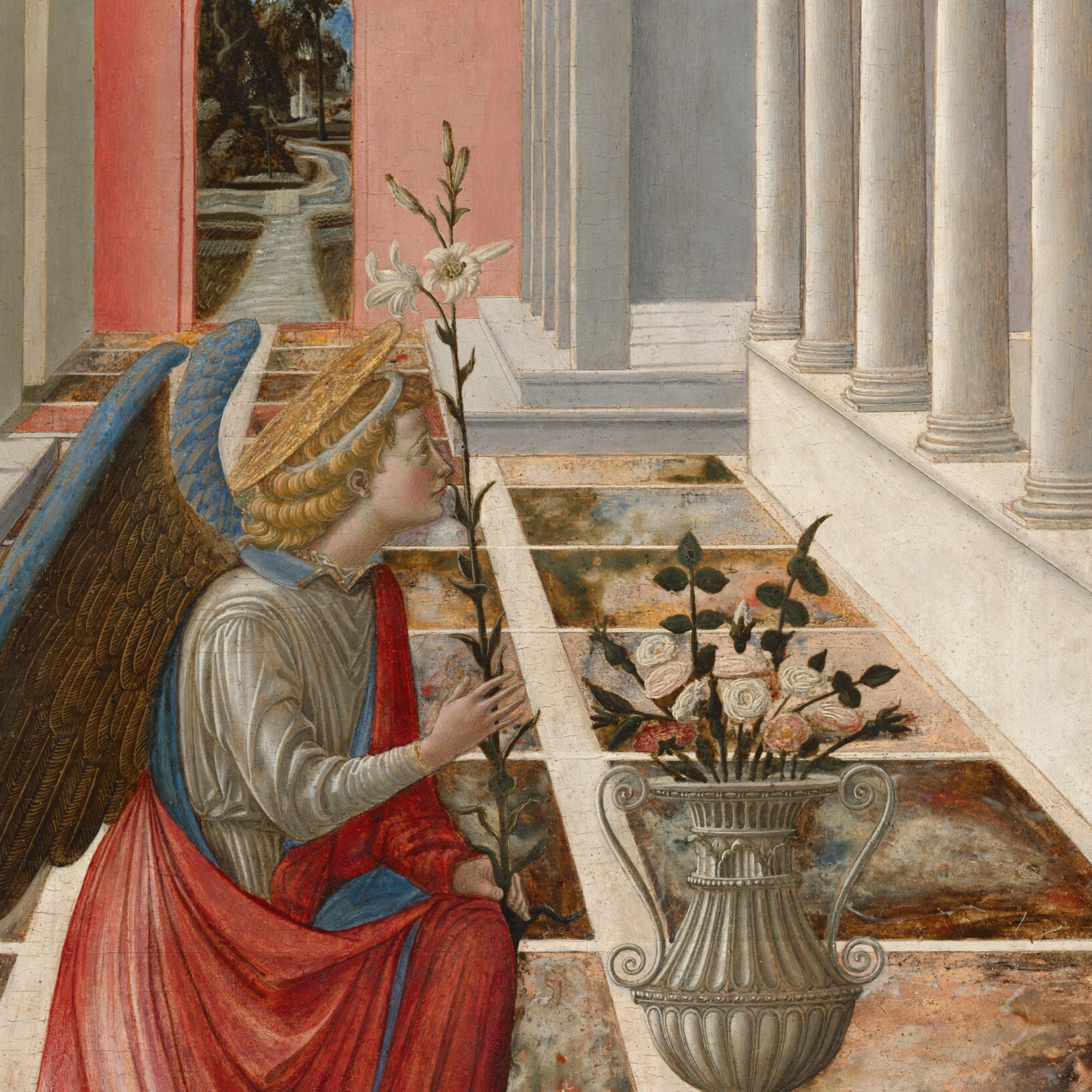
Detail of The Annunciation by Fra Carnevale, c. 1445/1450, National Gallery of Art Washington, D.C.
The vase of pink and white roses standing between the pair calls to mind another popular title for Mary: Rosa Mystica, the Mystical Rose. Long considered one of the most beautiful flowers, the rose expresses Mary’s beauty and joy.
A Unique Early Renaissance Masterpiece
Although Carnevale left behind few identifiable works, his Annunciation stands out as an unparalleled masterpiece among other Early Renaissance paintings of the same scene. Carnevale’s architectural expertise enables him to craft a unique piece, setting the event in a street or courtyard between two buildings. He also utilizes the common symbolism of the time to visually convey three titles of the Virgin Mary: Hortus Conclusus, Porta Caeli, and Rosa Mystica.