
The Met Acquires Significant Renaissance Painting Lost for Centuries
The Metropolitan Museum of Art announced its acquisition of a long-lost painting by Renaissance artist Rosso Fiorentino (1494–1540) in a press release on Thursday.
The painting Madonna and Child with Saint John the Evangelist (1512-1513) was considered lost for centuries, until a recent conservation treatment uncovered the figure of Saint John the Evangelist in the foreground of the work.
The painting depicts Saint John holding a book and looking upwards at Christ, who is depicted as a muscular and energetic infant. The Virgin Mary stands in the back, reading a book and placing her left hand on Christ’s arm.
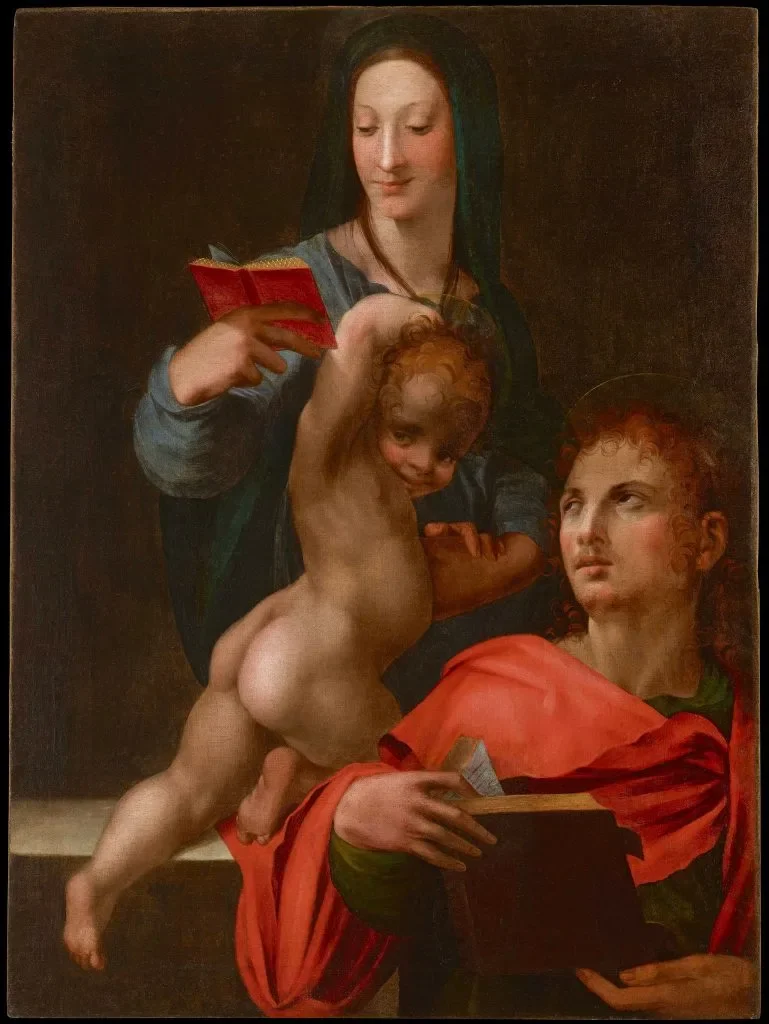
Madonna and Child with Saint John the Evangelist by Rosso Fiorentino, 1512-1513, Courtesy The Met
Giorgio Vasari, often called the “father of art history,” mentioned the artwork in his groundbreaking book Lives of the Most Excellent Painters, Sculptors, and Architects in 1550. Vasari describes “a painting of the Madonna and Child with a half-length figure of Saint John the Evangelist” that Rosso presented to Fra Jacopo of the Servite Order, who then offered Rosso his first major commission at the Florentine church of Santissima Annunziata.
“Paintings by Rosso are exceedingly rare, numbering only about two dozen, and many of his most celebrated works remain undocumented or unfinished,” said Stephan Wolohojian, lead curator of The Met’s Department of European Paintings. “The discussion of this painting in Vasari’s Lives of the Artists, often described as the first book of art history, gives the work the added distinction of having been part of art-historical discourse since the discipline’s inception. Executed on canvas and preserved in remarkably good condition, it is the artist’s earliest recorded painting to survive.”
The painting demonstrates the beginning of Rosso’s influential role in the development of Mannerism, a European artistic style that emerged in the 16th century. The Mannerist style is characterized by an artificiality and distortion of proportions, such as in the works of the Greek painter El Greco (1541-1614).
Commenting on Rosso’s Madonna and Child, The Met’s French Director and CEO Max Hollein stated that the painting “is a rare and pivotal early work by one of the most important painters of the 16th century, striking in its experimental ambition and psychological intensity.”
“With his unusual placement of the figures and daring postures, Rosso transforms a familiar devotional type into a charged encounter that draws the beholder into a complex interplay of seeing, feeling, and believing,” continued Hollein. “The rediscovery of this work reshapes our understanding of Rosso’s early oeuvre and the emergence of more expressive and dynamic compositions in 16th-century Florentine painting.”
Madonna and Child is currently on display for public viewing at The Met.