
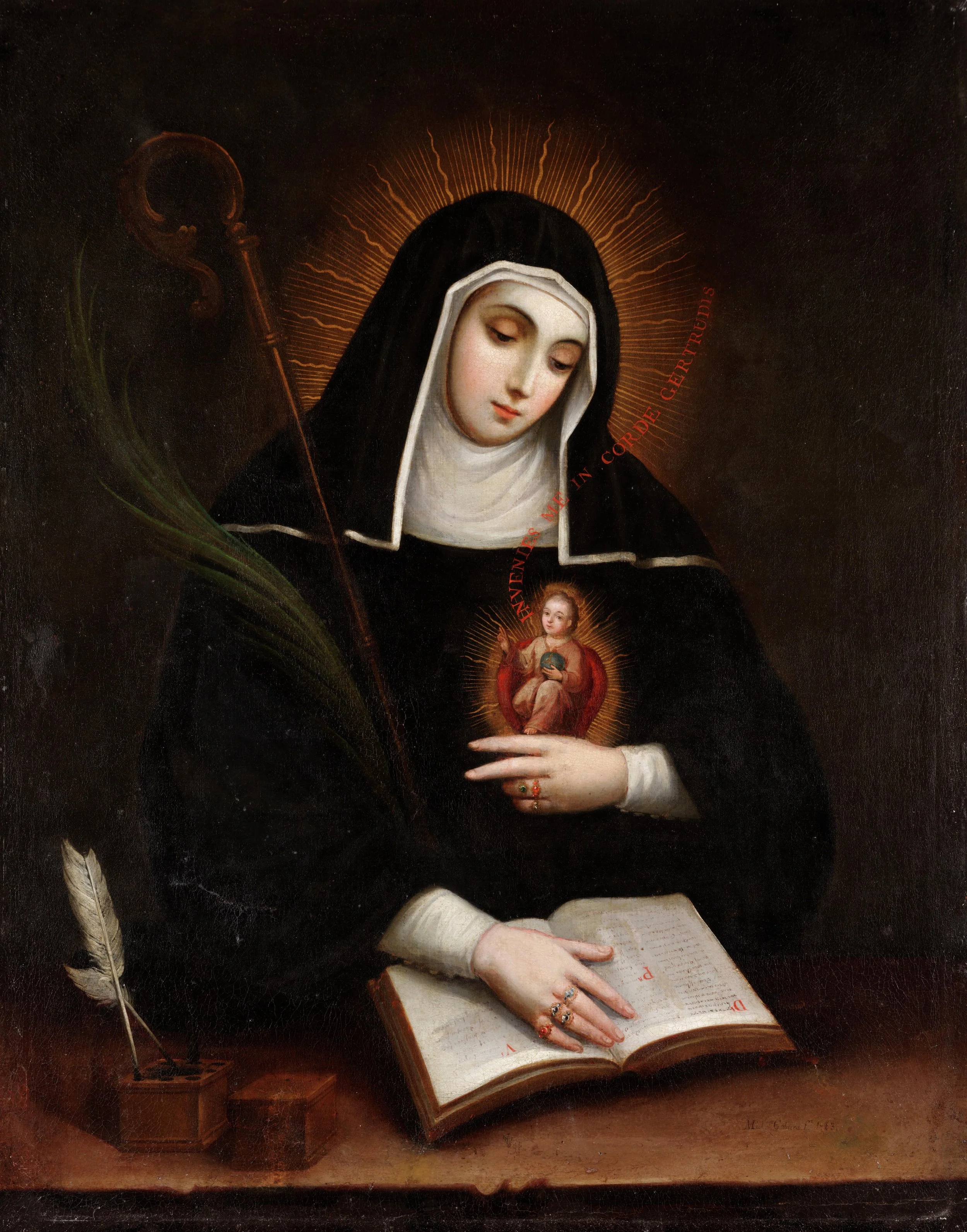
Miguel Cabrera, St. Gertrude, 1763, Dallas Museum of Art
On the feast of the Epiphany in the year 1256, St. Gertrude the Great was born in the Holy Roman Empire. At age five, she entered the Benedictine Monastery of Helfta as a student and never left, becoming a nun in the community and remaining there until her death in 1302. Gertrude had her first mystical experience at 25 years old. She is numbered among the great mystics of the 13th century, along with St. Francis of Assisi and St. Mechthild of Magdeburg, a fellow nun at Helfta who became her spiritual sister.
One of the most prominent Mexican painters of the 18th century, Miguel Cabrera, created a portrait of Gertrude in 1763. In St. Gertrude, the mystic appears clothed in the black-and-white habit of the Benedictine order. With her eyes lowered, she gazes at an open book resting on the desk before her. Having received an education in the classical liberal arts and the writings of the Church Fathers, it is possible that she could be studying. However, the more likely explanation suggests itself through the quills and inkstand to her right. Gertrude could very well be writing Book II of The Herald of Divine Love, a firsthand account of her dialogues with Christ.
Perhaps Gertrude has been drawn into a mystical encounter in the midst of her work. Has she put her quill aside in order to turn her whole attention toward prayer? We can see who is within her heart at this moment: the Child Jesus, whom Cabrera has depicted as the Salvator Mundi, or Savior of the World. Christ holds a globe in one hand and raises His other in a traditional gesture of blessing. Above his head rises a Latin phrase in red letters: Invenies me in corde Gertrudis, which translates to “You will find Me in the heart of Gertrude.”
This depiction corresponds to a vision Gertrude experienced one Christmas night, which she recorded in The Herald of Divine Love (Book II, Chapter VI). She wrote, “My soul beheld before it suddenly a delicate Child, but just born, in whom were concealed the greatest gifts of perfection. I imagined that I received this precious deposit in my bosom with the tenderest affection.” Christ then told her that He would communicate His divinity to her, permeating her soul like the sun’s rays diffusing through the air. Through this intimate union with Christ, Gertrude would be increasingly transformed into His likeness.
Cabrera’s painting contains another interesting aspect derived from Gertrude’s mystical experiences. She wears seven rings: four on her right hand and three on her left. These rings represent seven promises given to her by Christ for those who seek her spiritual assistance. Gertrude recounted these promises in The Herald of Divine Love (Book II, Chapters XX–XXI), describing a vision in which Christ confirmed them. He placed her hand within His Sacred Heart, revealing seven rings on her fingers when she withdrew her hand.
It is important to note that Cabrera was likely influenced by the iconography of St. Gertrude that can be traced back to Fray Diego de Yepes, a Spanish Hieronymite priest and bishop who commissioned an early Spanish portrait of Gertrude around 1600. He instructed the painter to include several of the elements seen in Cabrera’s composition: the Latin phrase Invenies me in corde Gertrudis, the Infant Jesus in her heart, and the seven rings on her right hand. Cabrera may have encountered this imagery in a Spanish devotional print or book circulating in colonial Mexico, or through other paintings that adopted the same iconography.
In St. Gertrude, Cabrera includes two other attributes that appear in earlier representations of the saint: a crosier and a palm. A symbol of authority, the crosier typically appears in Christian art in association with a bishop, archbishop, abbot, or abbess. While Gertrude never held the position of abbess at Helfta, a nun named Gertrude of Hackeborn was abbess during the saint’s lifetime. The two women were sometimes confused over the centuries, and this may explain why some artists depicted Gertrude the Great with a crosier. Pope Benedict XIV added the title “the Great” in the 18th century to distinguish the two nuns.
As a result, Cabrera’s choice of a crosier may be an inherited artistic mistake. Or it may be intentional, signifying Gertrude’s spiritual authority within the monastery. In any event, the palm is another unusual symbol for Gertrude. In Christian art, the palm is usually held by martyrs, representing their sacrifice and victory over death. Since Gertrude did not undergo martyrdom, the palm could simply stand for her holiness and triumph over sin.
In his portrait of Gertrude, Cabrera offers the viewer the opportunity to reflect on the saint’s mystical union with Christ as His Bride, or “nuptial mysticism.” She is more widely known in Catholic devotion as an intercessor for the holy souls in Purgatory. Gertrude had visions of departed souls suffering in Purgatory and often prayed for them. Her feast day falls on November 16, which happens to be the month dedicated to the souls in Purgatory.