
Francisco de Zurbarán: The Spanish Caravaggio
The National Gallery in London is currently hosting an exhibition on Francisco de Zurbarán, a Spanish Baroque painter known for his sacred artwork depicting saints, martyrs, and other religious subjects. Zurbarán received many commissions from monasteries around Seville, leading him to develop a personal style that suited the meditative function of his works. His dramatic tenebrism and naturalism have led some art historians to nickname him “the Spanish Caravaggio.” The Italian master frequently used tenebrism, a type of chiaroscuro characterized by sharp contrasts between light and darkness, in his compositions.
The resemblance between Zurbarán and Caravaggio also extends to the realism that characterized their artwork. This naturalism makes Zurbarán further comparable to Diego Velázquez, a contemporary who rivals the former in being honored as the greatest painter of the Spanish Golden Age. However, the two Spanish painters diverged in their subject matter based on their respective positions. Velázquez served as the leading court painter to King Philip IV of Spain in Madrid, which caused portraits of the royal household to dominate his commissions. While Velázquez created a handful of religious works, Zurbarán specialized in them due to his ecclesiastical clientele. As a result, his workshop typically made most of his paintings for chapels and monasteries.
This article will examine how Zurbarán developed a personal style that enhanced the devotional purpose of his artwork, illustrating the point with several of his most famous paintings: The Crucifixion, Saint Serapion, Agnus Dei, Saint Francis in Meditation, and The Crucified Christ with a Painter.
Francisco de Zurbarán
Zurbarán was baptized on November 7, 1598, in Fuente de Cantos, Spain. His father was a tradesman. Zurbarán went to Seville in 1614 to apprentice under Pedro Díaz de Villanueva, a minor artist whose life remains obscure. In 1617, Zurbarán married María Paet, who died seven years later after the birth of their third child. Zurbarán then married a wealthy widow in 1625. One of the sons from his first marriage, Juan de Zurbarán, became a still life painter. Juan was trained by his father, who also dabbled in still life painting throughout his career. Despite the fact that there are fewer than ten surviving still lifes by Zurbarán himself, his Still Life with Lemons, Oranges and a Rose is one of the most iconic Spanish still lifes from the 17th century.
The Crucifixion
Zurbarán received his first major commission on January 17, 1626, when he signed a contract with the prior of San Pablo el Real, a Dominican monastery in Seville. The contract stipulated that Zurbarán make 21 paintings in eight months, including works of Saints Dominic, Bonaventure, Thomas Aquinas, and several Doctors of the Church. Zurbarán also produced his earliest signed and dated artwork, The Crucifixion, for the sacristy of the monastery.
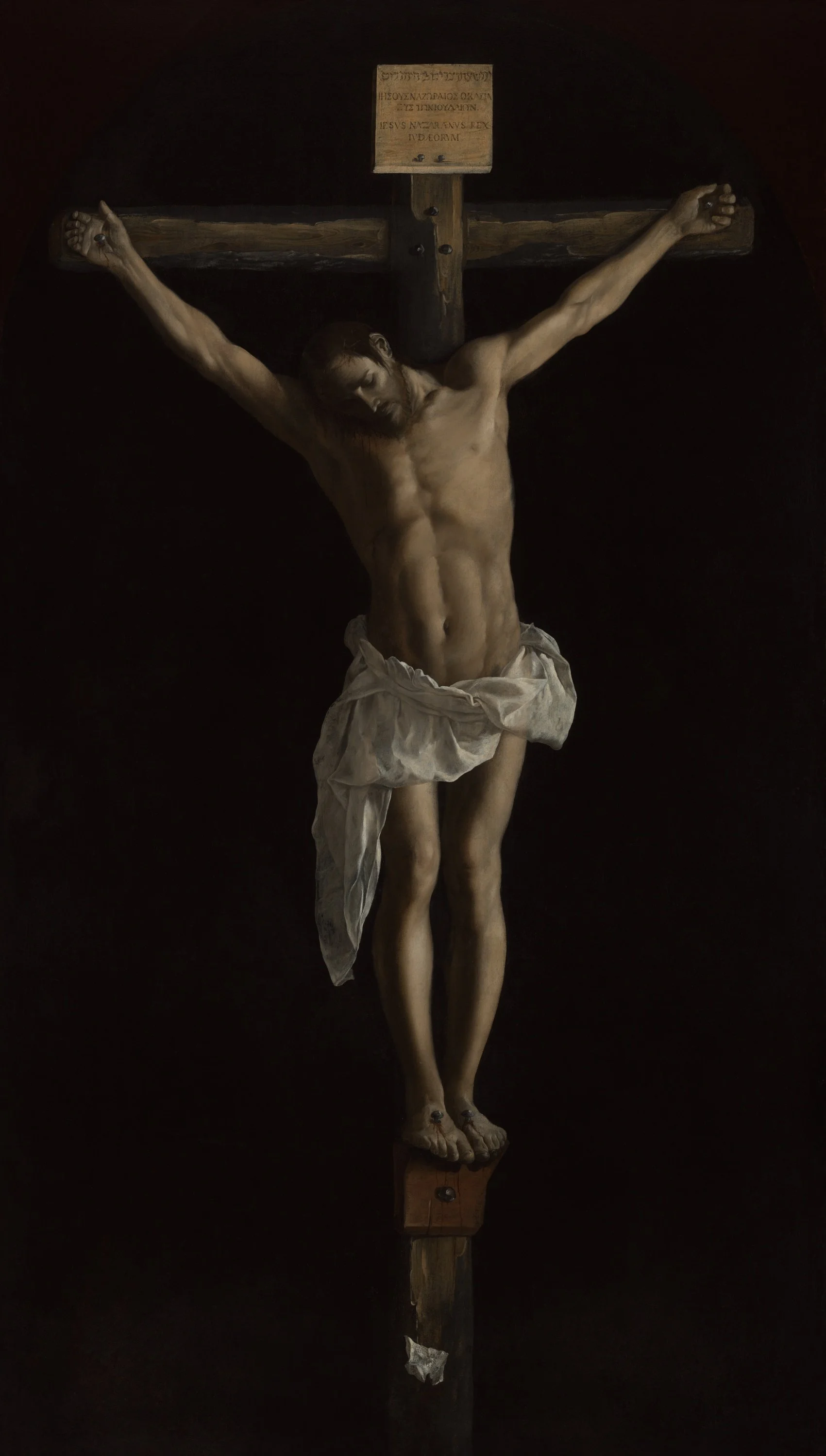
Francisco de Zurbarán, The Crucifixion, 1627, The Art Institute of Chicago, Public Domain.
While it is impossible to verify Zurbarán’s actual level of familiarity with Caravaggio, the Crucifixion serves as an early example of how Zurbarán appears to imitate the tenebrism and naturalism of the Italian Baroque painter. The background of the Crucifixion is completely black, isolating the figure of Christ on the Cross. Visitors to the monastery viewed the Crucifixion through a grill, and the dark background of the artwork likely blended into the wall of the dimly lit sacristy that housed it. They found themselves contemplating a lifelike Christ, pictured with an almost sculptural body. Zurbarán rendered the Crucifixion with a simplistic beauty, enabling viewers to enter into an intimate and deeply personal encounter with Christ.
Saint Serapion
As part of his next commission, Zurbarán made what is widely considered to be his masterpiece. The Mercedarians of Seville contracted Zurbarán on August 29, 1628, to create 22 paintings for their monastery. Zurbarán painted Saint Serapion for their funerary chapel, depicting one of the most important Mercedarian saints.
Saint Serapion of Algiers dates back to the earliest years of the Spanish order, which was founded in 1218 to ransom Christians enslaved by Muslims. Serapion participated in captive exchanges, likely offering himself as a hostage in place of other Christians. During one such situation in 1240, the ransom money did not arrive on time, and Serapion’s captors martyred him on an X-shaped cross like St. Andrew the Apostle.
With Saint Serapion, Zurbarán followed the Spanish Baroque tradition that favored martyrs as religious subjects. Paintings of popular Catholic martyrs both reflected and contributed to the religious fervor of the Counter-Reformation in 17th-century Spain. Artists such as Jusepe de Ribera painted dramatic scenes meant to evoke an emotional response tending toward piety. In contrast, Zurbarán opted for scenes that fulfilled their meditative purpose through a quieter means. Zurbarán’s portrayal of Saint Serapion shows the martyr in a pose that suggests crucifixion without making it immediately explicit.
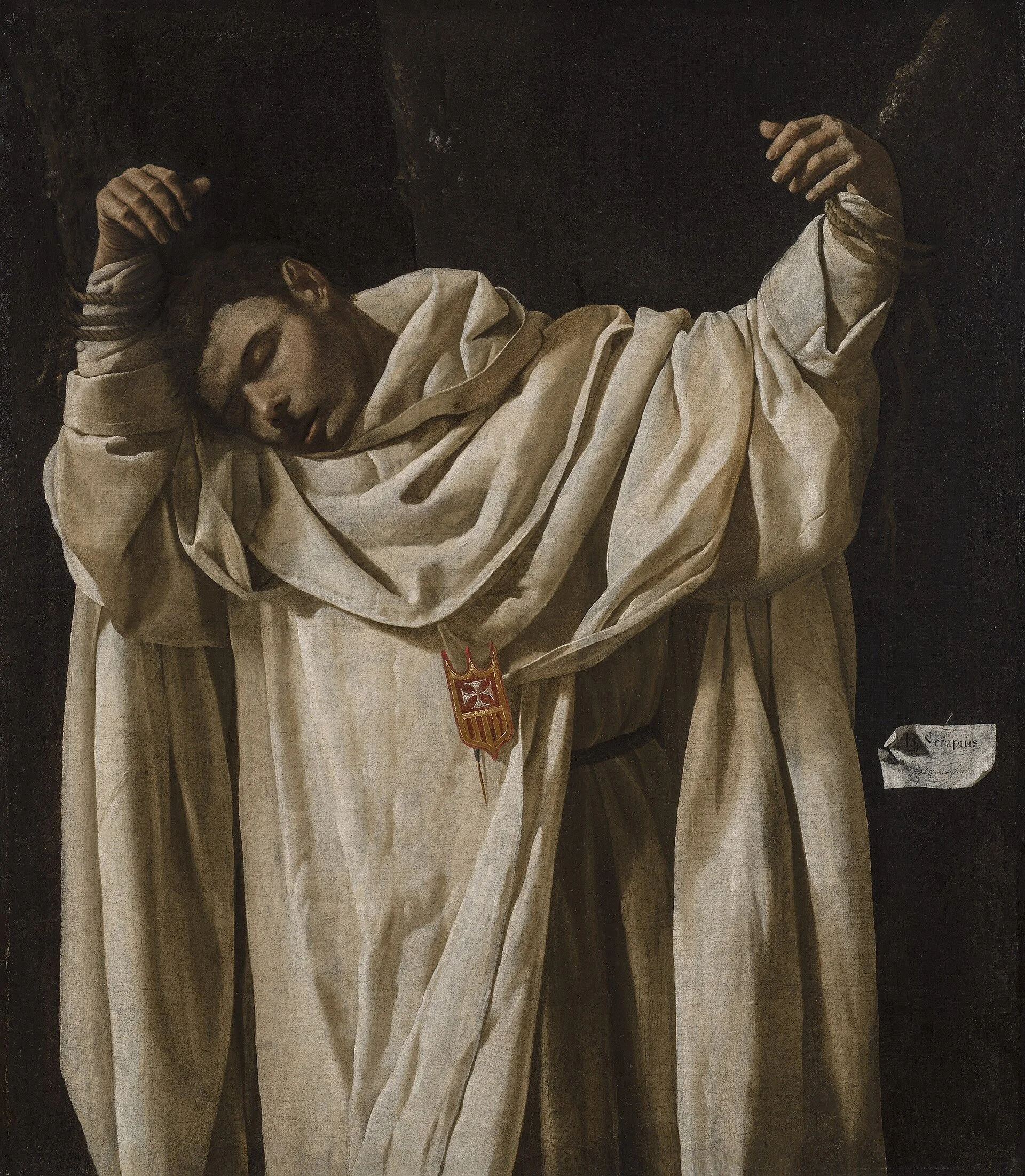
Francisco de Zurbarán, Saint Serapion, 1628, Wadsworth Atheneum Museum of Art, Wikimedia Commons, Public Domain.
In the painting, the martyr’s hands are tied to two barely visible branches above his head. His limp body leans against a central post behind him. Zurbarán again uses chiaroscuro, contrasting Serapion’s white robes with the heavy blackness surrounding him. Light shines on the saint, whom Zurbarán has painted as an ordinary-looking monk who seems to have fallen asleep. While the narrative of the tragedy is certainly present in the composition, a sense of stillness and tranquility enhance the contemplative aspect of the artwork. Monks of the Mercedarian monastery could meditate on the true charity that characterized Serapion’s life and ultimate sacrifice, reflecting on his death without becoming overwhelmed by the theatrical drama that defined other Baroque depictions of martyrdom.
Agnus Dei
Following these two projects for monasteries in Seville, the leaders of the city found Zurbarán’s religious artwork so impressive that they invited him to permanently move there. Zurbarán relocated with his family and worked in Seville for the next 30 years with his workshop. He left briefly from 1634 to 1635 to accept King Philip IV’s invitation to paint at his court in Madrid, during which time Zurbarán completed his only mythological works: a series of ten paintings that showed the labors of Hercules. In terms of his personal life, Zurbarán’s second wife died in 1639. He married for the third and final time a few years later.
During the 1630s, Zurbarán produced at least five paintings of Agnus Dei, or the Lamb of God. The subject represents Christ, whom St. John the Baptist refers to twice as the “Lamb of God” in the Gospel of John. The Museo del Prado owns the Agnus Dei that is considered the best out of Zurbarán’s five versions. It was likely commissioned for private devotion. A seal on the back indicates that it later belonged to King Ferdinand VII, the king of Spain in the early 19th century.
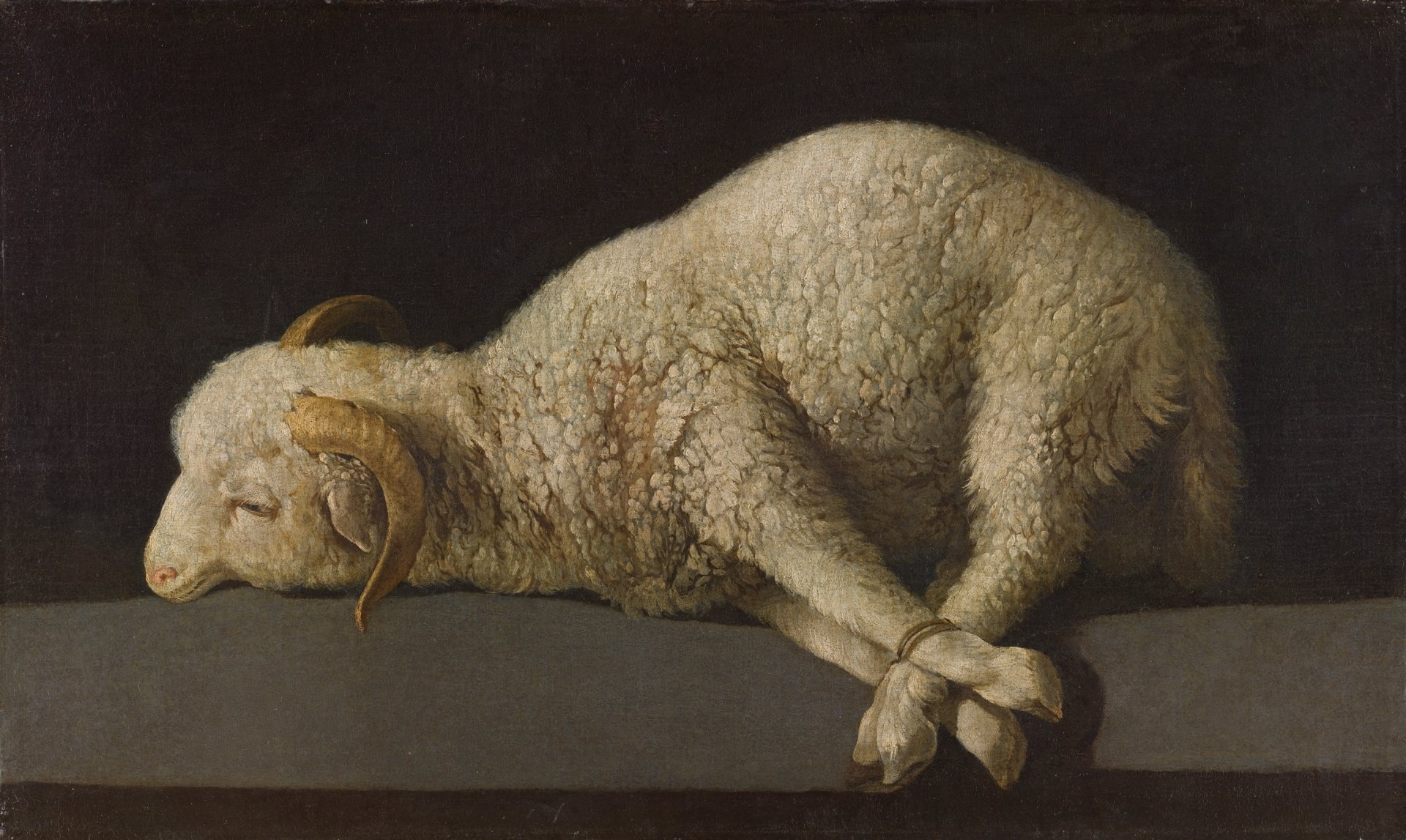
Francisco de Zurbarán, Agnus Dei (also called A Lamb), 1635-1640, Museo del Prado.
Zurbarán’s Agnus Dei depicts a merino lamb lying on a gray table with its ankles bound—a position traditionally associated with sacrifice. The lamb’s eye reveals that the creature is alive, accepting its fate with apparent meekness and docility. The scene recalls Isaiah’s prophecy of the Suffering Servant: “Though harshly treated, he submitted / and did not open his mouth; / Like a lamb led to slaughter / or a sheep silent before shearers, / he did not open his mouth” (NABRE). A person gazing at Zurbarán’s Agnus Dei could contemplate how Christ fulfilled this prophecy, reflecting on His great humility and love for mankind.
Once again, the simplicity of Zurbarán’s style makes this piece particularly appropriate for meditation. The contrast of white on black emphasizes the figure of the lamb, omitting anything that could distract the viewer from pondering the Scriptural meaning behind the symbolism of the lamb. However, the straightforwardness of the piece did not prevent Zurbarán from executing fine details such as the texture of the wool, showcasing his masterly ability to render his subject in a realistic manner.
Saint Francis in Meditation
By the late 1930s, Zurbarán’s workshop also exported works to South America. For example, records from 1647 list paintings that were sent to Lima, Peru. At the same time, Zurbarán and his workshop continued to make paintings for monastic communities in southern Spain. He notably created over 40 paintings of St. Francis of Assisi, his namesake. The Franciscan Order was the largest religious order in 17th-century Europe, and it had a large presence in Spain. Franciscan monasteries likely provided Zurbarán with an abundance of commissions for religious paintings of their founder.
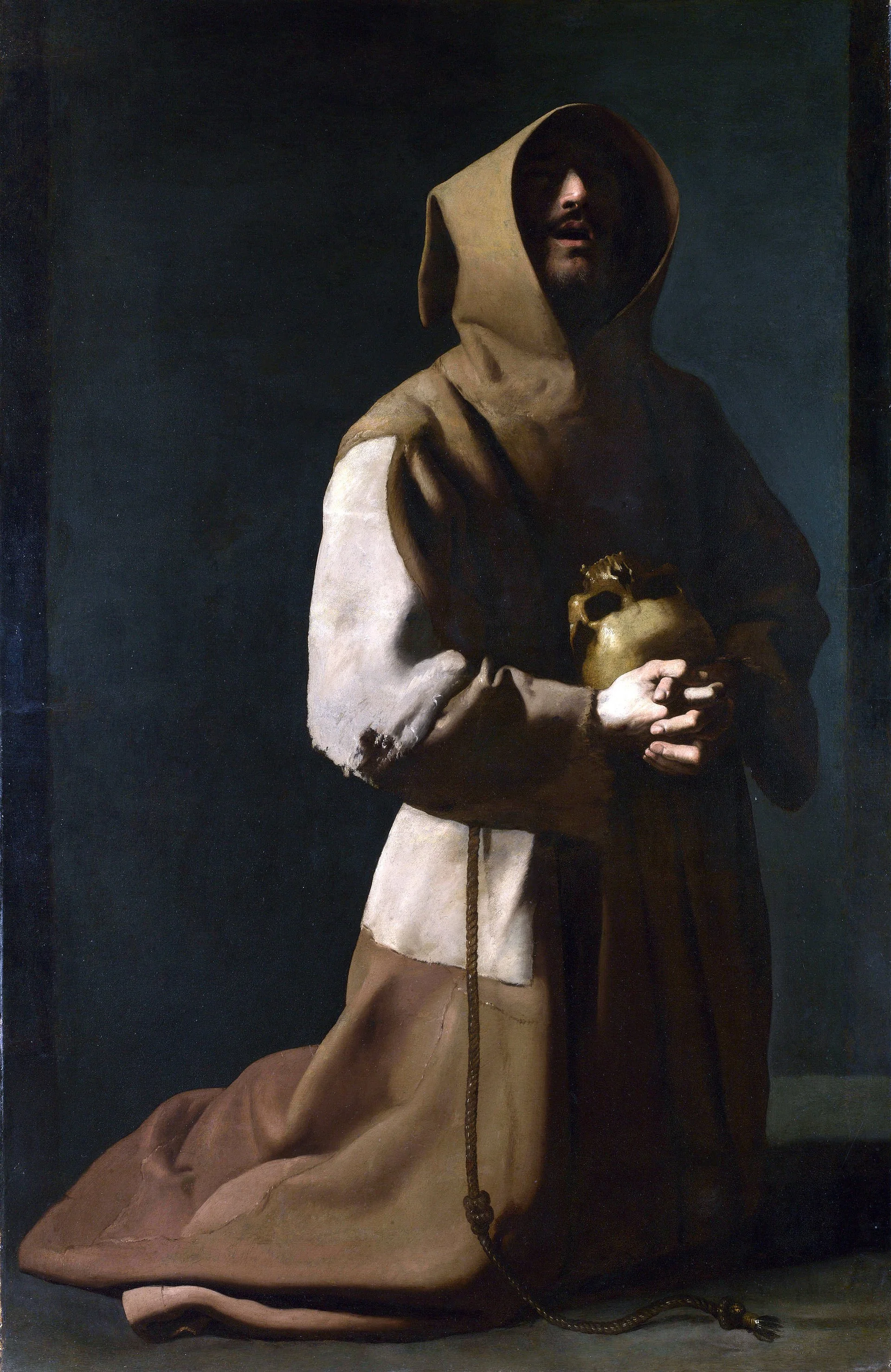
Francisco de Zurbarán, Saint Francis in Meditation, c. 1635-1639, National Gallery, London, Wikimedia Commons, Public Domain.
An excellent example of Zurbarán’s portrayal of Francis is Saint Francis in Meditation from the National Gallery in London. Francis kneels on the bare ground in a patched brown garment, emphasizing his embrace of poverty. He clasps his hands and looks heavenward in fervent prayer, holding a skull to his chest. The skull symbolizes death, which Francis famously called “Sister Death” in his Canticle of the Creatures. Unlike the close-up of Serapion, which clearly showed his face, this painting of Francis shrouds his facial expression with shadows. Light from an outside source illuminates the left side of the saint’s body, while darkness hides the space behind him.
Saint Francis in Meditation shows a deeply personal moment of Francis communicating with God. Franciscan friars could literally meditate on Francis meditating, looking to their founder as the prime example for their prayer life. Zurbarán also captures defining aspects of the Franciscan spirituality within the artwork: poverty, humility, and peace. His use of tenebrism highlights the mended robe and bare ground, and Francis’ posture implies total surrender to the will of God. The friars contemplating this scene could learn from Francis, striving to follow him on the path of holiness toward union with God.
The Crucified Christ with a Painter
The early 1940s marked the beginning of the end for Zurbarán’s artistic career. His workshop remained active, but the softer style of Bartolomé Esteban Murillo, his younger contemporary, rose in popularity. Zurbarán’s harsh tenebrism started looking outdated—the ever-changing tastes of patrons had immense weight in the artistic sphere. Murillo soon outpaced Zurbarán in becoming the most admired painter in Seville.
Zurbarán experienced a tragedy in his personal life around this time, losing his son Juan during a devastating plague that wiped out almost half the city’s population in 1649. Together with Seville’s waning economic prosperity, these factors may explain why Zurbarán left for Madrid in 1658. He worked there until his death on August 27, 1664.
A painting from 1650 reveals how Zurbarán altered his painting style, presumably to adapt to shifting preferences. The Crucified Christ with a Painter clearly bears the marks of Murillo’s influence. The crucified Christ contrasts sharply with Zurbarán’s 1627 Crucifixion discussed earlier. The later painting still contains an intense interplay between light and darkness, but the impenetrable black background is faded. Christ’s elongated form also appears less sculptural than before. Zurbarán apparently received criticism for changing his style, but he likely felt that Murillo’s competition left him with no viable alternative.
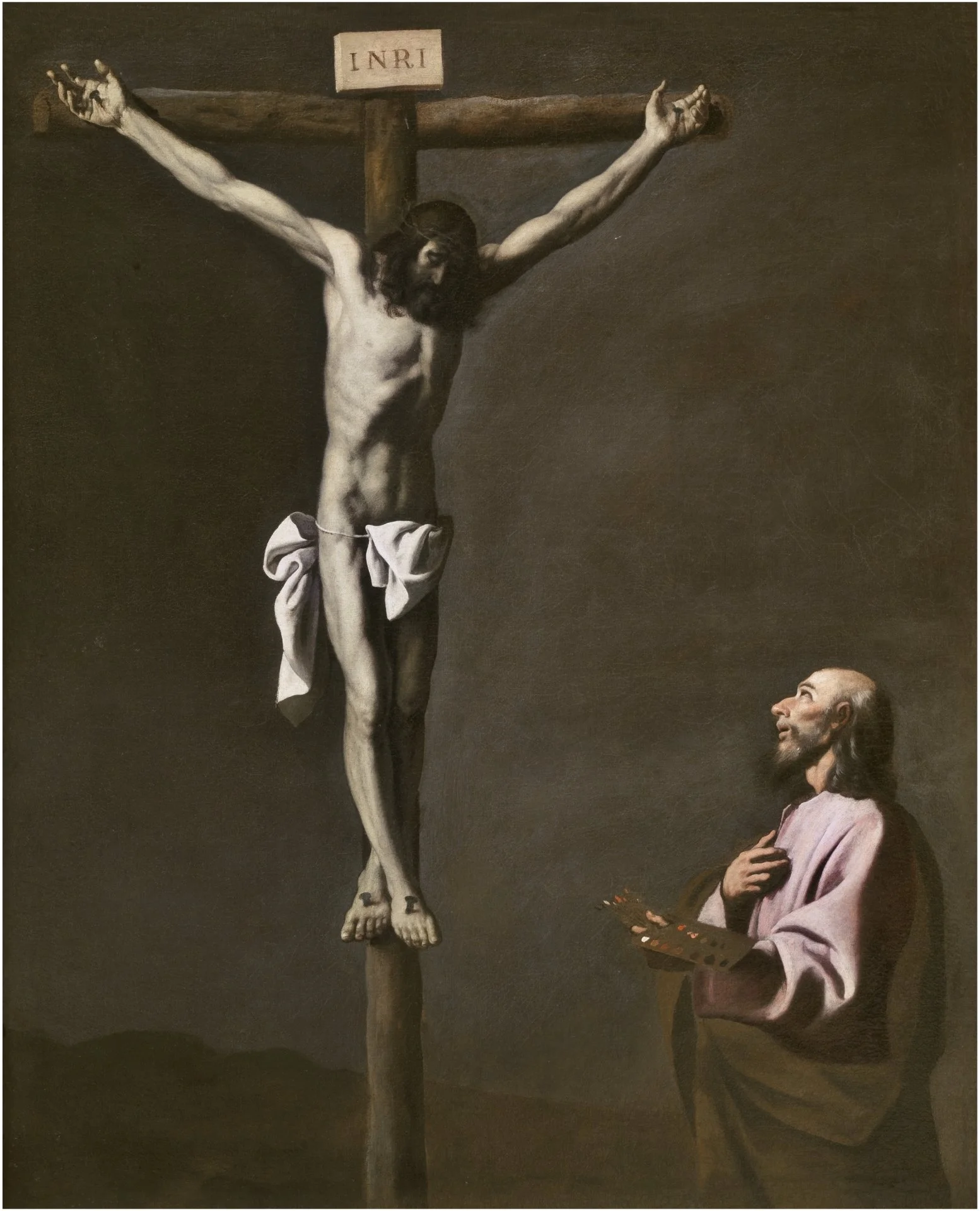
Francisco de Zurbarán, The Crucified Christ with a Painter, c. 1650, Museo del Prado.
Regardless of this controversy, the Crucified Christ with a Painter may provide the key to understanding Zurbarán’s approach to painting. The man standing in the bottom right corner is St. Luke the Evangelist, who is traditionally regarded as an artist. He grips a palette and brushes in one hand and holds the other to his heart, gazing at Christ with awe and reverence. Perhaps here Zurbarán is making a statement about the vocation of the Christian artist. Luke fixes his eyes on Christ, placing him at the center of his artistic endeavors. The person of Christ must inspire and inform the Christian artist, who has to first contemplate divine truths to then communicate them through his artwork.
In his Letter to Artists, Pope St. John Paul II summarized the role of Christian art: “Art must make perceptible, and as far as possible attractive, the world of the spirit, of the invisible, of God. It must therefore translate into meaningful terms that which is in itself ineffable.” Zurbarán emphasized the gravity of that responsibility, portraying the humility and devotion necessitated by such a calling. In his painting, Zurbarán ultimately portrays Luke as a humble servant captivated by the merciful love and goodness of his divine master. The spiritual task set before the Christian artist cannot be subordinated to worldly fame and success, but rather ceaselessly draw from this deep wonder for divine beauty, which displays itself so visibly in the crucified Christ.
The figure of Luke may in fact be a self-portrait of Zurbarán, at least symbolically. While little is known about Zurbarán’s personal holiness, it can be hoped that he sought to imitate such faith in his own life, given his legacy as the greatest religious painter of the Spanish Baroque period. His tenebrism and realism, which earned Zurbarán the nickname “the Spanish Caravaggio,” strengthened the devotional function of his work, imbuing his artwork with stillness and peace. His paintings encourage piety in a quiet way, in contrast to the dramatic portrayals by other Spanish Baroque artists.
The Zurbarán exhibition will be at the National Gallery in London through August 23, 2026. The Louvre will then host the exhibition from October 7 to January 25, 2027, followed by the Art Institute of Chicago from February 28 to June 20, 2027.
A 19-minute video produced by the National Gallery on the exhibition can be watched here. The artwork may also be seen in the Zurbarán book published on the exhibition.