
The 15 Mysteries of the Rosary Paintings at St. Paul’s Church, Antwerp
The following account is based on a booklet written by Armand Storck, the non-musical events coordinator at St. Paul’s Church, Antwerp. He kindly shared the English version of the booklet with the author via email.
In 1615, the Dominican friar Jan Boucquet traveled over seven hundred miles to attend the general chapter of the order in Bologna, Italy. While there, he visited the Basilica of San Domenico, which was built in the 13th century to house the remains of St. Dominic. Fifteen Mysteries of the Rosary paintings in the Chapel of the Rosary impressed Boucquet, and he returned to Antwerp with an inspiration.
St. Paul’s Church, Antwerp
Boucquet was the prior of the Dominican monastery attached to St. Paul’s Church in Antwerp. The Dominicans had been present in the city since the 13th century, and they had rebuilt the church in the 1500s. The new St. Paul’s Church was consecrated in 1571, just six years before the Calvinists took over Antwerp in 1577. The Dominicans returned when Calvinist rule ended in 1585, and they focused on redecorating the church according to the contemporary Baroque style.
The idea that dawned on Boucquet during his trip to Bologna fit in perfectly with the decorating program. Boucquet arrived in Antwerp determined to replicate the fifteen Mysteries of the Rosary paintings in St. Paul’s Church. The cycle of paintings would not only serve as an artistic expression of the city’s Marian devotion, but it would also actively foster that devotion among a semi-illiterate congregation. The fifteen paintings would serve as a visual aid for meditation, allowing the faithful to pray a decade of the Rosary with each one.
The 15 Mysteries of the Rosary Paintings
Boucquet naturally decided to approach the best painter north of the Alps: Peter Paul Rubens, one of the most prominent artist in the Counter-Reformation movement. Rubens planned the series and likely enlisted the ten other painters who contributed to the project—including Anthony van Dyck, who studied under Rubens. The notable Flemish Baroque artist Jacob Jordaens contributed the Fifth Sorrowful Mystery, The Crucifixion. The artists completed the fifteen Mysteries of the Rosary paintings between 1617 and 1620. They further collaborated with wealthy merchants to purchase Caravaggio’s Our Lady of the Rosary as the centerpiece of the series.
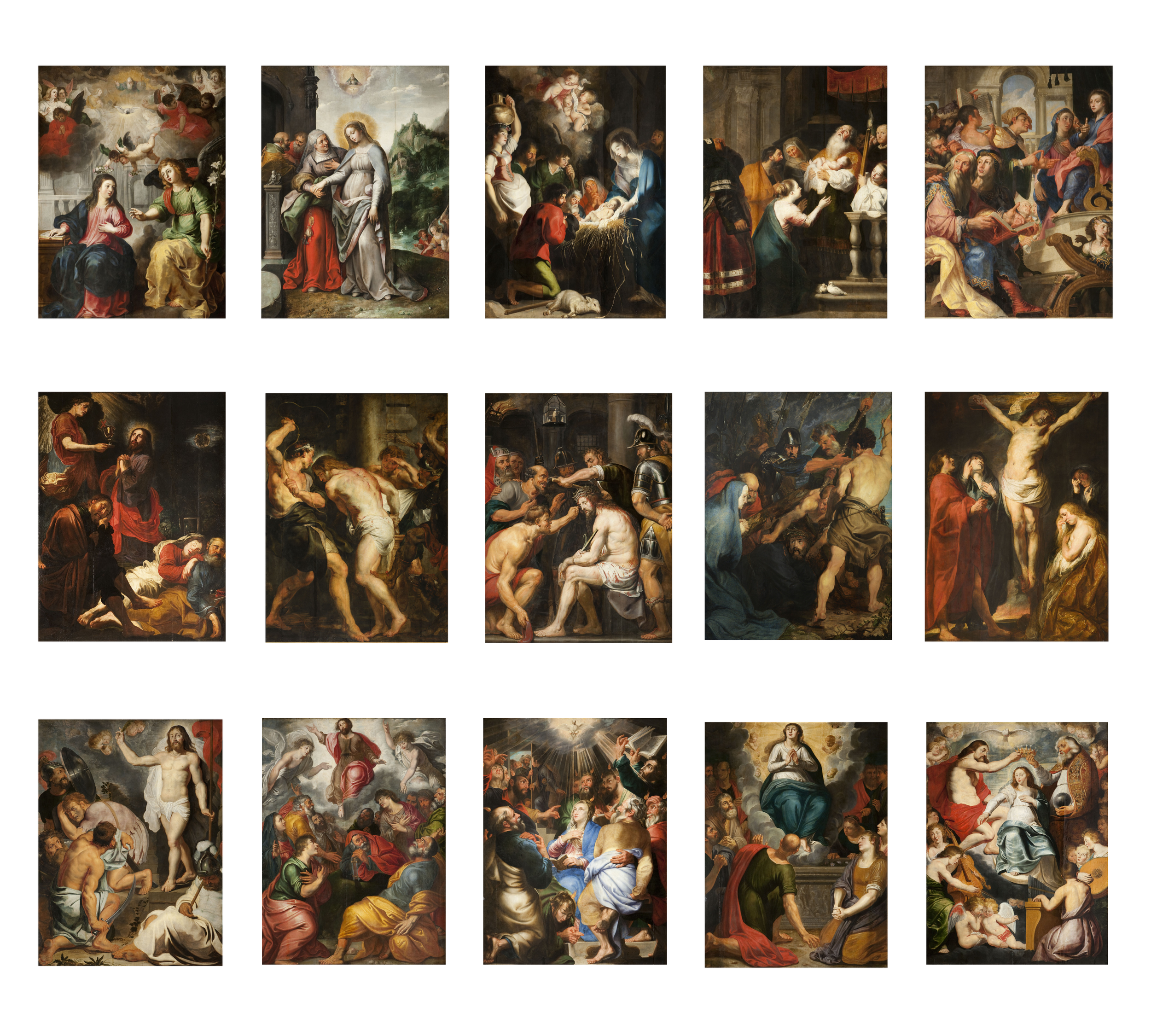
Mysteries of the Rosary, c. 1617-1620, St. Paul’s Church, Antwerp, Licensed under CC BY 4.0 by KIK-IRPA, Belgium.
The paintings were hung in the northern aisle of St. Paul’s Church, which enabled people to linger in front of them. In an era that predated photography, a painting by Flemish artists Pieter Neefs the Elder provides a glimpse of the church less than two decades after the completion of the series. The Mysteries of the Rosary paintings can be seen hanging on the left, and closer inspection shows Caravaggio’s Our Lady of the Rosary in the central place of honor.

Pieter Neefs the Elder, The Interior of the Dominican Church, Antwerp, Looking East, with the Procession of the Holy Sacrament, 1636, Rijksmuseum, Public Domain.

(Detail) Pieter Neefs the Elder, The Interior of the Dominican Church, Antwerp, Looking East, with the Procession of the Holy Sacrament, 1636, Rijksmuseum, Public Domain.
The Flagellation by Peter Paul Rubens
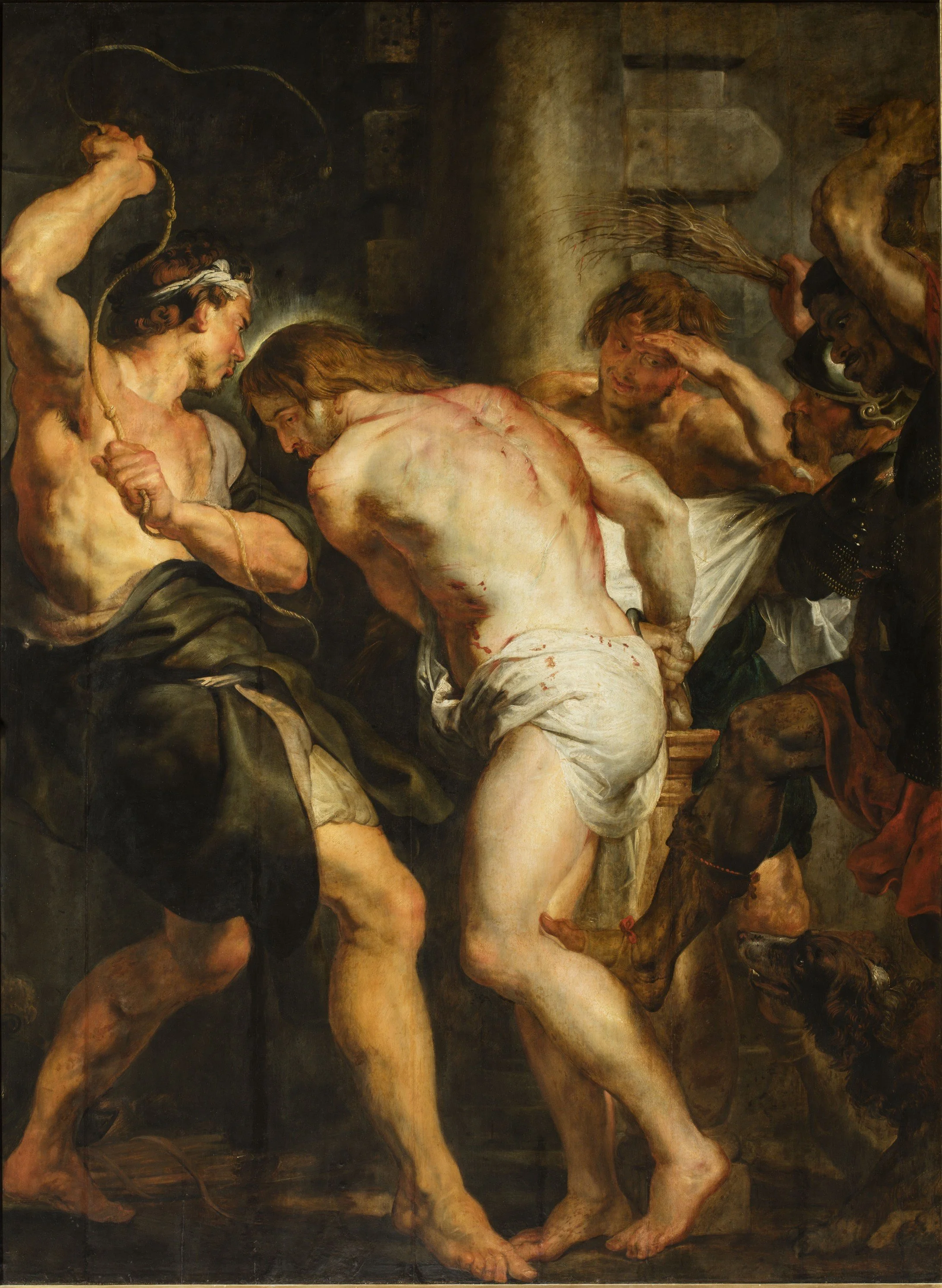
Peter Paul Rubens, The Flagellation, c. 1617, Licensed under CC BY 4.0 by KIK-IRPA, Belgium, photo X134755.
Rubens and van Dyck each contributed one painting in the series. Rubens portrayed the second Sorrowful Mystery: the Scourging at the Pillar, also known as the Flagellation. Christ is located in the center of the composition. His body twists in a way that fits into the curve of the figure next to Him: one of His torturers, who raises his arms for the next blow. Rubens highlights the horror of the scourging by dramatically depicting the diabolic behavior of Christ’s tormentors in the Flagellation. The man on the right kicks Christ’s leg, while his companion also prepares to strike Him. The bright red wounds show clearly on Christ’s body, drawing attention to the blood that He shed for sinners.
In addition to the Flagellation, Rubens also painted The Dispute about the Holy Sacrament and St. Dominic’s Vision to hang over altars in St. Paul’s Church.
Jesus Meets His Mother by Anthony van Dyck
Van Dyck painted the fourth Sorrowful Mystery: the Carrying of the Cross, during which Christ traditionally met His Mother on the road to Calvary. Jesus Meets His Mother is one of the earliest works by Van Dyck, who was nineteen years old at the time of its creation. He went through an extensive drafting process and ended up drastically changing his plan over time, transitioning from a horizontal to a vertical composition.
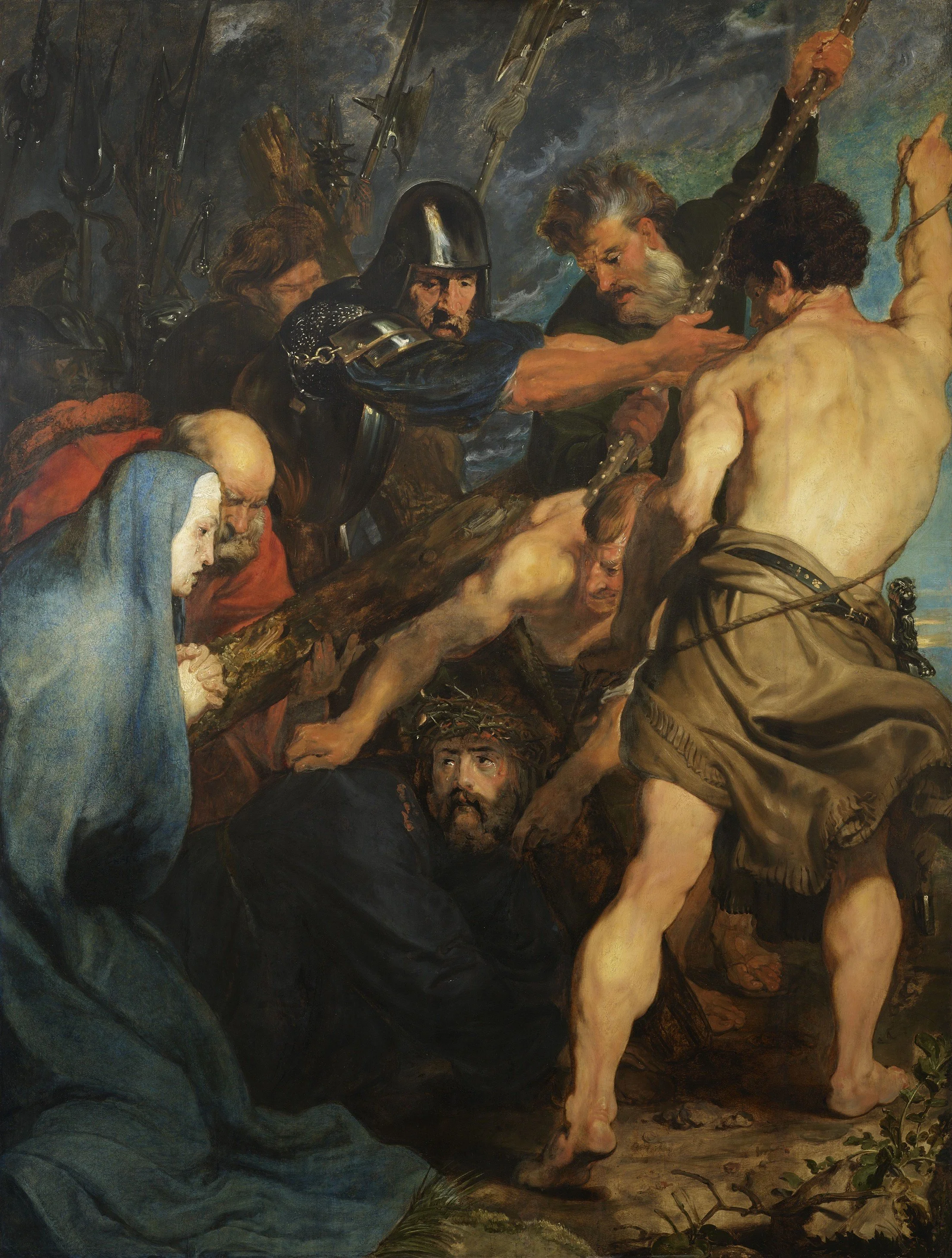
Anthony van Dyck, Jesus Meets His Mother, c. 1617, Licensed under CC BY 4.0 by KIK-IRPA, Belgium, photo X060744.
In the painting, Jesus has fallen beneath the heavy weight of the Cross. He looks up at His Mother with an agonized gaze, a single tear falling down each side of his face. Mary is also weeping. She clasps her hands and leans forward, unable to do anything to relieve the suffering of her Son. Simon of Cyrene stands behind her, lifting the beam of the Cross. The soldier in the foreground raises a whip to lash out at Jesus, and another soldier pulls on His garment. The motion circles around the face of Christ, the central focus of the composition.
Meditating on the Mysteries of the Rosary
The fifteen Mysteries of the Rosary paintings from St. Paul’s Church provide a beautiful means of meditating on the lives of Jesus and Mary. For this reason, Seek What Is Above includes them in The Fifteen Saturdays of the Most Holy Rosary, a book that features fifteen meditations on the Mysteries based on the writings of St. Bartolo Longo. The Antwerp paintings complement the meditations, offering a new and intentional way to reflect on the Mysteries.